

Automotive sourcing is becoming increasingly strategic as OEMs balance cost, supplier capability, localization, technology access, and supply-chain resilience. With India’s auto component industry reaching INR 7.59 lakh crore in FY2025-26 and imports rising to USD 25.4 billion, sourcing decisions now require a broader evaluation than component price alone.
A structured Auto Component Sourcing Market Study combining market intelligence, supplier benchmarking, cost analysis, localization assessment, and risk evaluation can help businesses to identify competitive suppliers, sourcing locations, and models across component categories.
To determine the most suitable sourcing strategy, OEMs need a structured framework that evaluates suppliers beyond cost alone. The following factors provide a comprehensive basis for comparing sourcing alternatives and identifying long-term supplier value.
Factors considered for choosing the Next Source
Organizations can help OEMs evaluate sourcing decisions across four factors. This provides a broader basis for determining whether to retain an existing supplier, develop a new domestic source, diversify internationally, or establish a strategic partnership.
- Cost Structure: Purchase price is only one part of the equation. A total cost analysis helps compare suppliers by considering sourcing, logistics, duties, and other procurement costs.
- Capability Assessment: Suppliers must consistently meet technical, quality, and operational requirements. This is increasingly important as vehicles incorporate advanced technologies such as electronics, EV systems, software, and specialized materials.
- Localization: Local sourcing can reduce exposure to freight costs, currency fluctuations, trade barriers, and geopolitical risks. Assessing localization opportunities at both component and sub-component levels helps identify areas for greater domestic value addition.
- Supply Risk Assessment: Supplier competitiveness must be balanced with resilience. Evaluating dependencies on single facilities, countries, critical materials, or upstream suppliers helps reduce potential supply disruptions, particularly in electronics, EV components, and semiconductors.
The outcome of these evaluations depends on the component category, technology maturity, supplier capability, cost position, and risk profile, for this OEMs may adopt different sourcing models.
Where Should OEMs Source Next?
The right sourcing decision depends on the component, technology, supplier capability, cost structure, and level of supply risk. A structured Auto component sourcing market study can help OEMs compare sourcing options and determine which model is most appropriate for each category:
- Source Locally: Prioritize domestic suppliers where capability, cost competitiveness, capacity, and quality can support sustainable OEM requirements.
- Develop Locally: Identify capable suppliers requiring technology, capacity, process, or investment support before becoming viable long-term sourcing partners.
- Partner Strategically: Consider joint ventures, technology partnerships, supplier development, or long-term agreements where capability gaps require collaboration.
- Build a Hybrid Model: Combine domestic and international suppliers to balance cost, localization, technology access, flexibility, and supply-chain resilience.
Nexdigm can analyze and interpret this sourcing assessment findings into a prioritized supplier strategy, creating a smooth transition from market evaluation to actionable sourcing decisions.
Nexdigm’s OEM Sourcing Structured Framework
Nexdigm’s OEM Sourcing Framework combines market intelligence, supplier benchmarking, cost analysis, localization assessment, and supply-risk evaluation. The process involves the following steps for sourcing OEMs:
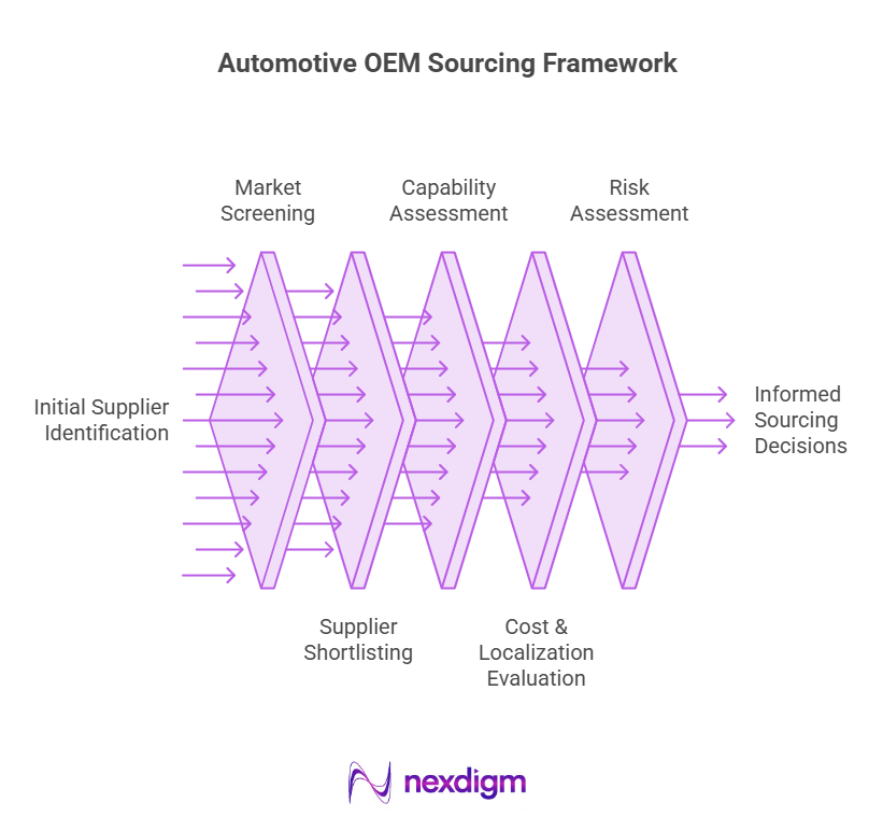
- Market Screening: Nexdigm identifies relevant suppliers, manufacturing locations, component categories, technology capabilities, and emerging sourcing markets.
- Supplier Shortlisting: Potential suppliers are screened against OEM requirements, production scale, technology, quality, cost competitiveness, and strategic fit.
- Capability Assessment: Nexdigm evaluates manufacturing, engineering, R&D, capacity, quality, technology, and scalability to determine supplier readiness.
- Cost & Localization Evaluation: Suppliers are compared using total sourcing cost while assessing opportunities to increase domestic value addition and reduce imported dependencies.
- Risk Assessment: Nexdigm evaluates supplier concentration, logistics exposure, upstream dependencies, critical materials, and geopolitical factors.
Through this structured approach, Nexdigm helps OEMs move from broad supplier identification to informed sourcing decisions, enabling greater flexibility across evolving automotive component requirements.
Why Businesses choose Nexdigm?
Selecting the right sourcing market requires balancing cost advantages with supplier capability, localization potential, quality requirements, scalability, and long-term supply risk. Nexdigm supports OEM businesses across:
- Supplier Identification: Identify and assess suppliers that align with OEM quality, technology, capacity, and commercial requirements.
- Cost Competitiveness: Compare component costs, labour, logistics, duties, localization economics, and total landed costs.
- Localization Assessment: Evaluate domestic supplier availability, capability gaps, imported dependencies, and opportunities for local sourcing.
- Supply Risk Assessment: Analyze supplier concentration, geographic exposure, logistics dependencies, lead times, and continuity risks.
- Supplier Development: Identify capability improvements required to bring potential suppliers in line with OEM expectations.
Nexdigm’s OEM Sourcing Assessment
Nexdigm assisted an automotive OEM in assessing sourcing opportunities across conventional and advanced components. EV components represented 4.6% of domestic OEM supplies, highlighting a rapidly evolving supplier landscape. As a result, the client strengthened technology-focused sourcing, supplier diversification, and future platform readiness.
Benefits of Nexdigm’s OEM Sourcing Assessment
Nexdigm’s sourcing assessment helped the automotive OEM navigate evolving supplier landscapes and make informed sourcing decisions across conventional and advanced component categories by:
- Strengthening technology-focused sourcing strategies
- Identification of emerging and capable suppliers
- Supporting supplier diversification and risk reduction
- Enhanced supply-chain resilience and continuity
Finding the right sourcing strategy requires a careful balance of supplier capability, localization opportunities, and supply-chain resilience. Nexdigm helps OEMs make confident sourcing decisions that support both current business needs and future growth.
To take the next step, simply visit our Request a Consultation page and share your requirements with us.
Harsh Mittal
+91-8422857704