

Auto components are becoming increasingly important to how automotive supply chains are organized across countries. The WTO reported that global automotive-product trade was broadly stable in value terms in the first 11 months of 2025, while the IEA notes that nearly 22 million electric cars were produced globally in 2025, creating new demand for batteries, motors, power electronics, and control systems.
Around one-quarter of these electric cars were traded between major production and demand centers. These changes make auto components trade analysis useful for identifying which products are moving most actively, where suppliers are concentrated, and which destination markets are becoming commercially important.
Electrification Is Changing the Component Mix
The transition toward electric vehicles is changing the importance of individual automotive components. Batteries, electric motors, power electronics, control systems, and related electronic parts are gaining strategic relevance alongside conventional components. The IEA reports that China produced about 75% of the world’s electric cars in 2025, while its electric-car exports more than doubled to over 2.5 million units.
Supplier Networks Are Becoming More Diversified
Automotive manufacturers are expanding sourcing across multiple countries, creating more resilient, flexible, and cost-competitive supply networks as global trade patterns evolve.
- Alternative Sourcing Bases Are Growing: Manufacturers are increasingly sourcing components from emerging Asian economies, reducing dependence on traditional production hubs and improving supply chain flexibility.
- Trade Shifts Reflect Competitive Advantages: Rising exports from countries such as India, Viet Nam, and Thailand highlight improvements in manufacturing capabilities, costs, and market access.
Diversified supplier networks enable automotive businesses to manage risks, access new capabilities, and build more resilient sourcing strategies.
Nexdigm’s Role in Identifying Component Trade Shifts
As supplier networks expand across countries, businesses need to understand not only where components are being traded, but also which suppliers are gaining relevance, where demand is emerging, and what is driving these changes. Nexdigm brings together auto components trade analysis, trade, market, company, and supply-chain intelligence to provide this broader perspective.
Nexdigm’s Approach to Auto Component Trade Intelligence Services
Auto-component markets are interconnected across manufacturers, suppliers, production hubs, and destination markets. Nexdigm helps businesses decode these relationships to identify:
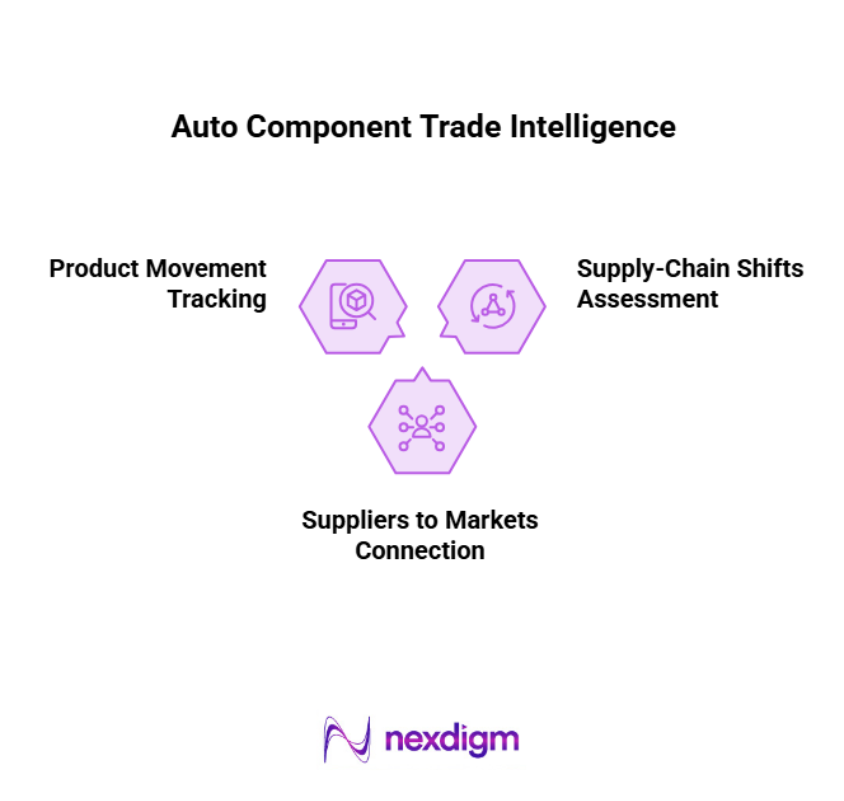
- Track Product Movements: Examine component-level trade flows to identify products experiencing rising demand, changing sourcing patterns, or increasing international activity.
- Connect Suppliers to Markets: Link manufacturers and supplier capabilities with destination demand, OEM ecosystems, production hubs, and buyer requirements to identify commercially relevant relationships.
- Spot Supply-Chain Shifts: Assess geographic concentration, emerging supplier countries, production changes, and trade dependencies to identify both diversification opportunities and potential exposure.
Nexdigm’s approach provides businesses with a market-connected view of component trade, supporting more informed decisions across sourcing, supplier development, market expansion, and supply-chain planning.
How Nexdigm’s Approach Answers Key Business Questions
Nexdigm’s approach connects product, supplier, demand, and trade signals to answer the practical questions that shape automotive sourcing and market strategy. These are:
- Which components are gaining demand?
Analyze trade growth, vehicle production, EV adoption, and destination-market activity to identify component categories with increasing requirements. - Who are the important suppliers?
Map manufacturers, supplier shares, export activity, capabilities, and geographic presence to identify established and emerging supply partners. - Where are new sourcing opportunities emerging?
Compare supplier countries, production hubs, trade flows, pricing, and market access to identify viable alternative sourcing locations. - Which markets offer expansion potential?
Assess import growth, OEM activity, vehicle production, aftermarket demand, and competitive conditions to prioritize attractive destination markets. - Where are supply-chain dependencies developing?
Examine supplier concentration, geographic exposure, critical routes, and infrastructure dependencies to identify potential vulnerabilities.
This enables businesses to move from component-level trade data to clear answers on sourcing, suppliers, markets, opportunities, and supply-chain risks.
Why Businesses Trust Nexdigm
Businesses need actionable intelligence that supports strategic decisions across sourcing, supplier management, and market expansion. Nexdigm helps businesses transform complex automotive trade and market data into practical business advantages such as:
- Identifying Reliable Supply Opportunities: Evaluating supplier capabilities, sourcing alternatives, and emerging manufacturing hubs to reduce supply risks and strengthen procurement strategies.
- Improving Market and Investment Decisions: Assessing demand trends, competitive dynamics, pricing movements, and industry developments to support market entry, expansion, and investment planning.
- Enhancing Supply Chain Resilience: Discovering diversification opportunities, monitor sourcing shifts, and identify potential disruptions before they impact operations and business performance.
By combining trade intelligence, market research, and automotive sector expertise, Nexdigm helps businesses make faster, more informed decisions that improve efficiency, reduce risk, and unlock new growth opportunities.
Nexdigm’s Case
Nexdigm supported an automotive client by reviewing component trade transactions across 13 markets, covering 22 major component categories and supplier-destination combinations. The analysis highlighted 6 fast-growing component segments, 9 emerging supplier markets, and 5 priority destination markets, helping the client identify sourcing alternatives and focus its expansion strategy.
To take the next step, simply visit our Request a Consultation page and share your requirements with us.
Harsh Mittal
+91-8422857704