

Auto finance decisions are increasingly shaped by the affordability of the monthly payment rather than vehicle price alone. In the United States, Experian reported that the average amount financed for a new vehicle reached $41,073 in Q1 2025, while the average monthly payment was $745.
Higher vehicle prices, longer loan terms, interest rates, down-payment requirements, and household income are therefore becoming important factors in finance adoption.
For banks, auto lenders, dealerships, fintech companies, and investors, understanding the market requires more than measuring vehicle sales. The opportunity is to understand who can finance a vehicle, what payment structure they prefer, and where financing demand remains underserved.
An Auto finance market assessment helps evaluate borrower demand, vehicle affordability, financing structures, lender competition, credit conditions, and market economics. Nexdigm connects these factors to identify attractive customer segments, product opportunities, competitive gaps, and areas where auto-finance demand can expand.
Understanding the Affordability Picture with Nexdigm
Nexdigm begins with the understanding of the relationship between vehicle prices, household finances, and monthly payment capacity. The assessment considers:
- Vehicle prices: Evaluation of how vehicle costs impact purchasing decisions and financing requirements.
- Household income: Assessment of earning capacity to determine affordability and repayment potential.
- Monthly payments: Examination of customer’s ability to manage loan installments within their budget.
- Used versus new vehicles: Comparison of affordability, financing needs, and customer preferences between new and pre-owned vehicles.
This creates a more realistic view of affordability. Two customers purchasing vehicles at the same price may have very different financing needs because of income, credit quality, available savings, or preferred repayment periods. Nexdigm uses these differences to segment the market more precisely.
Role of Nexdigm in Tracking Financing Demand
Vehicle purchases can generate different financing requirements depending on customer and vehicle characteristics. Nexdigm evaluates demand across:
- New Vehicles: Financing needs associated with higher purchase prices.
- Used Vehicles: Demand driven by affordability and lower upfront costs.
- First-Time Buyers: Customers entering the vehicle-finance market for the first time.
- Repeat Buyers: Existing borrowers replacing or upgrading vehicles.
- Commercial Users: Businesses and professionals requiring vehicles for operating activities.
This segmentation helps lenders identify where financing demand is strongest and where customer needs differ.
Identifying the Right Auto Finance Opportunity
For investors and lenders, Nexdigm combines demand and economics to identify the most attractive market segments. The assessment considers:
- Vehicle demand: Assessment of consumer demand across vehicle categories to identify growth opportunities.
- Financing penetration: Measurement of the extent to which vehicle purchases are financed within the market.
- Customer affordability: Evaluation of income levels and repayment capacity to determine financing potential.
- Credit conditions: Examination of credit availability, risk profiles, and lending environment dynamics.
- Dealer networks: Assessment of dealer reach and partnerships that support vehicle sales and financing access.
This approach allows decision-makers to compare opportunities across geographies, borrower segments, vehicle categories, and financing models.
How Nexdigm Identifies the Next Growth Areas
Future auto-finance opportunities may develop around changing vehicle preferences, digital lending, underserved borrowers, and new distribution models. Nexdigm evaluates opportunities across used-vehicle finance, digital auto lending, EV financing, and dealer platforms. The objective is to identify where structural market changes could create new financing demand.
Nexdigm also assesses evolving customer expectations, regulatory developments, and technology adoption that may influence financing trends. This helps lenders and investors prioritize high-growth segments, develop targeted offerings, and capture emerging opportunities in the evolving automotive ecosystem.
The Nexdigm Auto Finance Framework
The auto finance market is influenced by a combination of customer affordability, borrowing behavior, competitive dynamics, and market economics. Nexdigm’s Auto Finance Framework conducts Auto finance market assessment to evaluate these interconnected factors to provide a comprehensive view of financing opportunities, market risks, and growth potential.
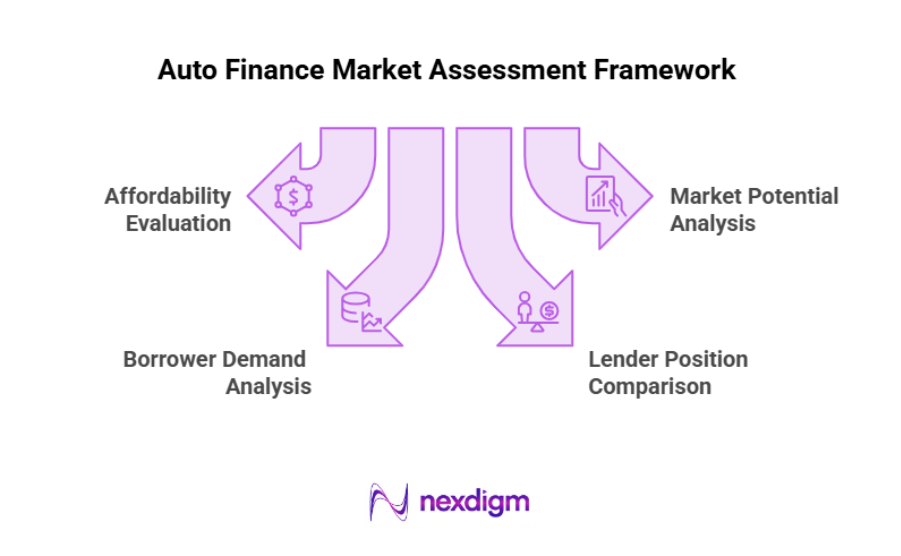
- Affordability: Evaluates vehicle prices, customer income, down-payment requirements, interest rates, loan tenures, and monthly repayment capacity to understand how easily consumers can finance vehicle purchases.
- Borrower Demand: Measures customer segments, financing preferences, credit profiles, and vehicle-buying behavior to identify demand patterns and financing needs across different borrower groups.
- Lender Position: Compares banks, credit unions, captive finance companies, fintech lenders, and dealer-finance providers to assess competitive strengths, market presence, and lending capabilities.
- Market Potential: Assesses market size, financing gaps, competitive dynamics, risk factors, growth prospects, and commercial economics to identify attractive and sustainable auto-finance opportunities.
These factors represent where financing demand is strongest, which customers remain underserved, and where lenders can build sustainable auto-finance opportunities.
Nexdigm’s Case
An auto lender used Nexdigm’s Auto finance market assessment to identify underserved borrower segments and improve financing strategies. Within 12 months, loan applications increased 29%, approval-to-disbursement conversion improved 24%, digital applications rose 37%, and customer acquisition costs declined 16%, strengthening lending efficiency and market reach.
To take the next step, simply visit our Request a Consultation page and share your requirements with us.
Harsh Mittal
+91-8422857704