

Automotive opportunities vary considerably by country. In 2025, India produced 6.49 million vehicles, while Mexico produced 4.03 million and Thailand 1.45 million, highlighting the different scales of regional manufacturing. On the demand side, Brazil recorded 2.69 million vehicle sales, while Türkiye reached 1.42 million and Indonesia 1.06 million.
The US remained a major market with 16.68 million sales. These differences show why businesses cannot rely on market size alone when selecting automotive destinations. Production strength, demand growth, supplier availability, investment activity, trade access, and competitive conditions can make one country more suitable than another.
This makes auto industry country attractiveness analysis useful for comparing markets against specific manufacturing, sales, sourcing, and investment objectives.
Manufacturing Strength Is Uneven Across Countries
Countries with established automotive industries can offer mature supplier networks, skilled labor, manufacturing infrastructure, and export connectivity. At the same time, emerging manufacturing locations may offer expanding capacity, growing supplier ecosystems, and access to developing demand. Comparing production volumes with investment activity and export performance helps businesses understand whether a country’s automotive manufacturing base is established, expanding, or still developing.
Demand Potential Requires a Closer Look
Vehicle sales provide an initial view of market opportunity, but the underlying demand profile matters just as much. Businesses can examine sales growth, vehicle segments, EV adoption, vehicle parc, consumer trends, and competitive intensity to determine whether demand is broad-based or concentrated in specific categories.
- Growing Demand: Rising vehicle sales and expanding vehicle ownership can indicate opportunities for manufacturers, suppliers, and aftermarket businesses.
- Segment Potential: Strong performance in specific passenger-vehicle, commercial-vehicle, or EV segments can reveal targeted opportunities even in smaller overall markets.
A country becomes more commercially attractive when demand potential aligns with the manufacturing, supplier, trade, and investment conditions needed to serve that demand effectively.
Nexdigm’s Automotive Industry Expertise
Country attractiveness in the automotive sector depends on how market demand, manufacturing capabilities, supplier ecosystems, investment trends, and competitive conditions interact.
Nexdigm brings automotive industry expertise, market intelligence, trade analysis, company research, and competitive insights to evaluate these factors together.
Our sector-focused perspective helps businesses understand which countries offer stronger opportunities for sales, manufacturing, sourcing, investment, or regional expansion, based on their specific strategic priorities rather than broad market-size comparisons.
Nexdigm’s Approach in Assessing Auto Industry Country Attractiveness
Nexdigm evaluates countries through a combination of factors, allowing businesses to understand not only where demand exists, but whether the wider ecosystem can support sustainable automotive activity. These factors are:
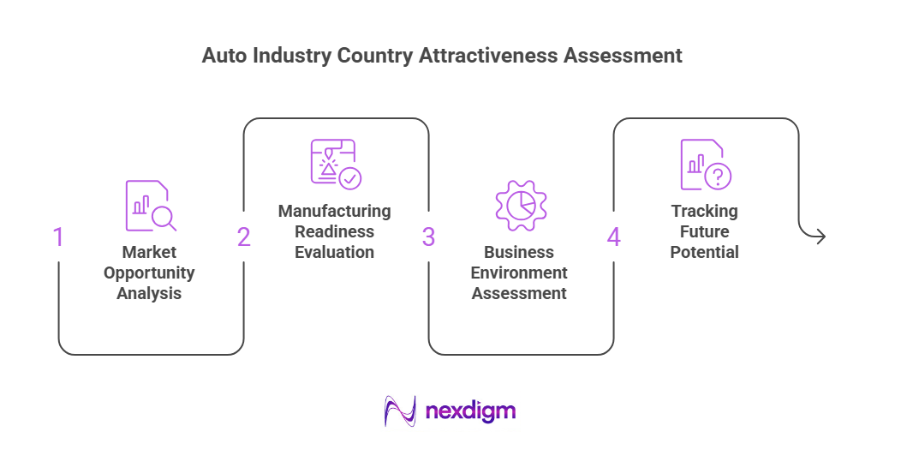
- Market Opportunity Analysis: Assess vehicle sales, segment growth, EV adoption, vehicle parc, and consumer trends to determine the depth and trajectory of demand.
- Manufacturing Readiness Evaluation: Examine production capacity, OEM presence, supplier depth, infrastructure, and investment activity to evaluate manufacturing potential.
- Business Environment Assessment: Consider trade access, logistics, incentives, operating conditions, competition, and regulatory factors that can influence commercial feasibility.
- Tracking Future Potential: Track planned investments, capacity additions, supplier expansion, and emerging demand to identify countries whose attractiveness could strengthen over time.
This enables Nexdigm to compare countries against specific business objectives rather than relying on a single market-size indicator.
How Experts at Nexdigm Interpret Country Attractiveness
Nexdigm’s auto industry country attractiveness analysis goes beyond collecting country-level indicators. Our automotive expertise helps interpret what those indicators mean for a company’s specific growth objectives, competitive position, and operating model. These are:
- Connect Market and Manufacturing Signals: Relate vehicle demand with production capacity, supplier presence, investment activity, and trade connectivity to understand the broader automotive ecosystem.
- Strategic Fitness: Evaluate whether a country’s strengths align with the client’s objective, such as sales expansion, manufacturing, sourcing, localization, or investment.
- Emerging Opportunity and Constraints: Identify the factors supporting market attractiveness alongside potential limitations, helping businesses understand the commercial context behind each market.
- Competitive Positioning: Examine OEM presence, market shares, product portfolios, and competitor investments to understand how a business could position itself within each country.
- Future Market Potential: Consider planned capacity additions, upcoming investments, demand shifts, and supplier development to identify countries where automotive opportunities could strengthen over time.
This interpretation enables Nexdigm to turn country-level data into business-relevant insights that support more focused automotive expansion and investment decisions.
Nexdigm’s Case
Nexdigm assessed 12 automotive markets across demand, manufacturing, suppliers, investment, trade, and competition. The analysis identified four countries with demand growth above 10% and three markets where manufacturing capacity was expanding by more than 15%, helping the client shortlist priority countries for sales, sourcing, and manufacturing opportunities.
To take the next step, simply visit our Request a Consultation page and share your requirements with us.
Harsh Mittal
+91-8422857704