

Shipping records can provide a detailed view of how automotive parts move between manufacturers, suppliers, distributors, and markets. Global automotive production reached 96.4 million vehicles in 2025, while international trade in vehicles and components continues to connect production hubs across Asia, Europe, and North America. The United States, for example, imported more than $200 billion of automotive products in 2025, illustrating the scale of cross-border sourcing.
At the component level, shipment records can reveal supplier relationships and changing trade routes that broader vehicle statistics may not capture. This makes auto parts bill of lading analysis useful for understanding sourcing patterns, competitor activity, customer networks, and potential supply-chain opportunities.
Shipping Records Can Reveal Hidden Sourcing Relationships
Bill of lading records can provide information such as shipper, consignee, product description, shipment origin, destination, quantity, and transportation route. When these records are analyzed over time, businesses can identify recurring supplier-buyer relationships, new sourcing markets, changes in shipment frequency, and shifts in customer activity. This creates a more detailed picture of how auto parts are actually moving through international supply networks.
What Shipment Patterns Can Tell Businesses
Shipping records can reveal more than the movement of auto parts. When analyzed across products, companies, origins, destinations, and time periods, they can show how sourcing networks are developing and where competitive activity is changing. Recurring shipments may indicate established relationships, while new routes or suppliers can point to diversification, market expansion, or changes in procurement strategy.
Nexdigm’s Role in Interpreting Auto Parts Shipment Patterns
Nexdigm combines shipment intelligence with automotive market and company research to turn individual shipping records into actionable insights. The key patterns assessed by experts at Nexdigm are:
- Supplier Relationships: Analyze recurring shippers, products, origins, and shipment frequency to identify established suppliers, emerging sources, and changing procurement relationships.
- Customer Networks: Examine consignees, destinations, shipment patterns, and product flows to identify important customers, distributors, and potential market-development opportunities.
- Competitive Movements: Compare shipment activity, supplier participation, product categories, and trade routes to identify competitor expansion, sourcing shifts, and market changes.
This approach helps businesses move beyond individual shipment records to understand how auto-parts sourcing and customer networks are evolving across markets.
Nexdigm’s Auto Parts Shipment Assessment Framework
To turn shipment records into commercially useful intelligence, Nexdigm conducts auto parts bill of lading analysis to help businesses understand who is moving parts, where they are moving, which relationships are changing, and what those shifts could mean strategically through the following steps:
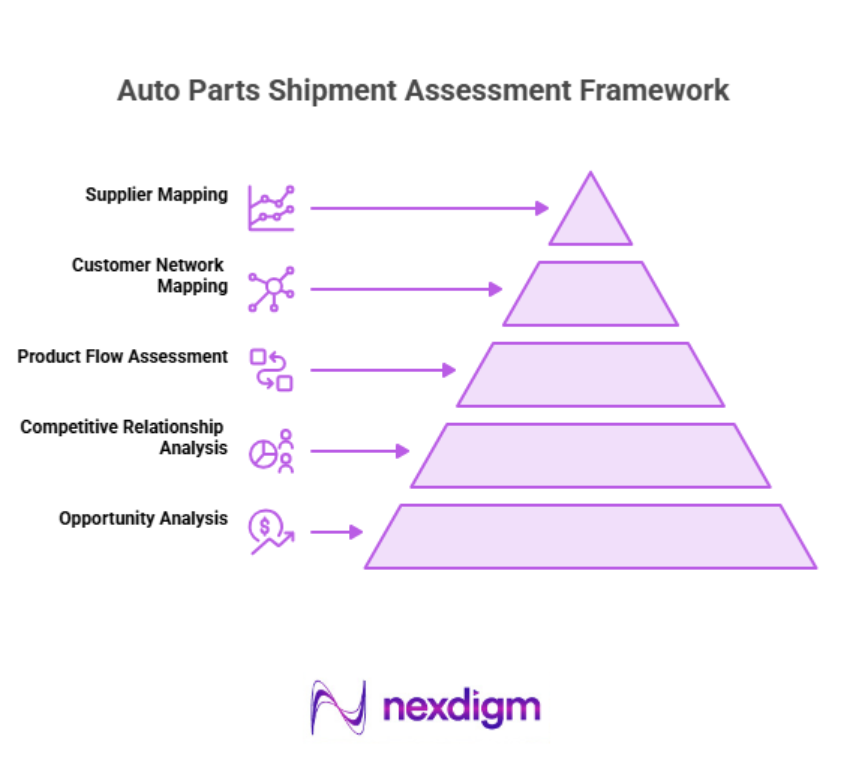
- Supplier Mapping: Identification of shippers, exporters, manufacturers, trading companies, and recurring suppliers to understand the competitive supply base for specific auto-part categories.
- Customer Network Mapping: Analysis of consignees, importers, distributors, OEM-linked businesses, and destination markets to identify established and emerging customer relationships.
- Product Flow Assessment: Examination of part descriptions, shipment frequency, quantities, origins, destinations, and trade routes to determine which products and corridors are gaining importance.
- Competitive Relationship Analysis: Comparison of supplier participation, customer coverage, shipment growth, and market presence to identify competitor movements and potential gaps in the market.
- Opportunity Analysis: Combination of supplier, customer, product, and competitive signals to identify alternative sourcing options, prospective customers, market-entry opportunities, and areas for business development.
The framework converts shipment-level information into a connected view of the automotive supply network, giving businesses a stronger basis for sourcing, customer development, and competitive decisions.
Benefits of Nexdigm’s Auto Parts Shipment Assessment Framework
By connecting shipment records with supplier, customer, product, and competitive intelligence, Nexdigm’s assessment can help businesses:
- Improve Supplier Discovery: Identify active exporters, recurring suppliers, and emerging sourcing markets to broaden supplier options and support procurement decisions.
- Understand Customer Networks: Map importers, distributors, and recurring consignees to identify important accounts and potential customer-development opportunities.
- Monitor Competitor Activity: Track competitor shipment patterns, products, destinations, and supplier relationships to understand changes in market positioning.
- Identify Sourcing Shifts: Detect changes in shipment frequency, origins, routes, and suppliers that may indicate evolving procurement strategies.
- Assess Market Opportunities: Identify markets where shipment activity, customer participation, or product demand is increasing to support expansion planning.
These benefits help businesses move beyond tracking shipments to understanding the commercial relationships behind them, supporting more informed decisions across sourcing, sales, market expansion, and competitive strategy.
Nexdigm’s Case
Nexdigm supported an automotive-sector client by analyzing more than 16,500 bill of lading records across 10 markets and 14 auto-part categories. The assessment identified 27% growth in selected shipment flows, while the top five suppliers accounted for over 45% of shipments in targeted categories. The analysis also uncovered new supplier-customer relationships, helping the client evaluate sourcing diversification and customer-development opportunities.
To take the next step, simply visit our Request a Consultation page and share your requirements with us.
Harsh Mittal
+91-8422857704