

The automotive aftermarket is expanding alongside an aging vehicle parc and increasingly diverse sourcing needs. The global automotive aftermarket was estimated at $489.5 billion in 2025 and is projected to reach $509.8 billion in 2026, according to Grand View Research. In the US, the average light-duty vehicle age has reached a record 12.9 years, while the aftermarket is forecast to grow 5.4% in 2026 to $599.7 billion.
Supplier selection is becoming more complex as buyers balance price, quality, availability, product coverage, and delivery. AAPEX reports that 53% of aftermarket professionals have observed growing demand for lower-cost parts, while quality remains the leading factor influencing customer preference. Meanwhile, 70% of surveyed businesses have either completed, planned, or are actively pursuing supply-chain diversification.
For distributors, retailers, repair networks, and aftermarket businesses, auto spare parts vendor analysis can help identify suppliers that offer the strongest overall fit rather than simply the lowest quoted price.
The Right Vendor Is Not Always the Lowest-Cost Vendor
Spare-parts sourcing involves balancing several requirements simultaneously. A vendor may offer attractive pricing but have limited product coverage or inconsistent availability. Another may command a premium but provide stronger quality, broader catalogs, faster delivery, and better geographic coverage. The right sourcing decision therefore requires a broader assessment of vendor economics, product capability, supply reliability, market presence, and customer requirements.
Attributes That Shape Vendor Fit
A practical vendor comparison should consider more than price:
- Product Capability: Assess product range, application coverage, specifications, certifications, quality systems, and compatibility across vehicle makes and models.
- Supply Reliability: Examine production capacity, inventory availability, lead times, geographic footprint, fulfillment capabilities, and supply-chain resilience.
- Commercial Value: Compare pricing, payment terms, minimum order quantities, logistics costs, warranty policies, and overall landed-cost competitiveness.
Together, these factors help aftermarket businesses distinguish vendors that are merely available from those capable of supporting consistent and commercially sustainable sourcing.
Nexdigm’s Vendor Intelligence for Sourcing Decisions
Once vendor capabilities are understood, the next challenge is deciding which suppliers deserve deeper evaluation. Nexdigm can help organize supplier intelligence around the factors that matter most to each sourcing requirement:
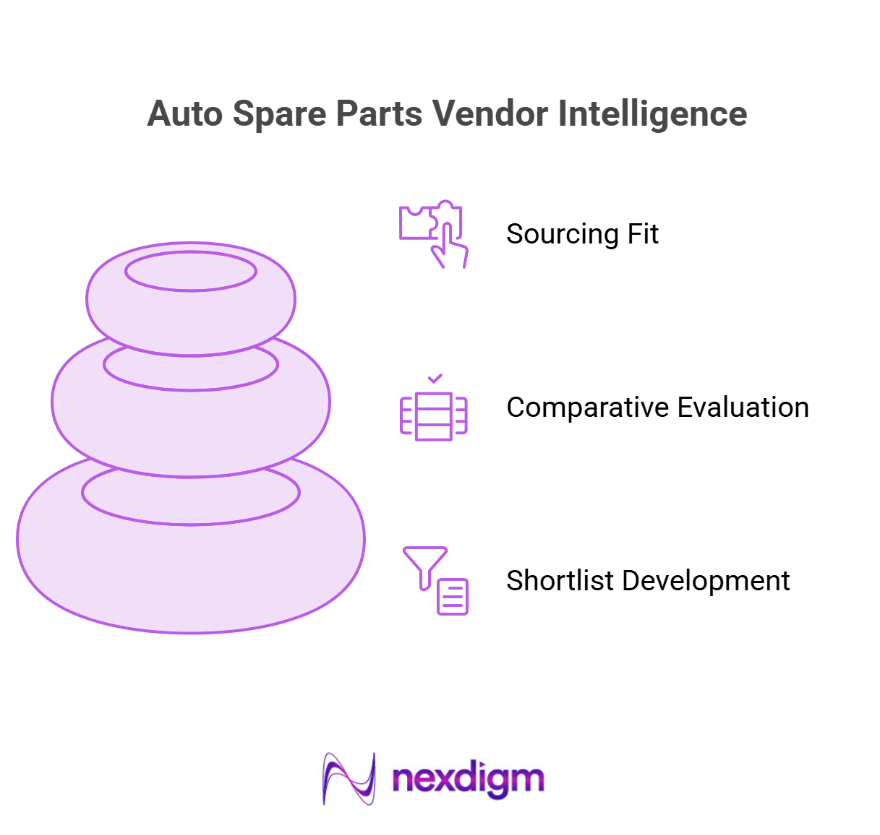
- Shortlist Development: Narrow a broad vendor universe to suppliers meeting defined product, quality, capacity, and geographic requirements.
- Comparative Evaluation: Assess shortlisted vendors against consistent commercial and operational criteria to make differences easier to interpret.
- Sourcing Fit: Identify suppliers that can support current requirements while offering the capacity, coverage, and flexibility needed for future aftermarket demand.
This helps procurement teams move from vendor discovery to a focused, evidence-based sourcing shortlist.
Nexdigm’s Strategic Value in Aftermarket Vendor Selection
A well-informed vendor shortlist can influence more than immediate purchasing decisions. Nexdigm can help organizations use supplier intelligence to strengthen the broader aftermarket sourcing strategy:
- Supply Resilience: Identify additional qualified vendors and reduce dependence on concentrated supplier relationships.
- Commercial Advantage: Compare supplier economics and market positioning to identify opportunities for stronger purchasing terms and overall value.
- Portfolio Coverage: Identify vendors that can fill product, geographic, or application gaps and broaden aftermarket sourcing options.
- Future Readiness: Consider supplier capacity, technology, product development, and market expansion plans when evaluating longer-term sourcing suitability.
This enables businesses to build a vendor portfolio that balances cost, quality, availability, coverage, and long-term sourcing resilience.
Applying Nexdigm’s Vendor Analysis Insights to Aftermarket Sourcing
Nexdigm’s vendor intelligence can support several practical sourcing decisions across the aftermarket:
- Vendor Selection: Use comparative supplier insights to select vendors aligned with specific product, quality, cost, and availability requirements.
- Supplier Diversification: Identify credible alternatives where dependence on a limited number of vendors could create supply or commercial exposure.
- Regional Sourcing: Evaluate suppliers across markets to identify opportunities for localization, improved availability, or more competitive landed costs.
- Category Expansion: Identify suppliers capable of supporting new product categories, vehicle applications, or emerging aftermarket requirements.
These applications help businesses turn auto spare parts vendor analysis into actionable sourcing and portfolio decisions.
Nexdigm’s Case
An aftermarket distributor assessed spare-parts vendors across five product categories and three regions using Nexdigm’s vendor analysis. The assessment identified 25% additional qualified vendor options, reduced vendor-screening time by 32%, and highlighted 19% sourcing gaps, supporting a more diversified and commercially focused supplier portfolio.
To take the next step, simply visit our Request a Consultation page and share your requirements with us.
Harsh Mittal
+91-8422857704