

Warehouse automation has become an important consideration for businesses managing high-volume inventory, complex distribution networks and increasingly demanding fulfilment schedules. Automated storage systems, conveyors, robotic picking equipment and autonomous mobile robots can help organisations improve material movement, storage utilisation and order processing.
However, sourcing automation equipment involves substantial investment and long-term operational commitments. Businesses must evaluate whether the technology can meet throughput requirements, integrate with existing warehouse systems and deliver measurable financial benefits.
A procurement decision based solely on equipment specifications or acquisition price may overlook important implementation and operating costs.
Understanding the Warehouse Automation Equipment Market
Warehouse automation encompasses several equipment categories, each designed to address specific operational requirements.
Automated Storage and Retrieval Systems (AS/RS) use mechanical equipment and software to store and retrieve inventory with limited manual intervention. These systems are commonly considered for facilities handling high inventory volumes or facing space constraints.
Conveyor and sortation systems automate the movement of cartons, pallets and packages between warehouse processes. Their configurations vary according to throughput requirements, product dimensions and facility layouts.
Robotic systems support picking, palletising, depalletising and material movement. Autonomous mobile robots and automated guided vehicles can transport inventory between designated locations, while robotic arms can perform repetitive handling tasks.
Other solutions include vertical lift modules, automated pallet systems, automated packaging equipment and dimensioning and scanning systems.
The supplier landscape includes original equipment manufacturers, specialised automation providers, system integrators and software vendors. Some suppliers offer individual equipment, while others provide complete warehouse automation solutions.
Evaluating Performance Beyond Equipment Specifications
Equipment performance should be assessed against actual warehouse operating conditions.
A conveyor’s maximum rated speed, for example, does not necessarily represent the throughput achievable in a facility. The number of transfer points, product dimensions, accumulation requirements and downstream processing capacity can all affect performance.
Procurement teams should examine throughput per hour, equipment availability, handling accuracy, cycle times and energy consumption.
For robotic systems, evaluation should include navigation accuracy, payload capacity, operating speed, charging requirements and performance across different floor conditions.
DPIIT’s Handbook on Warehousing Standards discusses technologies including automated storage systems, autonomous equipment, robotics, machine vision and automated material movement. It also highlights the importance of evaluating technology suitability and investment costs rather than assuming automation will automatically produce higher returns.
A supplier should therefore demonstrate performance through representative operating scenarios and documented technical specifications.
Integration: The Difference Between Equipment and a Working System
Warehouse automation equipment rarely operates independently. Its performance depends on coordination with warehouse management systems, warehouse control systems, enterprise applications and other material handling equipment.
A conveyor system, for example, may need to receive picking instructions from a WMS and coordinate equipment-level movement through a warehouse control system.
Procurement teams should establish which components are supplied by the equipment manufacturer and which responsibilities fall to the system integrator.
Important considerations include interface standards, API availability, data exchange, control architecture, cybersecurity, fault handling and compatibility with existing equipment.
Integration testing should also examine what happens when a component fails. A system that stops functioning because one device loses connectivity can create significant operational disruption.
Cost, Scalability and Implementation Considerations
The commercial evaluation should extend beyond the initial equipment quotation.
Automation investments may include equipment procurement, facility modifications, installation, software licensing, integration, commissioning, employee training and ongoing maintenance.
The total cost of ownership should also account for energy consumption, replacement components, technical support and equipment downtime.
Scalability requires similar attention. A system designed around current order volumes may become a constraint when product assortments expand or distribution requirements change.
Some businesses may benefit from phased automation, allowing individual processes to be upgraded before expanding across the entire facility. Others may prefer modular systems that can accommodate additional equipment over time.
A supplier’s ability to support upgrades, software changes and additional installations should form part of the commercial assessment.
Automated Warehouse Equipment Sourcing Framework
A structured automated warehouse equipment sourcing research exercise should follow six stages:
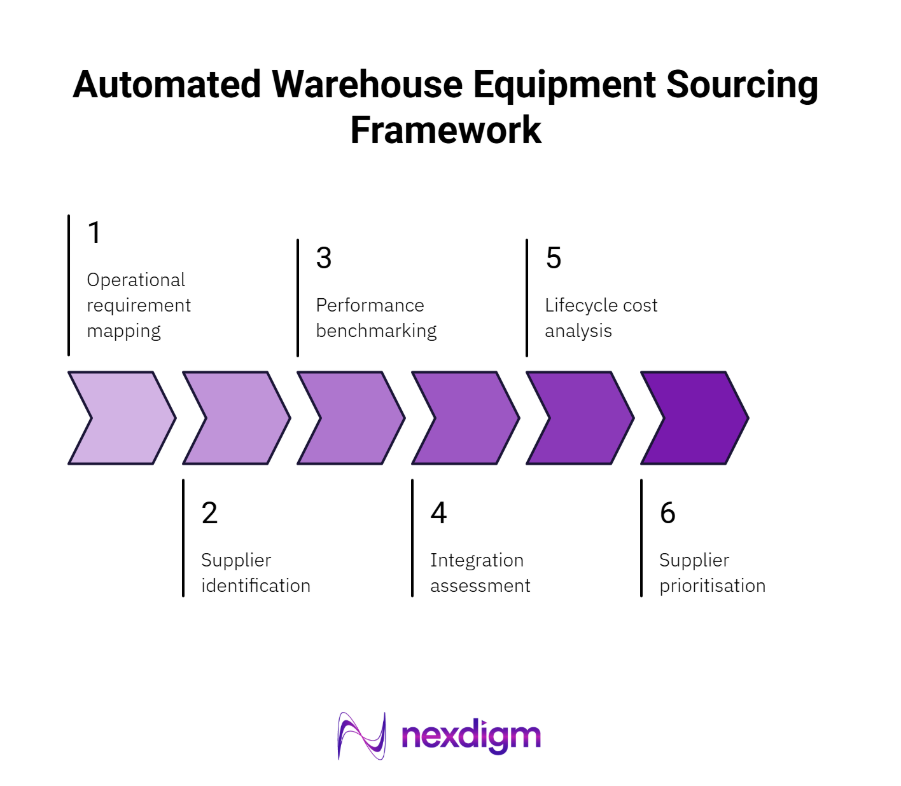
- Operational requirement mapping: Identify warehouse processes, throughput targets, product categories and facility constraints.
- Supplier identification: Map equipment manufacturers, technology providers and system integrators.
- Performance benchmarking: Compare capacity, cycle times, accuracy, equipment availability and energy requirements.
- Integration assessment: Evaluate WMS, WCS and ERP compatibility, control architecture and interoperability.
- Lifecycle cost analysis: Compare acquisition, installation, software, maintenance and operating expenses.
- Supplier prioritisation: Rank vendors according to technical suitability, scalability, service support and expected return on investment.
Nexdigm can support organisations through automation market research, equipment supplier mapping, technical and commercial benchmarking, and procurement intelligence. These assessments help businesses compare available solutions and identify suppliers aligned with their facility requirements and investment priorities.
Nexdigm’s Case Study: Evaluating Automation Investment Across Warehouse Operations
Nexdigm assessed 12 automation equipment suppliers across 3 warehouse facilities, comparing throughput, integration, maintenance and lifecycle costs. The research shortlisted 4 providers, identified an 18% variation in total implementation costs and established 7 performance benchmarks for automation procurement.
To take the next step, simply visit our Request a Consultation page and share your requirements with us.
Harsh Mittal
+91-8422857704