

Automation demand is often explained through one variable: labour shortage.
The relationship is real, but incomplete. Companies adopt automation when the economics of a process justify the investment, when labour constraints make manual production difficult to sustain, and when technology can be integrated without creating disproportionate operational complexity.
The strongest opportunities therefore emerge where several of these conditions overlap.
Labor Scarcity Is Only the Starting Signal
Manufacturing labour markets are changing through demographic shifts, skills shortages and rising expectations around productivity.
The International Federation of Robotics identifies labour shortages and demographic change as important drivers of robotics adoption, particularly in manufacturing and logistics. Its 2026 research also emphasises that robotics can increase productivity, create new tasks and help companies maintain production capacity when labour supply is constrained.
That distinction matters.
A shortage of workers creates pressure, but automation demand becomes commercially viable when the affected process has sufficient volume, repeatability, labour intensity and economic value.
Where Automation Economics Become Stronger
Automation is more likely to gain traction where manual processes create measurable constraints.
High-volume production provides repeated tasks that can justify capital expenditure. Labour-intensive operations create a larger potential saving. Quality-sensitive applications increase the value of consistency. Hazardous or physically demanding processes can create additional incentives.
Warehouse automation provides a useful example. Research on 2025 warehouse automation found that 93% of respondents considered durability, reliability and uptime very important when selecting automation systems, while support, service response, total cost of ownership and ROI also influenced decisions.
This suggests that automation buyers are evaluating outcomes rather than technology alone.
Adoption Is Expanding Beyond Traditional Automation Markets
Industrial robotics remains heavily concentrated in established manufacturing applications, but the geography and industry mix are changing.
The IFR reported 542,000 industrial robots installed globally in 2024, more than double the level of ten years earlier. Asia represented 74% of new deployments, Europe 16% and the Americas 9%. India ranked sixth among national markets, with approximately 9,000 new installations in 2024, up 7%.
The United States also recorded 38,000 industrial robot installations in 2025, an 11% year-on-year increase. Food-industry installations rose 30%, highlighting the expansion of automation beyond traditional automotive applications.
The opportunity therefore needs to be assessed at the application level.
Productivity Determines Whether the Investment Works
Automation demand depends on more than the number of tasks that can technically be automated.
The business case needs to establish what the automation changes.
Relevant measures include:
- Labour hours eliminated or redeployed
- Throughput improvement
- Scrap and defect reduction
- Cycle-time reduction
- Machine utilization
- Energy consumption
- Safety improvement
- Maintenance requirements
- Payback period
- Total cost of ownership
Deloitte’s 2025 Smart Manufacturing Survey found that manufacturers reported average improvements of 10% to 20% in production output, 7% to 20% in employee productivity and 10% to 15% in unlocked capacity from smart manufacturing initiatives.
These outcomes help explain why automation is increasingly treated as a productivity investment rather than simply a labour-substitution tool.
The Adoption Barrier Is Often Organizational
Technology availability does not guarantee adoption.
Existing equipment may be difficult to integrate. Operators may require retraining. Production systems may lack adequate data infrastructure. Smaller manufacturers may struggle to justify large upfront investments even when long-term savings appear attractive.
Deloitte found that 41% of surveyed manufacturers ranked factory automation hardware among their first- or second-highest investment priorities for the next 24 months, while 34% prioritised active sensors and 28% vision systems.
This points toward a broader automation market where hardware, sensing, software, integration and workforce capability develop together.
Nexdigm’s Automation Demand and Adoption Matrix
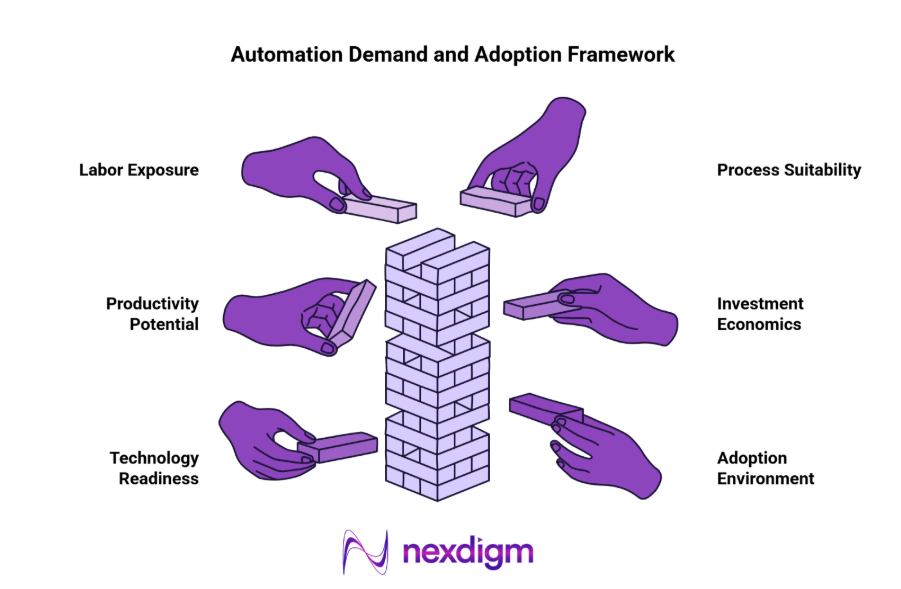
- Labor Exposure
Measure labour intensity, vacancy pressure, wage trends, skill shortages and workforce availability. - Process Suitability
Identify repetitive, high-volume, hazardous or quality-sensitive tasks that can be automated. - Productivity Potential
Quantify throughput, cycle-time, utilization, quality and capacity improvements. - Investment Economics
Assess capex, operating savings, payback, ROI and total cost of ownership. - Technology Readiness
Evaluate infrastructure, equipment compatibility, connectivity, data availability and integration requirements. - Adoption Environment
Map industry maturity, buyer willingness, workforce capability, regulations and competitive adoption.
Nexdigm can support automation demand and adoption assessment through industry segmentation, labour analysis, technology benchmarking, ROI assessment, adoption modelling and market opportunity evaluation.
The result is a market view that identifies not merely where automation exists, but where the conditions for further adoption are strongest.
Nexdigm Case Study: Identifying High-Potential Automation Markets
Nexdigm assessed automation opportunities for an industrial technology provider by mapping labour intensity, application suitability and investment economics across target industries. With global robot installations at 542,000 units in 2024 and US installations up 11% to 38,000 in 2025, the analysis helped prioritize industries with stronger automation adoption potential.
The assessment gave the client a clearer basis for prioritizing target sectors, refining its market-entry focus and aligning its automation offering with applications where productivity economics supported adoption.
To take the next step, simply visit our Request a Consultation page and share your requirements with us.
Harsh Mittal
+91-8422857704