

Automation is fundamentally an exercise in production economics rather than technology adoption. Even as US industrial robot installations grew 11% to 38,000 units in 2025, led by automotive at 13,500 units and food up 30%, a viable business case still demands measurable returns.
Hardware must justify its capital expenditure through tangible gains in throughput, labor productivity, quality, and asset utilization. Rising industry adoption signals opportunity, but capital deployment only makes commercial sense where operational volume and cost structures support the investment.
Labour Availability Can Create the First Trigger
Workforce constraints often trigger the case for automation, but labor costs alone rarely justify the investment. High turnover, rising wages, overtime, and skilled-operator shortages certainly increase the friction of manual work, yet capital recovery depends heavily on production scale.
A single-shift line with low utilization can rarely amortize an automated system, whereas multi-shift, continuous operations transform the economics.
Workforce analysis is therefore the starting point of the evaluation rather than the final justification.
Productivity Changes the Value of the Machine
Automation can create value without removing an entire job category.
A robotic system may increase cycle speed, reduce changeovers, operate additional shifts, or remove bottlenecks that prevent a factory from using its existing capacity.
In that situation, the economic benefit comes from additional output rather than labour elimination.
Quality creates another source of value. Automated inspection can reduce defects, rework, and customer returns. Precision equipment can reduce variation that would otherwise increase material consumption.
A proper feasibility model therefore needs to quantify the value of the entire production improvement.
The Capital Requirement Goes Beyond the Robot
The headline price of automation hardware can substantially understate the investment required.
A production system may require end-of-arm tooling, conveyors, sensors, machine vision, PLC programming, safety systems, facility modifications, integration, commissioning, workforce training, software, and ongoing support.
The same hardware can therefore produce very different returns across two factories.
A digitally standardized facility with compatible machinery may integrate automation quickly. A plant operating older equipment without common interfaces may require significant additional investment before automation can even be deployed.
Technology readiness consequently becomes part of the commercial assessment.
Utilization Can Make or Break ROI
Automation economics are heavily dependent on asset utilization.
A machine operating three shifts can generate substantially more annual savings than one operating a single shift, while capital expenditure may remain broadly similar.
The calculation should therefore include:
- labour savings;
- additional production;
- scrap reduction;
- energy effects;
- maintenance;
- software and licensing;
- integration;
- financing;
- installation downtime;
- expected useful life.
The result is a total investment case rather than a simple comparison between machine price and wages.
Adoption Is Expanding Into New Industries
The latest robotics data shows that automation is no longer confined to automotive production.
US automotive installations reached 13,500 units in 2025, but food-industry installations grew 30%, reaching roughly 3,000 units. Metal and machinery and electrical electronics also recorded approximately 3,000 installations each.
This diversification expands the potential addressable market for automation suppliers.
However, different industries have different adoption barriers. Food processing can impose hygiene requirements. Pharmaceuticals require validation. Electronics demand precision. Warehousing requires integration with software and material flows.
The commercial opportunity therefore depends on application-specific economics.
Automation Readiness Is a Market Variable
A manufacturer may have a strong need for automation but lack the operational conditions required to deploy it.
Processes need sufficient standardization. Data systems need to communicate with production equipment. Employees need training. Maintenance teams need new technical capabilities.
For automation suppliers, identifying plants that already possess these conditions can produce a more realistic addressable market than simply counting factories.
This is where automation technology market feasibility consulting can connect technology adoption with actual customer readiness.
Nexdigm’s Automation Technology Feasibility Framework
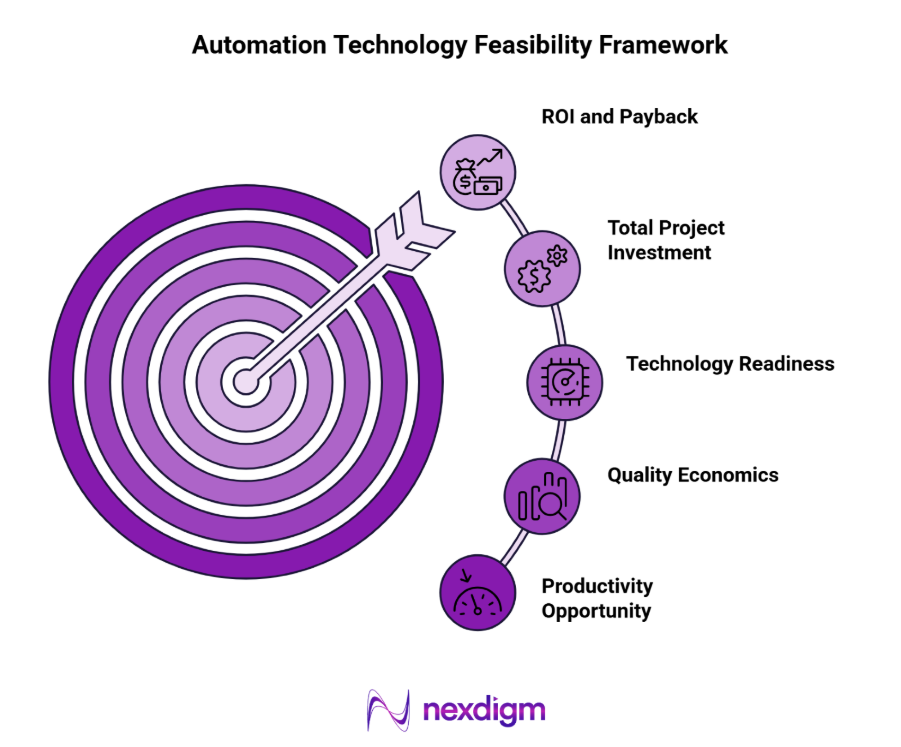
- Labour Economics
Measure wage levels, labour availability, turnover, overtime, recruitment difficulty, and operator requirements. - Productivity Opportunity
Quantify cycle-time reduction, throughput gains, additional shifts, bottleneck removal, and capacity utilization improvement. - Quality Economics
Measure scrap, rework, inspection costs, defects, customer returns, and expected quality improvement. - Technology Readiness
Assess machinery compatibility, PLC and MES connectivity, data availability, process standardization, and infrastructure. - Total Project Investment
Include equipment, integration, tooling, safety, software, installation, training, commissioning, and production disruption. - ROI and Payback
Model annual benefits against capital expenditure under different utilization, labour-cost, and production assumptions. - Adoption and Replication Potential
Evaluate workforce readiness, management acceptance, service requirements, technology maturity, and opportunities to replicate across plants.
Case Study: Automation Technology Market Feasibility Consulting
US industrial robot installations reached 38,000 units in 2025, up 11%. Food-industry installations rose 30%, while automotive reached 13,500. The data points to expanding non-automotive demand, but plant-level ROI remains dependent on utilization and integration.
To take the next step, simply visit our Request a Consultation page and share your requirements with us.
Harsh Mittal
+91-8422857704