

Brand positioning plays a major role in shaping how consumers perceive vehicles across premium and mass-market categories. An effective Automotive brand positioning strategy helps automakers define whether a vehicle should be seen as affordable, reliable, luxurious, innovative, sustainable, or performance-driven.
In premium segments, positioning often focuses on exclusivity, technology, comfort, and status, while mass-market positioning emphasizes value, durability, fuel efficiency, and accessibility. A strong market entry strategy ensures that brand messaging, pricing, distribution, and customer experience align with local expectations. This helps automotive companies build trust, differentiate from competitors, and improve adoption across diverse vehicle categories.
Recent figures show the scale of branding challenges across vehicle categories. The luxury car market was valued at about USD 1.29 trillion in 2024, showing strong premium demand. These numbers indicate that clear positioning is essential to differentiate premium appeal from mass-market value.
How can automotive brand positioning strategy influence premium and mass vehicle categories?
Automotive brand positioning strategy influences premium and mass vehicle categories by shaping customer perception, pricing expectations, value communication, emotional appeal, and trust across luxury-focused and affordability-focused buyer groups:
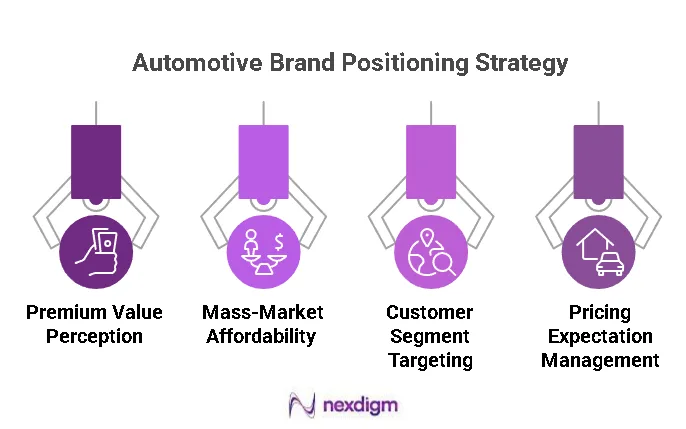
- Premium Value Perception: Positions premium vehicles around luxury, innovation, comfort, exclusivity, advanced technology, and superior ownership experience.
- Mass-Market Affordability: Positions mass vehicles around price, fuel efficiency, durability, practicality, low maintenance, and everyday usability.
- Customer Segment Targeting: Defines different buyer groups based on income, lifestyle, aspirations, family needs, and purchase motivations.
- Pricing Expectation Management: Aligns vehicle price with perceived benefits, category standards, competitor offerings, and customer willingness to pay.
Nexdigm Expertise in Customer Experience Strategy to Strengthen Automotive Brand Trust
Nexdigm helps automotive companies strengthen brand positioning across premium and mass vehicle categories by analyzing consumer perception, competitor positioning, pricing expectations, and market entry opportunities. Its services support customer segmentation, localization, go-to-market planning, and brand communication. This enables automakers to create distinct value propositions, build trust, improve visibility, and drive stronger acceptance among luxury and value-focused buyers.
Nexdigm’s Pricing Strategy to Support Premium and Mass-Market Brand Perception
Nexdigm’s Pricing Strategy to Support Premium and Mass-Market Brand Perception helps align pricing with customer expectations, competitor benchmarks, product value, affordability, and premium appeal across different automotive segments.
- Premium Price Benchmarking: Nexdigm compares luxury vehicle pricing, features, brand value, and competitor positioning to support premium customer perception.
- Mass-Market Affordability Analysis: Nexdigm evaluates buyer income, price sensitivity, ownership cost, and financing needs for value-focused vehicle categories.
- Value-Based Pricing Review: Nexdigm aligns vehicle prices with perceived benefits such as safety, technology, comfort, reliability, and after-sales support.
- Competitor Pricing Comparison: Nexdigm studies rival models, discounts, variants, and promotional offers to position vehicles effectively in each segment.
- Variant-Wise Pricing Strategy: Nexdigm supports pricing for base, mid, and premium variants to target different customer budgets and expectations.
Nexdigm’s case:
Nexdigm helped a global automotive company refine its pricing strategy for both premium and mass-market vehicle categories in India. By benchmarking 12 competitor models, studying 5 major cities, and analyzing over 1,500 customer responses, Nexdigm identified a 7–10% price gap between perceived value and actual pricing. The company revised variant pricing, improved financing offers, and repositioned its mass model around affordability, while maintaining premium appeal for its luxury variant.
To take the next step, simply visit our Request a Consultation page and share your requirements with us.
Harsh Mittal
+91-8422857704