

Casting remains a core manufacturing process across the automotive industry, producing components used in engines, transmissions, braking systems, suspension assemblies, structural applications and electric vehicle platforms. As vehicle designs evolve, casting suppliers are being evaluated on a wider range of requirements, including dimensional accuracy, material performance, process consistency, lightweighting and the ability to manufacture increasingly complex geometries.
For automakers and Tier 1 suppliers, selecting a casting partner requires a detailed understanding of the supplier’s process capabilities and production economics. Two manufacturers may offer similar components but differ substantially in tooling expertise, alloy control, machining integration, defect rates and available capacity. Benchmarking helps establish these differences before sourcing decisions are made.
Understanding the Main Automotive Casting Processes
The first step in supplier comparison is distinguishing between manufacturing processes. Each process supports different component types, production volumes and dimensional requirements.
- High-pressure die casting (HPDC): Uses high pressure to inject molten metal into a die. It is suited to high-volume production of complex aluminium and magnesium components.
- Gravity die casting: Relies on gravity to fill the mould and is used for components requiring particular material or mechanical characteristics.
- Low-pressure die casting: Uses controlled pressure to fill the mould, often supporting components such as aluminium wheels and selected structural parts.
- Sand casting: Offers flexibility for larger or lower-volume components, although surface finish and dimensional consistency may require additional processing.
- Investment casting: Supports intricate geometries and precision applications, generally with different cost and production-volume characteristics.
A supplier should be assessed against the process required by the component, rather than ranked through a generic casting-capability score.
Comparing Casting Suppliers and Their Manufacturing Capabilities
India’s automotive casting ecosystem includes companies such as Endurance Technologies, Rockman Industries, Jaya Hind Industries, Rico Auto Industries, Sandhar Technologies and other specialist foundries. International suppliers and regional manufacturers also serve OEM and Tier 1 requirements across different component categories.
A meaningful supplier profile should capture:
- Metals and alloys processed, including aluminium, iron, steel and magnesium where relevant.
- Casting processes and equipment range.
- Maximum component dimensions and weight.
- Tool and die design capabilities.
- In-house machining and finishing operations.
- Simulation, process monitoring and inspection capabilities.
- Existing automotive applications and customer relationships.
The presence of a casting machine with a particular tonnage does not by itself establish capability. Tooling design, mould-flow analysis, melt quality, process control and downstream machining all affect whether the supplier can consistently produce the required component.
Cost Benchmarking Beyond the Quoted Part Price
Casting economics are influenced by material consumption, yield, energy, tooling, labour, machining and scrap recovery. A low quoted price may reflect a different component specification, lower finishing requirements or a cost assumption that does not include all production stages.
Procurement teams should compare:
- Metal input costs and alloy composition.
- Material utilisation and casting yield.
- Tooling investment and expected tool life.
- Energy consumption and production cycle time.
- Machining, finishing and inspection costs.
- Scrap generation and recycling practices.
- Logistics and packaging requirements.
Material yield deserves particular attention. A process that uses more metal than necessary can increase input costs and create additional melting and recycling requirements. Similarly, a supplier with lower casting costs may have higher downstream machining expenses if dimensional consistency is weaker.
Quality and Process Capability
Casting quality depends on material composition, temperature control, mould design, filling behaviour, solidification and process repeatability. Defects such as porosity, shrinkage, inclusions, cracks and dimensional variation can affect component performance and increase rejection or rework.
Supplier evaluation should consider:
- Metallurgical testing and alloy traceability.
- Dimensional inspection and measurement systems.
- Non-destructive testing where component criticality requires it.
- Process monitoring and statistical process control.
- Tool maintenance and preventive maintenance systems.
- Corrective-action history and consistency across production batches.
For safety-critical and structural components, the consequences of process variation can be substantial. Supplier benchmarking should therefore distinguish between a manufacturer’s general quality certifications and demonstrated capability for the specific component and process under consideration.
Capacity, Technology and Future Demand
Capacity analysis should include installed equipment, current utilisation, operating shifts, plant layout, tooling availability and the time required to introduce new production lines. A supplier may have significant nominal capacity but limited flexibility if its machines are committed to existing customer programmes.
Technology investments can also affect future competitiveness. Automated handling, real-time process monitoring, simulation-led tooling design, improved melt treatment and closed-loop recycling can influence productivity and consistency. Lightweight aluminium castings are particularly relevant to vehicle manufacturers seeking to reduce component weight, although the economics depend on design, material and manufacturing requirements.
Nexdigm’s automotive casting supplier benchmarking can support casting supplier benchmarking through market mapping, supplier profiling, process-capability comparisons, manufacturing-footprint analysis and assessment of regional capacity developments. This provides procurement teams with a structured view of the available supplier base and its commercial characteristics.
Automotive Casting Supplier Benchmarking Framework
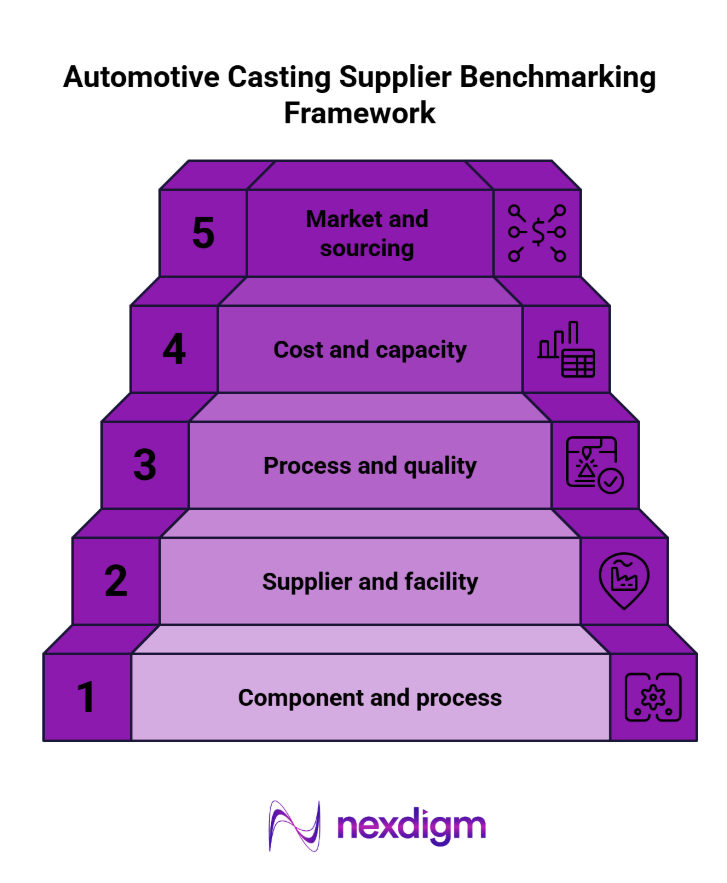
- Component and process classification: Identify material, geometry, production volume, tolerances and the casting process required.
- Supplier and facility mapping: Profile manufacturers by location, equipment, alloy capability, product portfolio and automotive customer exposure.
- Process and quality benchmarking: Compare tooling, simulation, metallurgical control, inspection methods and process-consistency indicators.
- Cost and capacity assessment: Evaluate material yield, energy, tooling, machining, utilisation, expansion plans and logistics economics.
- Market and sourcing-risk analysis: Assess regional supplier concentration, material dependencies, technology investments and alternative manufacturing sources.
Case Study: Comparing Automotive Casting Suppliers
A Tier 1 manufacturer reviewing aluminium casting sources needed to compare suppliers for transmission and structural components. Nexdigm’s research assessed 19 manufacturers across four regions, mapped their process capabilities and production footprints, and identified six suppliers with relevant equipment and machining capabilities for further evaluation.
To take the next step, simply visit our Request a Consultation page and share your requirements with us.
Harsh Mittal
+91-8422857704