

Semiconductors have become central to vehicle performance, safety, connectivity, and power management. A modern vehicle may contain more than a thousand semiconductor devices across its electronic systems, with requirements ranging from relatively mature microcontrollers to advanced processors used in driver assistance and vehicle computing. This creates a supplier landscape that is technically diverse and commercially interconnected.
For automakers, identifying semiconductor vendors requires more than comparing manufacturers by revenue or product range. A supplier’s relevance depends on the devices it produces, the vehicle systems it supports, its manufacturing and packaging ecosystem, automotive qualification capabilities and exposure to upstream capacity constraints.
Which Semiconductor Categories Matter to Automakers?
Automotive semiconductor sourcing spans several distinct product categories:
- Microcontrollers (MCUs): Manage functions across body electronics, powertrain control, battery management, and other embedded systems.
- System-on-chips (SoCs): Combine processing capabilities for infotainment, connectivity, digital cockpits and advanced driver assistance.
- Power semiconductors: Including MOSFETs, IGBTs and silicon-carbide devices used in power conversion, motor control and charging systems.
- Memory components: Support software execution, data storage, infotainment, and advanced computing applications.
- Analogue and mixed-signal ICs: Enable sensor interfaces, power management, signal conditioning and communication between electronic components.
- Connectivity and radio-frequency devices: Support vehicle networking, wireless communication, positioning, and connected services.
These categories have different manufacturing requirements and supplier dynamics. A vendor with a strong position in power devices may not offer a suitable portfolio of automotive-grade processors or memory products.
Identifying Strategic Semiconductor Suppliers
The global automotive semiconductor ecosystem includes companies such as Infineon Technologies, NXP Semiconductors, Renesas Electronics, STMicroelectronics, Texas Instruments, onsemi and Microchip Technology. Advanced computing and connectivity requirements also bring companies such as Qualcomm and NVIDIA into the automotive technology landscape.
Supplier intelligence should establish where each company participates in the vehicle value chain. Important distinctions include:
- Product ownership and the extent of in-house design.
- Fabrication model, including owned manufacturing facilities and foundry dependence.
- Packaging and testing locations.
- Automotive product qualification and reliability capabilities.
- Existing relationships with OEMs and Tier 1 suppliers.
- Exposure to specific manufacturing nodes, materials and equipment ecosystems.
A broad product catalogue does not automatically translate into strategic suitability. The relevant question is whether a vendor can support the required application, production volume, and vehicle programme timeline.
Capacity and Supply-Chain Dependencies
Semiconductor capacity is difficult to assess through headline production figures alone. Automotive devices use multiple process technologies, and mature-node manufacturing remains important for many control and power-management applications. Advanced processors, meanwhile, may depend on different fabrication, packaging, and testing capabilities.
Automakers should examine capacity at several levels:
- Wafer fabrication capacity relevant to the required device category.
- Foundry relationships and allocation arrangements.
- Assembly, packaging, and testing locations.
- Dependence on specialised substrates, wafers and manufacturing equipment.
- Capacity expansion plans and competing demand from other sectors.
The distinction between a chip designer and a manufacturer is particularly important. A fabless semiconductor company may have strong product engineering but depend on external foundries and outsourced assembly and test providers. Its supply resilience therefore depends partly on partners outside its direct operational control.
This is why automotive chip supplier intelligence should include upstream mapping rather than stopping at the direct vendor. A semiconductor supplier may appear diversified at the company level while relying on a concentrated manufacturing or packaging network.
Cost, Qualification and Commercial Risk
Semiconductor pricing reflects more than the physical device. Design complexity, process technology, production volumes, packaging, testing and long-term supply commitments all influence commercial terms. Automotive qualification can also create switching costs because alternative devices may require hardware redesign, software adaptation and extensive validation.
A supplier comparison should consider:
- Unit pricing across different volume scenarios.
- Engineering and non-recurring development costs.
- Product lifecycle and end-of-life policies.
- Minimum order quantities and lead-time commitments.
- Qualification requirements and replacement complexity.
- Regional manufacturing exposure and logistics costs.
Automakers should also assess product longevity. Vehicle platforms can remain in production for many years, while semiconductor product cycles may be shorter. A vendor’s lifecycle-management approach and commitment to long-term automotive supply can therefore be as important as its initial price.
Building a Strategic Semiconductor Vendor Map
A useful supplier map connects semiconductor manufacturers to the vehicle systems and component suppliers that use their products. For example, an MCU supplier may serve body-control modules, battery-management systems, and powertrain electronics through different Tier 1 relationships. Mapping these connections helps automakers understand shared dependencies across apparently separate vehicle systems.
Nexdigm’s procurement research can support this work through semiconductor supplier profiling, market and capacity analysis, geographic footprint mapping, and assessment of product portfolios and industry relationships. Such research helps procurement and strategy teams identify relevant vendors, understand market concentration, and evaluate sourcing alternatives.
Automotive Semiconductor Supplier Intelligence Framework
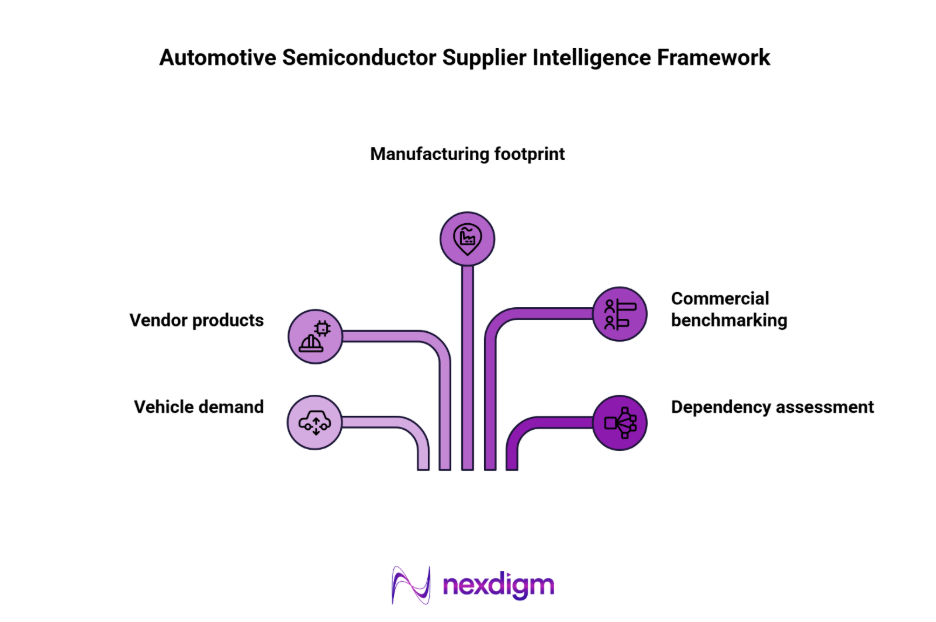
- Vehicle-system demand mapping: Identify semiconductor requirements across powertrain, body electronics, ADAS, infotainment, connectivity and electrification.
- Vendor and product identification: Map semiconductor companies by device category, application, product portfolio and customer ecosystem.
- Manufacturing footprint analysis: Examine fabrication, foundry, packaging and testing dependencies across regions.
- Commercial and qualification benchmarking: Compare pricing factors, lifecycle policies, automotive qualifications and switching requirements.
- Strategic dependency assessment: Identify concentrated sub-tier exposure, capacity constraints, geographic risks, and potential alternative sources.
The resulting intelligence provides a more complete picture of supplier suitability than a conventional vendor list.
Case Study: Mapping Automotive Semiconductor Vendors
A vehicle manufacturer reviewing semiconductor exposure across three electronic systems required greater visibility into vendor dependencies. Nexdigm’s research profiled 32 semiconductor companies, mapped their product categories and manufacturing footprints, and identified seven concentrated sourcing dependencies for further procurement and engineering review.
To take the next step, simply visit our Request a Consultation page and share your requirements with us.
Harsh Mittal
+91-8422857704