

Automotive procurement is increasingly being asked to manage materials beyond their first use. The EU’s new End-of-Life Vehicles Regulation, which entered into force in August 2026, strengthens requirements covering vehicle design, reuse, recycling, recovery, traceability, and recycled content. It sets a 15% recycled-plastic target for new vehicles from 2032, rising to 25% from 2036, while creating a framework for recycled-content targets for steel and aluminium.
The scale of the opportunity is significant. The European Commission estimates that 10–12 million vehicles reach the end of their lifespan in Europe every year. Under the new framework, the EU expects that by 2035, 5.4 million tonnes of materials could be recycled at higher quality or reused, including plastics, steel, aluminium, copper, and critical raw materials.
Battery circularity is also becoming strategically important: the IEA estimates that around 1.2 million EV batteries could reach end of life in 2030 and 14 million by 2040. For procurement teams, automotive circular supply chain procurement means moving beyond one-time material purchases toward sourcing models that keep products, components, and materials in productive use for longer.
The Shift From Linear Buying to Circular Sourcing
Traditional procurement largely follows a linear path: source raw materials, manufacture components, use the vehicle, and eventually dispose of the product. Circular procurement introduces additional loops, that is reuse, repair, refurbishment, remanufacturing, recycling, and material recovery. This changes what procurement teams need to evaluate. Supplier capability is no longer limited to cost, quality, and delivery; it can also include reverse flows, recoverability, recycled inputs, take-back systems, material traceability, and recovery economics.
Loops That Can Reshape Automotive Procurement
Circular sourcing in automotive procurement is built around three interconnected value loops. The first focuses on reusing and refurbishing components through repair, restoration, and second-life applications. The second emphasizes recycling and reprocessing recovered materials so they can re-enter production while meeting quality and performance standards. The third involves recovering valuable resources from end-of-life vehicles and reintegrating them into future manufacturing needs. Together, these loops help procurement teams transition from one-time material purchasing to maximizing value throughout the entire vehicle lifecycle.
How Experts at Nexdigm Connect Circular Procurement Loops
Circularity creates value when reuse, recovery, and recycling work as connected parts of the sourcing model. Nexdigm can help organizations understand how these loops interact and where procurement can create stronger connections:
- Connect Material Flows: Link end-of-life materials and recovered components with relevant sourcing and production requirements.
- Bridge Ecosystem Gaps: Identify where recyclers, suppliers, dismantlers, processors, and logistics partners need stronger coordination to enable circular flows.
- Balance Circular Options: Compare reuse, refurbishment, remanufacturing, recycling, and recovery based on value retention, feasibility, cost, and supply requirements.
- Create Procurement Pathways: Translate circular opportunities into sourcing models that can be integrated into supplier relationships, category strategies, and procurement planning.
Through automotive circular supply chain procurement, Nexdigm helps organizations look at the supply chain as a connected system, where materials can retain value across multiple procurement and production cycles.
Nexdigm’s Circular Procurement Assessment
To determine where circularity can create practical sourcing value, Nexdigm can assess the supply chain across key dimensions:
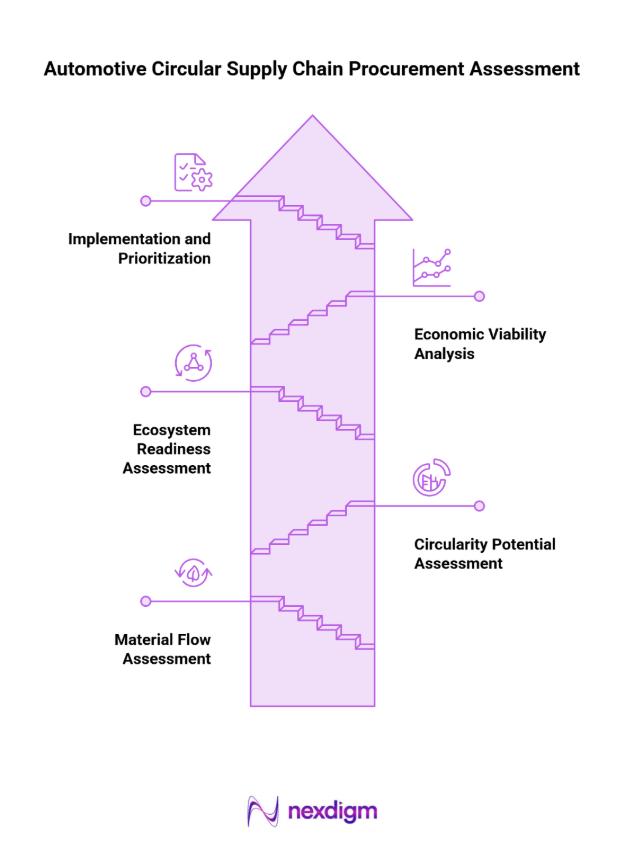
- Material Flow Assessment: Map where materials enter, move through, and leave the supply chain to identify opportunities for recovery and reintegration.
- Circularity Potential: Evaluate components and materials for reuse, refurbishment, remanufacturing, recycling, or recovery based on technical and commercial feasibility.
- Ecosystem Readiness: Assess recyclers, recovery partners, suppliers, logistics networks, and processing capabilities needed to support circular sourcing models.
- Economic Viability: Compare costs, recovered-material value, logistics, processing requirements, and potential savings across alternative circular pathways.
- Implementation Priorities: Rank opportunities based on feasibility, supply impact, circularity potential, scalability, and strategic importance.
This automotive circular supply chain procurement assessment helps organizations identify where circular models can work, what is required to enable them, and which opportunities merit procurement attention first.
Nexdigm’s Insights for Circular Procurement Decisions
The assessment can translate circularity opportunities into practical procurement priorities. Nexdigm can help organizations use the findings to:
- Select Circular Pathways: Determine whether reuse, refurbishment, remanufacturing, recycling, or recovery offers the strongest fit for each material or component.
- Prioritize Supplier Engagement: Identify suppliers and ecosystem partners where collaboration could unlock greater recovery, reuse, or recycled-material potential.
- Guide Investment Decisions: Highlight areas where processing capabilities, reverse logistics, technology, or supplier development may be required to enable circular models.
- Measure Procurement Impact: Establish relevant indicators around recovered materials, reuse rates, circular sourcing, resource efficiency, and value retention.
This enables automotive circular supply chain procurement to move from identifying circular opportunities to making focused sourcing decisions that can be implemented and measured.
Nexdigm’s Case
An automotive manufacturer assessed its circular sourcing opportunities across five regions, evaluating material recovery, supplier capability, reverse logistics, and recycled-input potential. Nexdigm’s assessment identified 30% of opportunities with capability or supply constraints and prioritized 16 actions across recovery partnerships, recycled materials and traceability. The findings helped procurement focus on circular pathways with stronger feasibility, scalability, and sourcing value.
To take the next step, simply visit our Request a Consultation page and share your requirements with us.
Harsh Mittal
+91-8422857704