

Competitive intelligence evaluating supply constraints, demand cycles, and localization trends help businesses navigate disruptions and shifting market dynamics.
The automotive semiconductor market is projected to exceed $120 billion by 2030, while chip shortages have previously reduced global vehicle production by over 10 million units in a single year.
Raw material volatility and production bottlenecks continue to impact supply chains, with lead times for automotive chips often exceeding 20–30 weeks. These insights enable companies to anticipate demand fluctuations, manage shortages, and adjust sourcing and production strategies effectively.
Automotive semiconductor analysis also tracks localization and technology trends across EVs, ADAS, and connectivity. Over 60% of OEMs are increasing regional sourcing to reduce dependency on global supply chains. Competitive intelligence helps optimize procurement, mitigate risks, and align investments with evolving semiconductor requirements.
Agreements in Competitive Intelligence for Supply, Demand, and Localization Trends
Semiconductor competitive intelligence services in this area operate within structured agreements that ensure accurate data sharing, confidentiality, and strategic alignment. These agreements help businesses evaluate supply constraints, demand cycles, and localization trends effectively in a growing market.
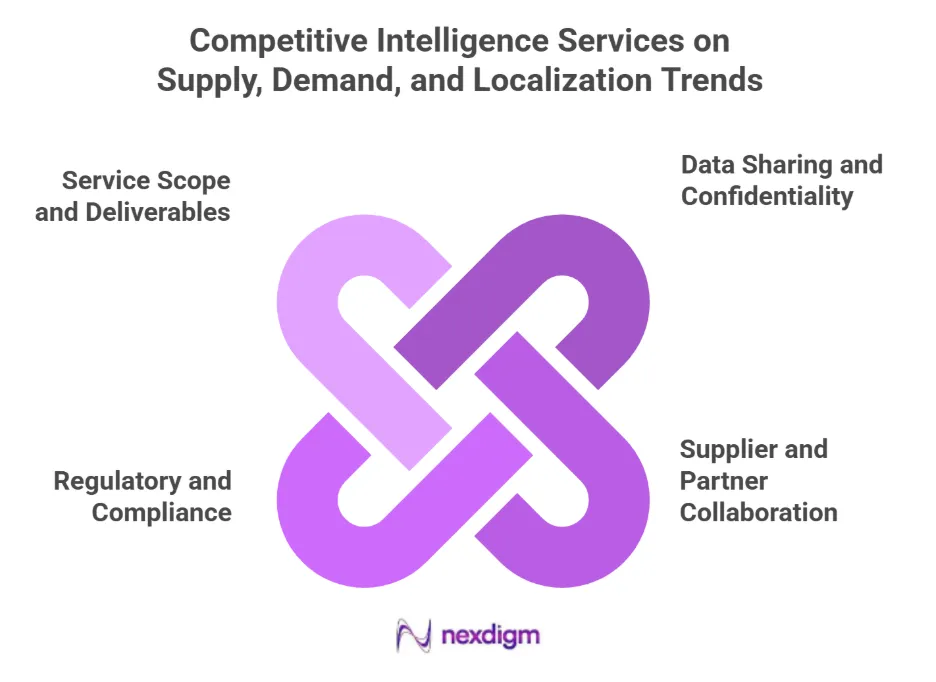
1. Data Sharing and Confidentiality Agreements
These agreements ensure that sensitive market, supplier, and competitor data is handled securely. They define how information is collected, shared, and protected, maintaining trust while enabling meaningful competitive intelligence analysis.
2. Supplier and Partner Collaboration Agreements
Competitive intelligence often involves inputs from suppliers and partners. Agreements outline roles, responsibilities, and data exchange protocols, ensuring accurate insights into supply constraints and localization strategies across the value chain.
3. Regulatory and Compliance Agreements
These agreements ensure that all intelligence activities comply with local and global regulations. They define acceptable practices for data usage, helping businesses avoid legal risks while analyzing market and supply chain dynamics.
4. Service Scope and Deliverables Agreements
Clearly defined agreements outline the scope of competitive intelligence services, including deliverables, timelines, and objectives. This ensures alignment between stakeholders and enables focused analysis of demand cycles, supply risks, and localization opportunities.
Nexdigm’s Measures for Supply, Demand, and Localization Intelligence
Nexdigm’s competitive intelligence services apply structured measures to evaluate supply constraints, demand cycles, and localization trends in growing markets. These measures help businesses monitor performance, reduce risks, and align strategies with evolving supply chain and market dynamics.
1. Supply Chain Disruption Tracking
Nexdigm measures supply risks by tracking disruptions, lead times, and supplier dependencies. This helps businesses anticipate shortages, diversify sourcing strategies, and maintain continuity in dynamic and growing markets.
2. Demand Cycle Analysis Metrics
Nexdigm evaluates demand fluctuations using historical data and market indicators. These metrics help businesses forecast demand cycles accurately and adjust production, inventory, and sales strategies accordingly.
3. Localization Index Assessment
Nexdigm measures the extent of local sourcing and manufacturing through localization indices. This helps businesses align with regional policies, reduce global dependency, and optimize cost structures effectively.
4. Cost and Efficiency Benchmarking
Nexdigm benchmarks operational costs and efficiency levels across competitors. This enables businesses to identify inefficiencies, optimize supply chains, and improve profitability in a competitive and expanding market.
5. Supplier Performance Evaluation
Nexdigm assesses supplier reliability, quality, and responsiveness using performance metrics. This helps businesses select strong partners, improve supplier relationships, and ensure stable operations amid changing supply and demand conditions.
Nexdigm’s Case:
Nexdigm helped an OEM mitigate supply risks by 26% and improve demand forecast accuracy by 21%, leveraging competitive intelligence on localization shifts and supply cycles in markets growing above 8–11% CAGR
To take the next step, simply visit our Request a Consultation page and share your requirements with us.
Harsh Mittal
+91-8422857704