

Automotive component costs are shaped by a combination of material prices, manufacturing processes, labour, energy, tooling, logistics and supplier commercial structures. Two suppliers manufacturing the same component may quote different prices because they use different materials, production technologies, plant locations or cost assumptions. A meaningful benchmark must identify the reasons behind these differences.
Cost competitiveness has become particularly important as automotive manufacturers manage volatile commodity prices and changing vehicle architectures. Steel, aluminium, copper, plastics and rubber influence a wide range of components, while electrification and electronic content introduce additional materials and manufacturing requirements.
Understanding the Main Drivers of Component Cost
The first step in benchmarking is to establish the cost structure of the component. A machined housing, stamped bracket, cast aluminium part and electronic control module have fundamentally different cost drivers.
A component-level cost assessment should consider:
- Material costs: Grade, specification, purchase quantity, yield, scrap recovery and exposure to commodity-price changes.
- Conversion costs: Labour, machine time, energy, process efficiency and production cycle time.
- Tooling and capital costs: Dies, moulds, fixtures, machining tools and equipment investment.
- Quality-related costs: Inspection, testing, rejection, rework and warranty exposure.
- Logistics costs: Packaging, freight, duties, warehousing and delivery frequency.
- Commercial costs: Payment terms, minimum order quantities, price revision clauses and volume commitments.
The relative importance of each category varies by component. Material cost may dominate a forged steel part, while tooling and conversion costs can be more significant for certain precision or high-complexity components.
Comparing Manufacturing Processes and Supplier Economics
Process selection can create substantial differences in unit economics. For example, a component manufactured through casting and subsequent machining may have a different cost profile from one produced through forging or fabrication. The comparison should account for material utilisation, production volumes, finishing requirements and component performance.
A process benchmark should examine:
- Production cycle time and throughput.
- Material yield and scrap generation.
- Automation and labour intensity.
- Energy consumption per unit.
- Tooling life and maintenance requirements.
- Secondary processing and inspection needs.
- Rejection rates and rework assumptions.
A lower-cost process is not automatically suitable. It may require design changes, higher tooling investment or additional validation. The commercial benefit must be assessed against the technical requirements and expected production volume.
What Recent Cost Pressures Reveal
Input-cost movements can affect automotive suppliers differently depending on their product mix and commercial arrangements. In June 2026, Crisil reported that raw materials accounted for nearly three-fourths of the cost structure of Indian auto component manufacturers it analysed. Steel and aluminium together represented 50–60% of input costs in that assessment, while higher input and freight costs were expected to pressure operating margins.
A supplier with greater exposure to steel or aluminium may experience a different cost trajectory from one focused on electronics or plastic components. The timing of price revisions also matters. Cost pass-through arrangements can operate with a lag, creating temporary differences between supplier costs and customer prices.
Comparing Commercial Terms Across Suppliers
Quoted prices are only one part of supplier economics. Procurement teams should examine how suppliers structure their commercial arrangements and how those terms respond to changes in volume, materials and production requirements.
Important comparison points include:
- Price validity periods and revision frequency.
- Commodity-linked adjustment mechanisms.
- Volume discounts and minimum order quantities.
- Tooling ownership, amortisation and maintenance charges.
- Payment terms and working-capital requirements.
- Freight, packaging and inventory responsibilities.
- Engineering-change and product-obsolescence costs.
Normalising these assumptions is essential. One supplier may include tooling amortisation in its unit price, while another quotes tooling separately. Comparing the two figures without adjusting for these differences produces an unreliable result.
Building a Defensible Automotive Cost Benchmark
A robust benchmark combines market-level input information with supplier and process data. It should distinguish between observed market prices, supplier-reported commercial information and analytical estimates. Where exact supplier cost breakdowns are unavailable, ranges and clearly stated assumptions are more defensible than false precision.
Automotive component cost benchmarking can help manufacturers understand where cost differences originate across materials, manufacturing processes and supplier markets. It can also identify components where regional production economics, material availability or process specialisation may influence competitiveness.
Nexdigm’s procurement research can support this work through market-price analysis, supplier mapping, manufacturing-cost comparisons and assessment of regional sourcing conditions. This provides a market-based reference for evaluating supplier economics and identifying areas that merit deeper commercial review.
Automotive Component Cost Benchmarking Framework
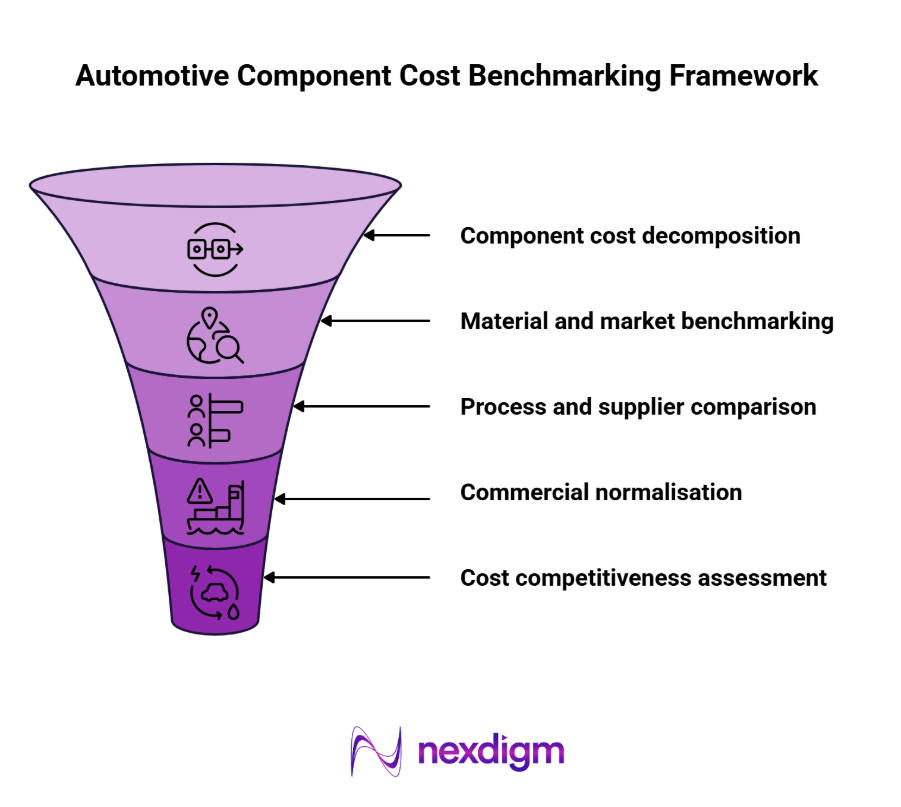
- Component cost decomposition: Break down the component into materials, conversion, tooling, quality, logistics and commercial cost elements.
- Material and market benchmarking: Compare relevant input prices, material specifications, regional availability and commodity exposure.
- Process and supplier comparison: Assess production methods, cycle times, yield, automation, capacity and supplier specialisation.
- Commercial normalisation: Align quotation assumptions, tooling charges, volume commitments, payment terms and price-adjustment clauses.
- Cost competitiveness assessment: Identify key cost differences, regional advantages, supplier dependencies and opportunities for further evaluation.
Case Study: Benchmarking Component Cost Structures
An automotive manufacturer reviewing metal components needed to understand price differences across its supplier base. Nexdigm’s research compared material and process economics across 16 component categories, assessed supplier markets in three regions, and identified four categories where input exposure and manufacturing differences warranted deeper commercial review.
To take the next step, simply visit our Request a Consultation page and share your requirements with us.
Harsh Mittal
+91-8422857704