

Choosing an automotive component supplier involves more than identifying manufacturers with competitive prices or established OEM relationships. The strategic fit of a supplier depends on the component being sourced, the vehicle platform, production volumes, technical requirements and the manufacturer’s ability to support the programme over its expected lifecycle.
India offers OEMs a broad supplier base across mechanical components, electrical systems, vehicle electronics, castings, forgings, precision-engineered parts and advanced automotive technologies. The Automotive Component Manufacturers Association of India (ACMA) reported industry turnover of approximately ₹6.73 lakh crore in FY2024–25. Supplies to OEMs reached ₹5.70 lakh crore, while exports stood at US$22.9 billion. This scale reflects the depth of the domestic manufacturing ecosystem, although the suitability of individual suppliers varies considerably by product category.
Supplier Selection Should Begin With the Component Requirement
An OEM sourcing a forged crankshaft, braking assembly or transmission component will have different technical and commercial priorities from one evaluating electronic control units, wiring harnesses or battery-management systems. Supplier selection must therefore begin with the application and specifications of the component.
For mechanical components, relevant requirements may include material expertise, dimensional accuracy, machining processes, tooling capabilities and production consistency. Electronic components require a different assessment, covering circuit design, software integration, sensor capabilities, testing infrastructure and technology partnerships.
The expected production programme also influences supplier suitability. A manufacturer capable of supplying limited volumes of specialised components may not have the capacity to support a high-volume passenger vehicle platform. Similarly, a large manufacturer may have the necessary scale but lack the specific engineering experience required for a technically complex component.
Which Supplier Categories Offer the Strongest Fit?
India’s automotive supplier landscape includes diversified Tier 1 manufacturers, product specialists and smaller engineering businesses.
Companies such as Samvardhana Motherson, Uno Minda and Bosch operate across multiple automotive product categories. Their portfolios include wiring systems, vehicle electronics, lighting, switches, sensors and other vehicle components. Their scale and established OEM relationships can make them relevant to programmes requiring broad product coverage or international manufacturing support.
Specialist manufacturers may offer a closer fit for particular component requirements. Bharat Forge has established capabilities in forging and precision-engineered products, while Endurance Technologies operates across suspension, braking and aluminium die-casting categories. Sundram Fasteners has a strong position in fasteners and precision components. Sona BLW Precision Forgings focuses on driveline and precision-forged products.
These manufacturers should not be compared through consolidated revenue alone. Their automotive exposure, product mix, manufacturing locations and capabilities within the relevant component category provide a more meaningful basis for evaluation.
Commercial and Technical Fit Must Be Evaluated Together
A structured automotive component supplier analysis should examine the relationship between a supplier’s commercial position and its technical capabilities.
Commercial assessment should consider pricing indicators, business scale, customer concentration, export exposure, investment activity and the cost implications of manufacturing location. A supplier with a lower quoted price may not necessarily offer the strongest overall sourcing proposition if the required tooling investment, logistics arrangements or production volumes create additional costs.
Technical assessment should focus on product specialisation, engineering resources, manufacturing processes, testing infrastructure and experience with comparable vehicle applications. For advanced automotive components, technology readiness and the ability to support future product development are increasingly relevant.
Operational factors complete the picture. Installed capacity, available production headroom, workforce capabilities, facility locations and access to upstream materials can determine whether a supplier can support a new programme. OEMs should also distinguish between current production capabilities and expansion plans that have not yet translated into operational capacity.
Localisation and Technology Readiness Are Changing Supplier Priorities
The transition towards electric and connected vehicles is altering the composition of automotive sourcing. Demand is expanding for power electronics, sensors, controllers, electric driveline components and thermal-management systems, alongside continued demand for conventional mechanical products.
The government’s PLI scheme for automobiles and auto components had 82 approved applicants as of November 2025. Its ₹25,938 crore budgetary outlay is intended to encourage domestic manufacturing of advanced automotive technology products and strengthen localisation. For OEMs, this creates a reason to examine suppliers’ current capabilities, investment commitments and participation in emerging product categories.
A supplier’s presence in an emerging technology segment should still be assessed carefully. Announced investments, technology partnerships and actual commercial production represent different stages of capability development.
Automotive Component Supplier Strategic Fit Framework
Nexdigm can support OEM sourcing decisions through market intelligence that maps supplier capabilities, competitive positioning and manufacturing ecosystems.
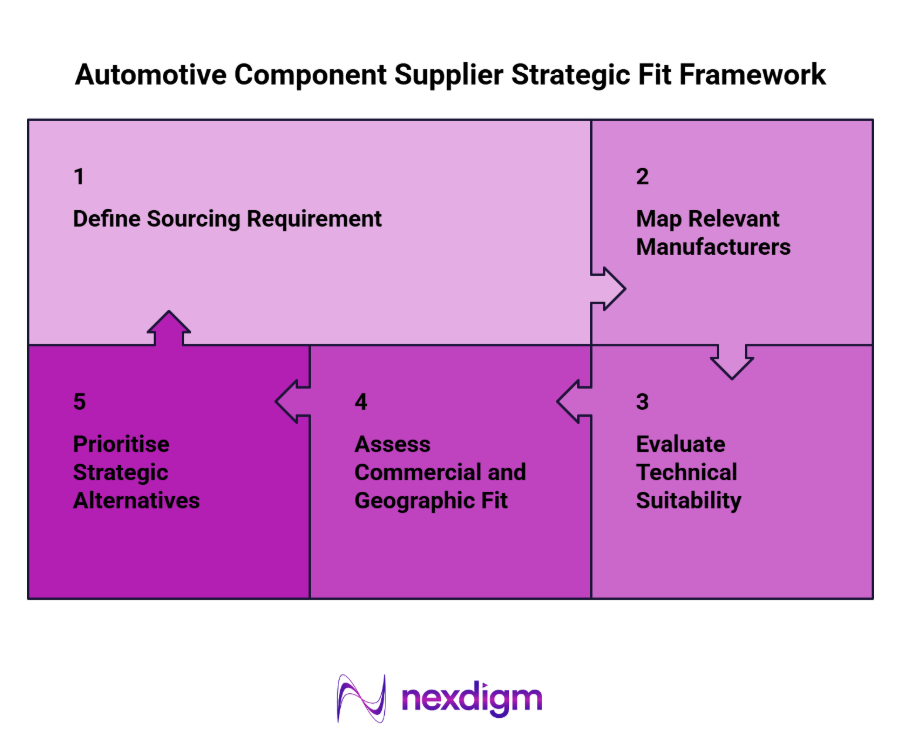
- Define the Sourcing Requirement: Establish component specifications, vehicle applications, production volumes, localisation targets and technology requirements.
- Map Relevant Manufacturers: Identify suppliers by product category, manufacturing process, geography, customer base and market presence.
- Evaluate Technical Suitability: Compare engineering capabilities, product specialisation, testing infrastructure and experience with similar applications.
- Assess Commercial and Geographic Fit: Examine business scale, customer concentration, market position, facility locations and relevant cost drivers.
- Prioritise Strategic Alternatives: Develop a shortlist based on the OEM’s requirements, identify capability gaps and assess alternative sourcing locations.
Nexdigm Case: Sourcing Alternatives for a New Vehicle Platform
An OEM evaluating domestic sourcing options across six component categories required a clearer view of available manufacturers. Nexdigm mapped 38 suppliers across four automotive clusters, compared product capabilities and manufacturing footprints, and identified nine candidates for further evaluation. Three categories required additional regional alternatives.
To take the next step, simply visit our Request a Consultation page and share your requirements with us.
Harsh Mittal
+91-8422857704