

Automotive manufacturers increasingly rely on specialised external partners for component production, sub-assemblies, electronics, precision engineering and selected manufacturing operations. Contract manufacturing can provide access to established facilities, technical expertise and production capacity without requiring an OEM or Tier 1 supplier to build every capability internally.
However, automotive requirements make contract manufacturing a demanding proposition. Suppliers must work within strict engineering specifications, production schedules, traceability requirements and quality expectations. The ability to manufacture a component is only one part of the assessment. Buyers must also understand whether a contract manufacturer can support the required volumes, manage product complexity and maintain consistent output over a programme’s lifecycle.
What Does Automotive Contract Manufacturing Include?
The term covers several different operating models. A contract manufacturer may produce a finished component to a customer’s design, undertake a specialised manufacturing process or deliver a complete sub-assembly.
Common categories include:
- Precision component manufacturing: Machining, casting, forging, stamping and fabrication of parts to customer specifications.
- Electronics manufacturing services: Printed circuit board assembly, electronic module production, testing and selected system integration.
- Mechanical sub-assemblies: Assembly of components such as seating mechanisms, braking sub-systems, steering assemblies and powertrain modules.
- Metal and plastic fabrication: Production of housings, enclosures, brackets, moulded parts and structural elements.
- Integrated manufacturing services: Engineering support, tooling, component sourcing, assembly and testing within a broader manufacturing arrangement.
These categories should not be grouped into a single supplier pool. A contract manufacturer with strong electronics assembly capabilities may have little relevance to a programme requiring large-scale metal forming or precision machining.
Evaluating Production Scale and Technical Complexity
Capacity is a central consideration, but nominal output figures can be misleading. A supplier may have a large facility while lacking the equipment, workforce or available production hours needed for a particular programme.
Complexity requires a separate assessment. Suppliers producing several variants of a component may need flexible tooling, production scheduling and changeover processes. Electronic assemblies may require software configuration, testing and traceability, while mechanical components can involve multiple manufacturing and finishing stages.
The supplier’s experience with comparable products and production environments is therefore more informative than its total revenue or facility size alone.
Quality Systems, Traceability and Programme Requirements
Automotive contract manufacturing requires disciplined process control. Product quality must be consistent across production runs, and manufacturers need systems that allow components and process records to be traced when defects arise.
Important indicators include:
- Automotive quality-management certifications and customer-specific approvals.
- Process validation and production-part approval experience.
- Inspection, testing and measurement infrastructure.
- Batch, component and material traceability.
- Non-conformance management and corrective-action systems.
- Change-control procedures for design and process modifications.
Certification is an important screening factor, but it does not establish capability for every component category. A supplier’s quality systems should be examined in relation to the manufacturing process and product complexity involved.
Commercial Structure and Supplier Dependencies
Contract manufacturing economics depend on more than the conversion charge. Tooling ownership, raw material sourcing, engineering changes, testing, inventory arrangements and logistics can all influence the total cost of the relationship.
Procurement teams should compare:
- Component conversion costs and material assumptions.
- Tooling and capital investment requirements.
- Minimum order quantities and volume commitments.
- Engineering and product-change charges.
- Inventory ownership and working-capital arrangements.
- Freight, packaging and delivery conditions.
Supplier dependency is another important consideration. If a contract manufacturer relies on a limited group of material vendors or specialist process providers, the OEM may face indirect exposure even when the direct supplier appears financially and operationally stable.
Finding Contract Manufacturers Across the Automotive Value Chain
The supplier landscape includes diversified component groups, specialist manufacturers and electronics-focused contract manufacturers. Companies such as Tata AutoComp, Motherson, Jabil, Flex and other manufacturing service providers participate in different parts of the broader automotive ecosystem. Their business models and automotive exposure vary, so comparisons should be based on actual product and process capabilities.
This is where automotive contract manufacturing supplier research becomes relevant. It provides a structured way to identify suppliers, understand their manufacturing specialisations, map facility networks and assess their exposure to automotive customers and end markets.
Nexdigm’s procurement research can support supplier discovery, market mapping, manufacturing footprint analysis and capability profiling. It can also help compare regional supplier ecosystems and identify areas where production capacity or specialist capabilities are concentrated.
Automotive Contract Manufacturing Supplier Assessment Framework
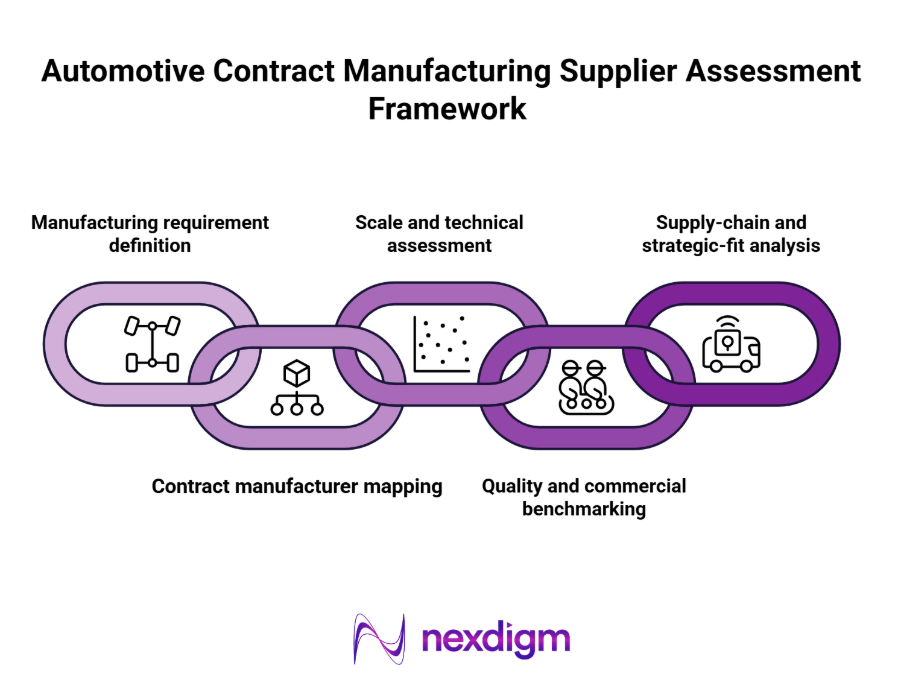
- Manufacturing requirement definition: Identify the product category, production process, annual volume, complexity and required level of supplier involvement.
- Contract manufacturer mapping: Identify relevant manufacturers by capability, industry exposure, location, product range and customer relationships.
- Scale and technical assessment: Compare facility capacity, equipment, automation, engineering resources and experience with similar production programmes.
- Quality and commercial benchmarking: Examine quality systems, traceability, testing, tooling costs, conversion economics and volume requirements.
- Supply-chain and strategic-fit analysis: Assess sub-tier dependencies, geographic concentration, customer exposure, expansion potential and alternative manufacturing sources.
Case Study: Identifying Automotive Contract Manufacturers
A Tier 1 supplier evaluating outsourced production for two component families needed to compare manufacturing scale and technical depth. Nexdigm’s research mapped 27 contract manufacturers across four markets, assessed their process capabilities and automotive exposure, and shortlisted seven suppliers for further technical and commercial review.
To take the next step, simply visit our Request a Consultation page and share your requirements with us.
Harsh Mittal
+91-8422857704