

Automotive electronics pricing strategies are becoming increasingly important as the market shifts toward connected and software-defined vehicles. Modern vehicles now rely on advanced sensors, control units, infotainment systems, connectivity modules, and software-enabled features, making electronics a major source of vehicle value. A strong automotive electronics pricing strategy helps manufacturers balance innovation, production costs, customer expectations, and competitive pressure.
Through pricing analysis, companies can evaluate component costs, software value, subscription models, and market demand to set profitable and competitive prices. As vehicles become more digital, pricing decisions must reflect both hardware performance and long-term software-driven revenue opportunities.
The automotive electronics market is projected at USD 300.49 billion in 2026 and may reach USD 538.81 billion by 2033, growing at 8.7% CAGR. The software-defined vehicle market is also expanding rapidly, with estimates ranging from USD 198.5 billion in 2025 to over USD 1.86 trillion by 2035. These figures show why pricing analysis is essential for competitive electronics and software pricing.
Key Factors Influencing Automotive Electronics Pricing Strategy
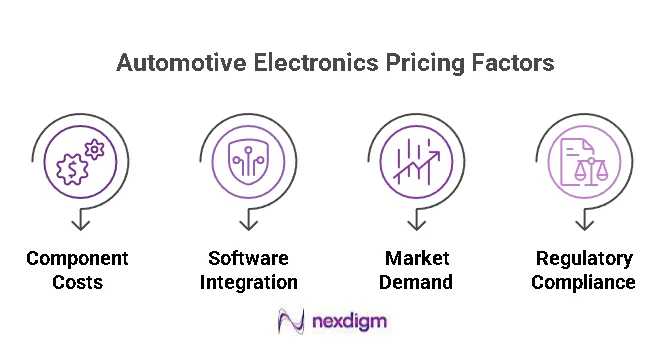
Key factors influencing automotive electronics pricing strategy include component costs, semiconductor availability, software integration, research and development investments, regulatory compliance, production scale, consumer demand, competitive pricing, technological innovation, and comprehensive pricing analysis to maximize profitability:
-
Component and Semiconductor Costs
Chip prices, sensors, and circuit components directly affect production expenses and final automotive electronics pricing strategy.
-
Software Integration Complexity
Advanced software, updates, and cybersecurity features increase development costs and influence value-based pricing decisions.
-
Market Demand and Customer Expectations
Higher demand for connected features, ADAS, and infotainment systems shapes pricing analysis and competitive positioning.
-
Regulatory and Safety Compliance
Safety standards, emissions rules, and data-security requirements add testing costs, affecting overall pricing strategy.
Nexdigm’s Data-Driven Automotive Pricing Decision Support
Nexdigm’s data-driven automotive pricing decision support helps businesses use market insights, cost data, competitor benchmarks, and profitability analysis to set effective prices. For connected and software-defined vehicles, this supports better pricing analysis across electronics, software features, subscriptions, and supplier agreements while improving margins, compliance, and market competitiveness.
Nexdigm’s Cost Benchmarking for Software-Defined Vehicle Electronics
Nexdigm’s cost benchmarking for software-defined vehicle electronics compares component, software, manufacturing, and operational costs against industry standards, enabling effective pricing analysis, improved cost control, competitive pricing strategies, and stronger profitability.
-
Component Cost Comparison
Benchmarks semiconductor, sensor, and control-unit costs to identify pricing gaps and savings opportunities.
-
Software Development Cost Review
Evaluates software, updates, cybersecurity, and integration costs for accurate pricing analysis.
-
Supplier Pricing Benchmarking
Compares supplier quotes and margins to improve negotiation and procurement decisions.
-
Manufacturing Cost Assessment
Reviews production, testing, and assembly costs to support competitive pricing strategy.
Nexdigm’s case:
Nexdigm helped a Tier-1 automotive electronics supplier benchmark costs for software-defined vehicle control units across 12 markets. Through pricing analysis, Nexdigm identified a 14% cost variance, optimized supplier pricing, and supported a revised pricing model. This helped the company reduce procurement costs by 9% and improve gross margins by 6%.
To take the next step, simply visit our Request a Consultation page and share your requirements with us.
Harsh Mittal
+91-8422857704