

Automotive electronics are becoming central to vehicle architecture. They support powertrain control, safety systems, connectivity, driver assistance, infotainment, and energy management. As manufacturers introduce electric and software-defined vehicle platforms, the supplier ecosystem is expanding beyond traditional automotive electronics companies to include semiconductor manufacturers, embedded software specialists, electronic manufacturing providers and integrated Tier 1 suppliers.
For procurement teams, identifying the right suppliers requires an understanding of where each company participates in the value chain. A semiconductor manufacturer, an electronic control unit supplier and a systems integrator may all contribute to the same vehicle platform, but their commercial roles and technical capabilities are different.
The Main Categories Within Automotive Electronics
Automotive electronics cover several interconnected product categories.
- Semiconductors and power electronics include microcontrollers, power-management devices, sensors, memory components, and power semiconductor modules. These products support battery systems, electric drivetrains, charging equipment, engine management, and vehicle control functions.
- Electronic control units and domain controllers process information from vehicle systems and manage functions such as braking, body electronics, powertrain operation, and advanced driver assistance. As vehicle architectures evolve, suppliers are developing more integrated computing platforms and centralised electronic systems.
- Connectivity and communication systems support telematics, vehicle-to-everything communication, navigation, connected services and wireless interfaces. These systems combine hardware, software, and communication technologies.
- Embedded software and electronic integration connect individual components to the wider vehicle architecture. Suppliers increasingly require expertise in functional safety, cybersecurity, software integration and system validation.
Which Suppliers Have Relevant Capabilities?
The supplier landscape includes established automotive technology companies and semiconductor specialists.
Bosch operates across automotive electronics, sensors, powertrain systems, and mobility technologies. Continental has capabilities spanning vehicle electronics, safety systems, displays and advanced driver assistance. Denso has a broad portfolio across electronic systems, thermal management, powertrain products, and vehicle components.
Aptiv focuses on vehicle architecture, electrical distribution systems, software and advanced safety technologies. Infineon Technologies and NXP Semiconductors are important semiconductor suppliers, with products used across automotive control, power electronics, connectivity and safety-related applications. Renesas Electronics also supplies automotive microcontrollers and system-on-chip products.
Within India, manufacturers such as Uno Minda, Minda Corporation and Tata AutoComp participate in selected automotive electronics and electrical product categories. Their relevance varies by product, manufacturing capability and OEM programme.
These companies operate at different levels of the value chain. Semiconductor manufacturers should be assessed separately from suppliers integrating complete vehicle electronics systems.
What Makes a Supplier Suitable for Future Vehicle Platforms?
Future vehicle platforms require electronics suppliers to support higher levels of integration, software functionality, and data processing. A company with strong capabilities in conventional electronic components may need additional investment or partnerships to participate in centralised computing, advanced connectivity or software-defined vehicle programmes.
A structured automotive electronics supplier analysis should examine:
- Product portfolio: Microcontrollers, power semiconductors, ECUs, sensors, connectivity modules, and integrated systems.
- Technology capabilities: Embedded software, domain controllers, system integration, cybersecurity, and functional safety.
- OEM relationships: Existing programmes, vehicle segment exposure, geographic reach and platform participation.
- Manufacturing and engineering footprint: Production facilities, design centres, testing infrastructure and localisation capabilities.
- Investment direction: Research and development, strategic partnerships, acquisitions and expansion into emerging technologies.
The distinction between product announcements and commercial production is important. A supplier may demonstrate a technology prototype without having the manufacturing capacity, customer approvals or programme experience required for high-volume automotive supply.
India’s Electronics Manufacturing Ecosystem
India’s semiconductor and electronics manufacturing base is developing through government-supported programmes and private investment. The Semicon India programme has an approved outlay of ₹76,000 crore and supports semiconductor manufacturing, design and associated ecosystem development.
The Electronics Component Manufacturing Scheme also targets domestic production of electronic components and related inputs. These developments may expand domestic access to selected electronic materials, components and manufacturing services over time.
However, the presence of a semiconductor or electronics manufacturing project does not automatically establish automotive-grade supply availability. Procurement research needs to assess the facility’s intended product categories, production timelines, technical capabilities and relevance to automotive applications.
For OEMs, this distinction helps separate suppliers that can currently support a sourcing requirement from those whose capabilities may become commercially relevant in the future.
Automotive Electronics Supplier Assessment Framework
Nexdigm can support procurement research through supplier identification, product mapping and assessment of manufacturers across the automotive electronics value chain.
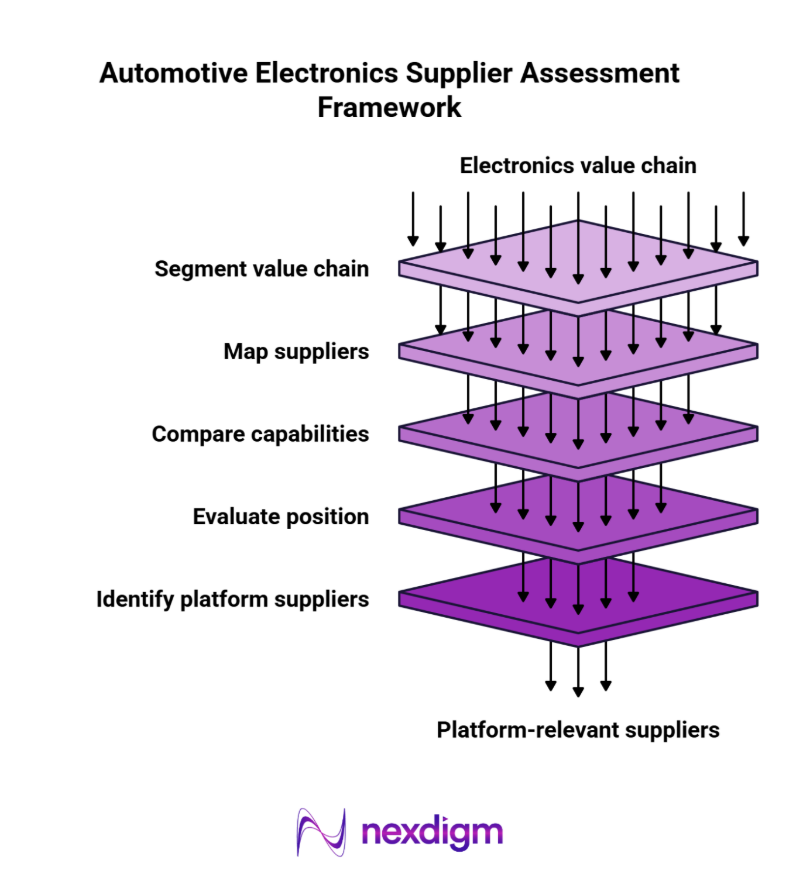
- Segment the Electronics Value Chain: Separate semiconductor devices, ECUs, power electronics, connectivity systems, and integrated vehicle platforms.
- Map Relevant Suppliers: Identify manufacturers and technology providers by product category, geography and automotive application.
- Compare Technology Capabilities: Assess product portfolios, engineering expertise, software capabilities and system integration experience.
- Evaluate Commercial and Manufacturing Position: Examine OEM relationships, manufacturing footprints, investment activity and market presence.
- Identify Platform-Relevant Suppliers: Prioritise businesses whose capabilities align with future vehicle architectures and the manufacturer’s sourcing requirements.
Case Study: Mapping Electronics Suppliers for an EV Platform
An automotive manufacturer evaluating an electric vehicle platform required visibility across power electronics, control systems and connectivity. The assessment mapped 34 suppliers across five product categories, identified 10 businesses for further evaluation, and highlighted three categories with limited domestic supplier depth.
To take the next step, simply visit our Request a Consultation page and share your requirements with us.
Harsh Mittal
+91-8422857704