

Automotive electronics demand is expanding as connected and software-defined vehicles become central to modern mobility. Vehicles now rely on advanced sensors, control units, semiconductors, infotainment systems, connectivity modules, safety electronics, and software-linked hardware to deliver smarter driving experiences.
For suppliers entering this space, a clear market entry strategy is important to assess OEM requirements, technology readiness, certification standards, localization needs, and competitive positioning. A strong automotive electronics supplier entry strategy helps companies identify high-growth product categories, build OEM partnerships, manage supply chain risks, and align with the shift toward intelligent, connected, and digitally controlled vehicle platforms.
Automotive electronics growth is being driven by connected, electric, and software-defined vehicle platforms. The software-defined vehicle market is projected to grow from USD 213.5 billion in 2025 to USD 1,237.6 billion by 2030, at a 34.0% CAGR.
Meanwhile, automotive electronics market estimates indicate growth from USD 428.5 billion in 2026 to USD 828.9 billion by 2035, showing rising demand for sensors, control units, connectivity modules, and in-vehicle computing.
Assessing Technology Readiness for Connected and Software-Defined Vehicle Components
This heading focuses on evaluating whether suppliers have the hardware, software compatibility, testing capabilities, cybersecurity standards, and integration readiness needed to support connected and software-defined vehicle components:
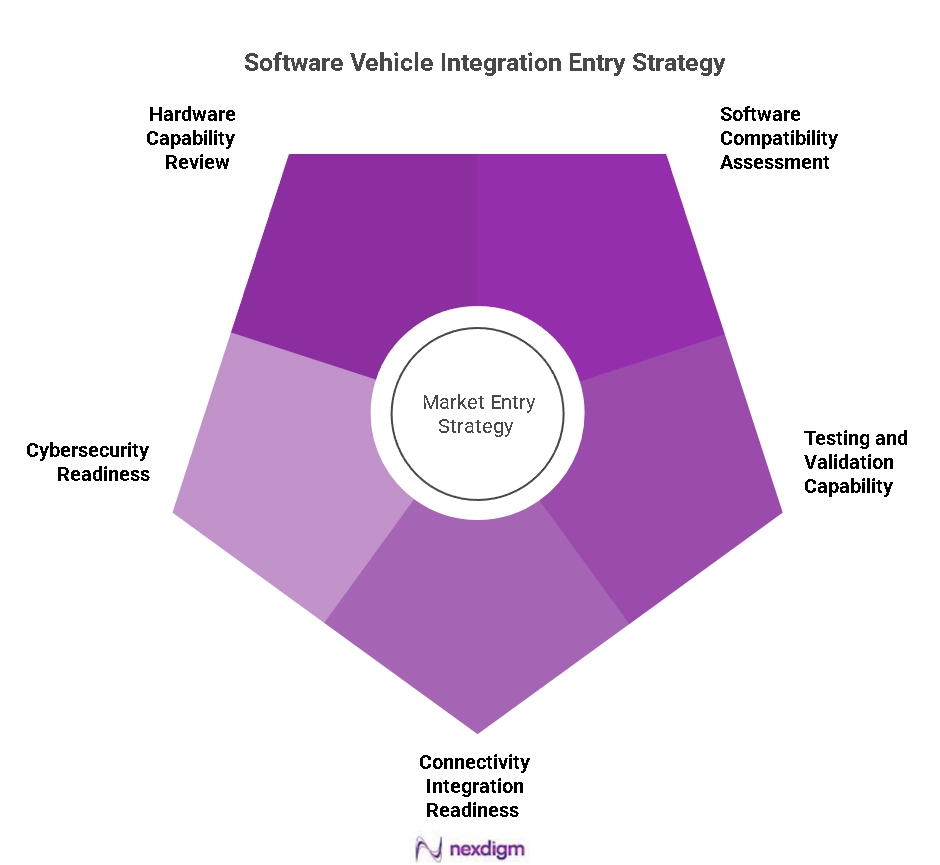
- Hardware Capability Review – Assess sensors, ECUs, connectivity modules, displays, processors, and control systems required for connected vehicle applications.
- Software Compatibility Assessment – Evaluate whether electronics components can support vehicle software platforms, updates, diagnostics, and system-level integration.
- Cybersecurity Readiness – Review encryption, secure communication, access control, threat detection, and compliance with automotive cybersecurity standards.
- Testing and Validation Capability – Assess simulation, functional testing, durability checks, safety validation, and interoperability testing for automotive electronics components.
- Connectivity Integration Readiness – Evaluate compatibility with 5G, Bluetooth, Wi-Fi, GPS, V2X, telematics, and cloud-connected vehicle systems.
Nexdigm’s Support in Identifying Electronics Opportunities Across Software-Defined Vehicle Platforms
Nexdigm’s Support in Identifying Electronics Opportunities Across Software-Defined Vehicle Platforms helps suppliers understand where demand is rising across sensors, ECUs, semiconductors, connectivity modules, infotainment, ADAS, and in-vehicle computing. Nexdigm can assess OEM technology roadmaps, platform requirements, supplier gaps, localization needs, and competitive positioning to help companies prioritize high-value electronics opportunities in software-defined vehicles.
How Nexdigm Helps Electronics Suppliers Find the Right Opportunities in Software-Defined Vehicles?
Nexdigm helps electronics suppliers identify opportunities in software-defined vehicles by assessing OEM needs, technology trends, product demand, supplier gaps, competition, localization scope, and market entry potential.
- OEM Technology Need Assessment – Nexdigm reviews OEM requirements for sensors, ECUs, connectivity modules, infotainment, ADAS, and in-vehicle computing systems.
- High-Growth Product Mapping – Nexdigm identifies fast-growing electronics categories linked to software-defined vehicles, connected mobility, automation, safety, and digital experiences.
- Supplier Gap Analysis – Nexdigm assesses gaps in local supplier availability, technical capability, certification readiness, production capacity, and OEM alignment.
- Competitive Landscape Review – Nexdigm benchmarks existing automotive electronics players, pricing models, product portfolios, partnerships, and market positioning.
- Technology Readiness Evaluation – Nexdigm reviews hardware quality, software compatibility, cybersecurity readiness, testing capability, and integration fit with vehicle platforms.
Nexdigm’s case:
Recently, Nexdigm has been involved with an automotive electronics supplier to identify opportunities across software-defined vehicle platforms. Nexdigm assessed 50+ OEM and Tier-1 programs, mapped demand across sensors, ECUs, connectivity modules, ADAS, and infotainment systems, and benchmarked 75+ competing suppliers. The study helped the company shortlist 4 high-growth product categories, identify 20 potential OEM/Tier-1 partners, and build a phased entry roadmap targeting connected and software-defined vehicle demand.
To take the next step, simply visit our Request a Consultation page and share your requirements with us.
Harsh Mittal
+91-8422857704