

Forged components are use across several safety-critical and load-bearing automotive applications, including crankshafts, connecting rods, axle components, steering parts, transmission elements and suspension systems. The process can deliver high strength and fatigue resistance, making forging an important manufacturing capability for passenger vehicles, commercial vehicles, two-wheelers and off-highway equipment.
The supplier landscape is diverse. Large integrated manufacturers serve global OEM programmes, while specialised forging companies focus on particular materials, component families or production processes. Identifying the right supplier requires an assessment of manufacturing scale, technical capability, quality systems, cost structure and the ability to support long-term production requirements.
Where Forging Fits in Automotive Manufacturing
Forging shapes metal through compressive forces, often improving the grain flow and mechanical properties of the finished component. The choice of process depends on the material, component geometry, dimensional requirements and production volume.
Major process categories include:
- Closed-die forging: Uses shaped dies to produce components with defined geometries and is common in high-volume automotive manufacturing.
- Open-die forging: Shapes metal between dies without fully enclosing the workpiece, supporting larger or less standardised components.
- Hot forging: Forms metal at elevated temperatures, improving workability and supporting complex shapes.
- Warm forging: Operates between hot and cold forging temperatures, balancing formability, and dimensional control.
- Cold forging: Forms metal at or near room temperature and can deliver high dimensional accuracy and surface finish for suitable components.
The process selected influences tooling costs, production rates, material utilisation, finishing requirements and the range of components a supplier can manufacture.
Automotive Forging Supplier Landscape
The global automotive forging ecosystem includes large manufacturers and specialist companies with different regional strengths. Suppliers such as Bharat Forge, Ramkrishna Forgings, CIE Automotive, AAM and other forging-focused manufacturers participate in different segments of the automotive and industrial markets. Their capabilities should be compared at the level of component families, materials, processes and production locations.
A supplier profile should capture:
- Forging processes and press or hammer capacity.
- Materials processed, including carbon steel, alloy steel and aluminium where applicable.
- Component weight and dimensional range.
- Heat treatment and machining capabilities.
- Tooling design and process engineering resources.
- Plant locations and production capacity.
- Customer relationships and end-market exposure.
Scale is relevant, but it is not a universal measure of suitability. A large manufacturer may be well positioned for high-volume crankshaft or axle programmes, while a specialist supplier may offer stronger technical fit for a particular steering or transmission component.
Comparing Technical Strength and Quality
Forging performance depends on material selection, billet preparation, heating control, deformation, die design, cooling, and subsequent heat treatment. Variations in these stages can influence grain structure, mechanical strength, and component durability.
Automotive buyers should examine:
- Material chemistry and traceability.
- Forging process control and repeatability.
- Die design, tool life and maintenance.
- Heat-treatment consistency.
- Dimensional accuracy and machining allowance.
- Mechanical testing and metallurgical inspection.
- Defect prevention and corrective action systems.
Quality assessment should be tied to the component’s application. A forged steering or suspension component may require different testing and process controls from a less safety-critical transmission part. The supplier’s ability to maintain consistency across production batches is therefore as important as its nominal process capability.
Cost and Manufacturing Capacity
Forging cost is shaped by steel or alloy prices, material utilisation, energy consumption, tooling, labour, production cycle time, heat treatment and machining. The component’s weight and complexity also influence material requirements and process economics.
A sourcing comparison should consider:
- Raw material grade and procurement exposure.
- Material yield, flash generation, and scrap recovery.
- Tooling investment and amortisation.
- Press capacity, cycle time, and production productivity.
- Heat treatment and machining costs.
- Energy and labour economics.
- Freight, packaging, and delivery requirements.
Capacity should be assessed at the facility level. A supplier’s total annual forging output may cover multiple industries and component categories, making it a poor indicator of capacity available for a specific automotive programme. Procurement teams should examine equipment configuration, current product mix, utilisation and expansion plans.
How Electrification Is Changing Forging Demand
Electrification is changing the mix of automotive components, but it does not eliminate the need for forged parts. Electric vehicles still require structural, steering, suspension, braking, and transmission-related components. Some traditional engine and transmission applications may decline over time, while demand for other component categories remains linked to overall vehicle production and platform design.
Suppliers are therefore managing a transition across product portfolios. Manufacturers with flexible equipment, materials expertise and the ability to serve multiple vehicle categories may be better positioned to adapt. Investment in automation, digital process monitoring, simulation, and energy efficiency can also influence long-term competitiveness.
Nexdigm’s automotive forging supplier landscape assessment can help automakers and component manufacturers map forging suppliers by process capability, material expertise, manufacturing footprint, capacity indicators and customer exposure. This market intelligence supports supplier discovery and comparison without treating total company scale as a substitute for component-level technical fit.
Automotive Forging Supplier Assessment Framework
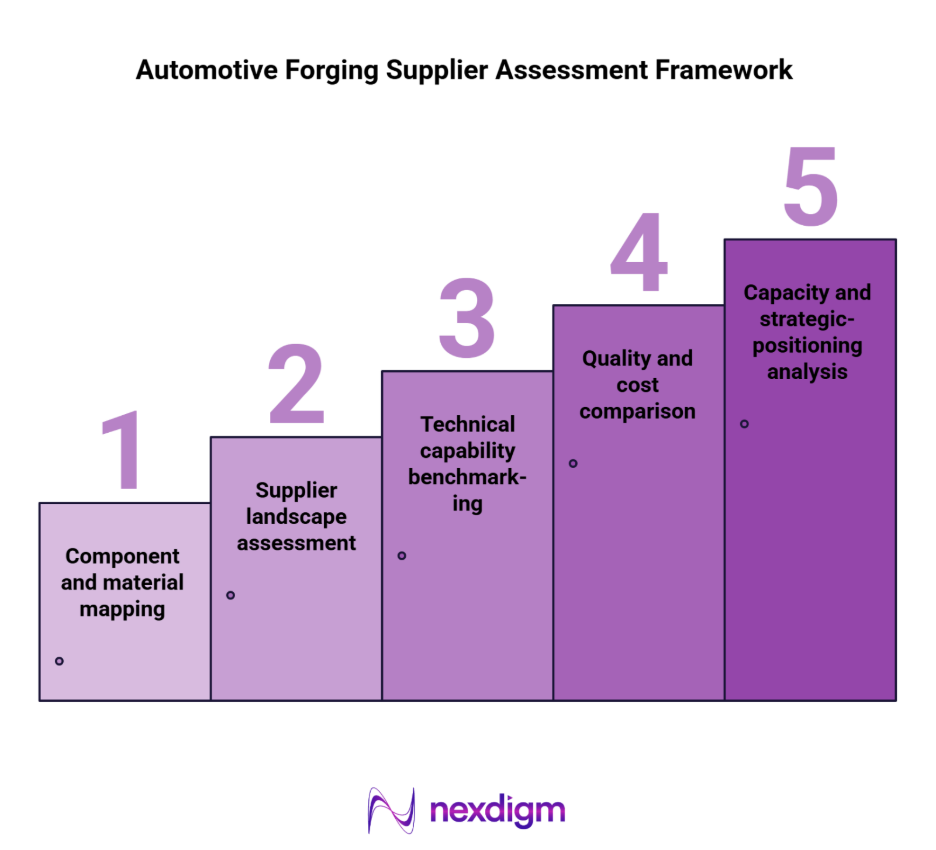
- Component and material mapping: Define component specifications, material grades, mechanical requirements, annual volumes and production processes.
- Supplier landscape assessment: Identify global and regional forging manufacturers by product range, plant locations, customer segments and manufacturing scale.
- Technical capability benchmarking: Compare forging processes, equipment range, tooling expertise, heat treatment, machining and testing capabilities.
- Quality and cost comparison: Assess material traceability, process consistency, defect controls, material yield, tooling economics and production costs.
- Capacity and strategic-positioning analysis: Examine facility-level capacity, utilisation, investment plans, geographic exposure and ability to support future vehicle programmes.
Case Study: Benchmarking Automotive Forging Suppliers
A commercial vehicle manufacturer reviewing forged axle and suspension components needed to understand regional supplier capabilities. Nexdigm’s research mapped 26 manufacturers across five markets, compared their process and material capabilities, and identified eight suppliers for further review based on component fit, manufacturing footprint and available capacity indicators.
To take the next step, simply visit our Request a Consultation page and share your requirements with us.
Harsh Mittal
+91-8422857704