

Automotive trade spans finished vehicles, engines, electrical equipment, body parts, transmissions, braking systems, and thousands of other components. In 2025, global vehicle production reached 96.4 million units, up 3.9% from 2024, with Asia accounting for more than 61% of global output. China alone produced 34.5 million vehicles, while India reached approximately 6.5 million.
At the trade-policy level, motor vehicles and their parts and accessories under HS Chapter 87 represented 17.7% of the trade covered by new import-related measures tracked by the WTO through November 2025. These developments highlight why automotive HS code analysis can provide a structured way to examine product flows, suppliers, buyers, and competitive movements across automotive markets.
Why HS Codes Matter in Automotive Trade
HS codes provide a standardized classification for tracking specific automotive products across international markets. Instead of analyzing the automotive sector as one broad category, businesses can examine individual product groups such as passenger vehicles, commercial vehicles, engines, transmissions, electrical components, and parts. This product-level view helps identify which categories are growing, where imports are concentrated, which countries are becoming important suppliers, and how competitive relationships are changing.
What Product-Level Trade Data Can Reveal
HS-code-based analysis becomes more useful when product movements are compared across markets and time.
- Product Demand: Rising imports of a specific component can indicate growing vehicle production, aftermarket requirements, or new manufacturing activity.
- Competitive Shifts: Changes in supplier shares, import origins, and export destinations can reveal companies or countries gaining or losing their market position.
Together, these signals help businesses move beyond headline automotive trade values and identify specific products, markets, suppliers, and competitive opportunities.
How Nexdigm Interprets Automotive Trade Patterns
Understanding automotive trade at the HS-code level requires more than tracking import and export volumes. Nexdigm helps businesses interpret product-level trade movements within the context of manufacturing trends, supplier networks, competitive dynamics, and market demand. This enables organizations to identify growth opportunities, assess competitive positioning, and make more informed sourcing, investment, and expansion decisions.
Nexdigm’s Automotive Trade Intelligence Framework
An effective automotive HS code analysis requires more than tracking product movements across borders. Nexdigm’s framework integrates trade intelligence, market dynamics, supplier activity, and competitive insights to help businesses with:
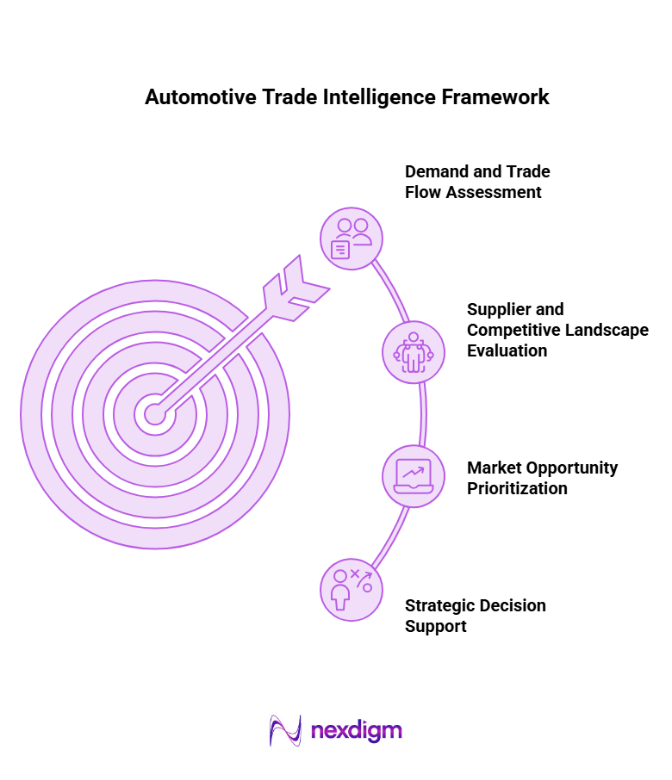
- Demand and Trade Flow Assessment: Analysis of automotive HS code analysis data to identify high-growth products, changing demand patterns, and emerging trade corridors.
- Supplier and Competitive Landscape Evaluation: Assessment of supplier concentration, sourcing dependencies, market shares, and competitive shifts across vehicle and component categories.
- Market Opportunity Prioritization: Comparison of markets based on import demand, trade activity, competitive intensity, and growth potential to identify attractive expansion opportunities.
- Strategic Decision Support: Translation of complex trade datasets into actionable recommendations for sourcing, diversification, investment, market entry, and supply chain optimization.
This framework helps businesses transform automotive HS code analysis into practical intelligence for informed commercial and strategic decision-making.
How Nexdigm’s Automotive Trade Intelligence Supports Strategic Decision-Making
Nexdigm’s framework goes beyond automotive HS code analysis by connecting product-level trade data with commercial, operational, and market realities. This helps businesses translate trade movements into strategic actions through:
- Product Portfolio Prioritization: Identify which vehicle and component categories are gaining traction across markets to align product offerings with evolving demand.
- Emerging Trade Corridor Identification: Track growing import-export routes to uncover new markets, distribution opportunities, and regional growth pathways.
- Value Chain Opportunity Mapping: Assess where activity is increasing across vehicles, components, and aftermarket products to identify opportunities for partnerships, localization, or expansion.
- Supply Network Optimization: Understand how sourcing and production networks are evolving across countries to improve efficiency and strengthen operational agility.
- Regulatory and Market Access Insights: Evaluate how tariffs, trade agreements, and market conditions may influence product competitiveness and cross-border business opportunities.
By combining automotive HS code analysis with broader industry intelligence, Nexdigm helps businesses uncover opportunities, anticipate market shifts, and make more confident strategic decisions.
Nexdigm’s Case
Nexdigm supported an automotive-sector client by analyzing trade activity across more than 20 HS code categories and 11 international markets. The assessment identified over 30% growth in selected component categories, while four supplier markets increased their share of target imports by more than 10 percentage points. The analysis helped the client identify priority product categories, alternative sourcing markets, and competitive shifts.
To take the next step, simply visit our Request a Consultation page and share your requirements with us.
Harsh Mittal
+91-8422857704