

Automotive investment strategies are increasingly shifting toward electric vehicles, software platforms, and connected mobility ecosystems as the industry moves beyond traditional vehicle manufacturing. Companies are investing in battery technology, charging infrastructure, digital features, connected services, and mobility solutions to meet changing customer expectations and regulatory demands.
An effective Automotive investment market entry strategy helps businesses identify attractive markets, assess technology readiness, evaluate partnerships, and reduce investment risks. By aligning capital allocation with EV adoption, software-driven revenue models, and connected mobility trends, automotive companies can strengthen competitiveness, enter high-growth segments, and build long-term value in evolving mobility markets.
Global electric car sales exceeded 17 million units in 2024 and are expected to surpass 20 million units in 2025. The software-defined vehicle market is estimated at about USD 315 billion in 2025, while the connected car market is projected to grow from USD 12.4 billion in 2024 to USD 26.4 billion by 2030, reflecting rising investment in digital mobility ecosystems.
Customer Adoption Analysis for EVs and Connected Vehicle Services
Customer Adoption Analysis for EVs and Connected Vehicle Services evaluates buyer readiness, charging access, digital feature demand, affordability, usage behavior, and trust levels to support successful market entry.
- EV Buyer Readiness: Assesses customer awareness, purchase interest, affordability, and willingness to shift from fuel vehicles to electric mobility.
- Charging Access Assessment: Evaluates home, workplace, and public charging availability to understand customer confidence in EV ownership.
- Connected Feature Demand: Studies interest in navigation, remote diagnostics, safety alerts, infotainment, app control, and over-the-air updates.
- Usage Behavior Analysis: Reviews driving distance, charging habits, commute patterns, and digital service use to estimate adoption potential.
- Affordability and Ownership Cost: Compares EV price, charging cost, maintenance, insurance, incentives, and resale value with conventional vehicles.
Nexdigm Software-Defined Vehicle Market Support for Investment Decisions
Nexdigm Software-Defined Vehicle Market Assessment for Investment Decisions helps automotive companies evaluate opportunities in software-led mobility, connected platforms, digital vehicle features, and subscription-based services.
It analyzes market demand, customer adoption, competitor capabilities, regulatory factors, technology readiness, and partnership opportunities. These insights support informed investment planning, reduce entry risks, and improve positioning in software-driven automotive ecosystems.
Nexdigm EV Market Feasibility Assessment for Strategic Automotive Investments
Nexdigm EV Market Feasibility Assessment for Strategic Automotive Investments evaluates EV demand, charging infrastructure, customer readiness, regulations, competition, incentives, and investment risks to support informed market entry decisions:
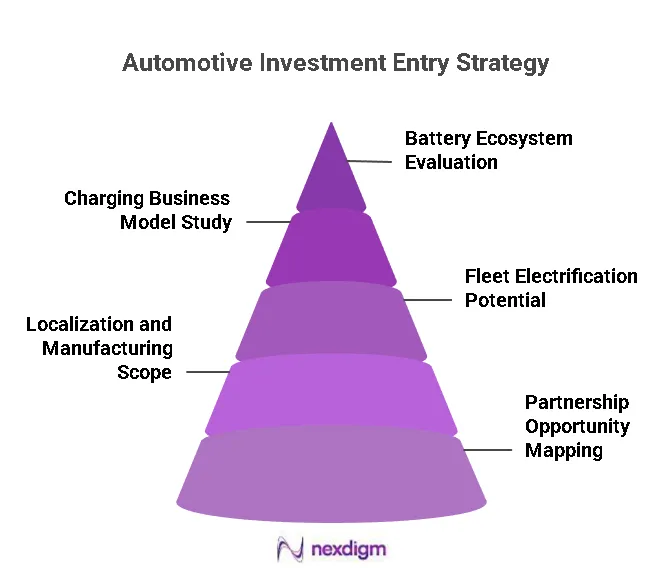
- Battery Ecosystem Evaluation: Nexdigm assesses battery sourcing, localization potential, supplier availability, recycling options, and cost impact on EV investment feasibility.
- Charging Business Model Study: Nexdigm reviews fast charging, home charging, fleet charging, and subscription models to identify viable infrastructure opportunities.
- Fleet Electrification Potential: Nexdigm analyzes demand from logistics, ride-hailing, corporate fleets, and public transport for scalable EV investment opportunities.
- Localization and Manufacturing Scope: Nexdigm evaluates local assembly, component sourcing, production costs, and policy benefits to improve investment viability.
- Partnership Opportunity Mapping: Nexdigm identifies battery partners, charging operators, technology providers, dealers, and fleet customers for EV market entry.
Nexdigm’s case:
Nexdigm helped a global automotive investor assess EV market feasibility before entering India. The team evaluated 10 target cities, benchmarked 18 EV models, reviewed 120 charging locations, and analyzed 2,500 potential customer responses. Findings showed that 64% of urban buyers were open to EV adoption if charging access improved and ownership costs were 15–20% lower than fuel vehicles. Nexdigm’s recommendations helped the company refine its investment plan, prioritize launch cities, and identify charging partnership opportunities.
To take the next step, simply visit our Request a Consultation page and share your requirements with us.
Harsh Mittal
+91-8422857704