

The automotive industry relies on highly coordinated global supply chains to manage millions of parts, components, and finished vehicles efficiently. Optimizing these networks is critical to ensure production continuity, reduce costs, and maintain delivery schedules. Leveraging automotive logistics analysis provides essential competitive intelligence, enabling manufacturers to benchmark performance, track rivals’ supply chain strategies, evaluate operational efficiency, and identify process improvement opportunities.
By analyzing inventory flows, transport systems, and supplier performance, companies can make data-driven decisions that strengthen their competitive position in the global automotive production landscape.
In 2025, the global automotive logistics market was valued at roughly USD 230–315 billion, depending on estimates, reflecting the scale of operations needed to support production and distribution of millions of vehicles and parts worldwide. The market is projected to grow to USD 365-496 billion by the early 2030s, driven by rising vehicle production, electric vehicle demand, and complex supply chains spanning inbound parts and finished vehicle distribution.
These trends underscore the importance of automotive logistics analysis in benchmarking performance and strategic planning.
Competitive Intelligence on the Strategic Role of Automotive Logistics
Competitive Intelligence on the Strategic Role of Automotive Logistics involves analyzing rival supply chain strategies, benchmarking operational efficiency, and identifying best practices to optimize global production networks and maintain a competitive edge.
- Global Supply Chain Overview – Analyze competitor network structures, production hubs, and logistics footprints to identify strategic strengths and operational efficiencies.
- Inbound Parts Logistics Analysis – Evaluate supplier coordination, lead times, and inventory management practices across rivals to benchmark best-in-class efficiency.
- Outbound Vehicle Distribution Evaluation – Assess delivery performance, dealer network coverage, and route optimization to understand competitor distribution effectiveness.
- Technology Adoption in Logistics – Monitor AI, IoT, and digital tools competitors use to enhance visibility, predictive planning, and operational performance.
- Operational Cost and Efficiency Benchmarking – Compare costs, utilization rates, and workflow efficiencies to identify gaps and improvement opportunities versus industry peers.
Nexdigm Advisory for Strategic Automotive Logistics Planning
Nexdigm Advisory for Strategic Automotive Logistics Planning helps automotive manufacturers design scalable and resilient global supply chains. By analyzing production networks, inbound parts management, and outbound vehicle distribution, Nexdigm identifies efficiency gaps, reduces costs, and improves delivery reliability. Their advisory includes benchmarking against competitors, optimizing logistics workflows, and implementing strategic planning solutions to ensure seamless operations across complex, high-volume automotive production networks.
Nexdigm Strategic Planning for Global Network Expansion for Automotive Logistics
Nexdigm Strategic Planning for Global Network Expansion in Automotive Logistics guides manufacturers in scaling production and distribution networks, optimizing routes, enhancing supplier collaboration, and ensuring efficient, resilient, and competitive global operations:
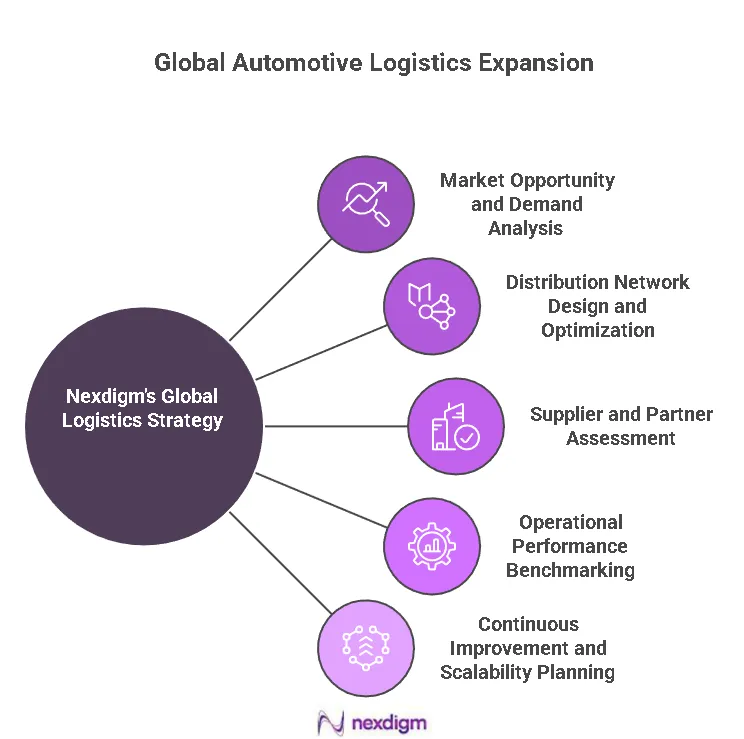
- Market Opportunity and Demand Analysis – Evaluate regional production needs, vehicle demand, and competitor networks to prioritize global logistics expansion opportunities.
- Distribution Network Design and Optimization – Plan strategic warehouse locations, transport hubs, and supply routes to enhance efficiency, scalability, and reliability across markets.
- Supplier and Partner Assessment – Evaluate vendor capabilities, reliability, and compliance to strengthen collaboration and ensure consistent parts and vehicle flow.
- Operational Performance Benchmarking – Define KPIs and track metrics such as delivery times, utilization, and cost efficiency across global networks.
- Continuous Improvement and Scalability Planning – Use insights, analytics, and benchmarking to refine networks, expand capacity, and support long-term growth.
Nexdigm’s case:
Recently, Nexdigm partnered with a multinational automotive OEM to assess its global parts distribution and vehicle outbound logistics. Through competitive benchmarking and logistics network redesign, Nexdigm helped the client reduce average transit times by 18 %, lower transportation costs by 12 %, and improve on‑time delivery performance to dealers by 22 %. The engagement included implementation of analytics dashboards and route optimisation recommendations, strengthening the client’s competitive positioning across key production regions.
To take the next step, simply visit our Request a Consultation page and share your requirements with us.
Harsh Mittal
+91-8422857704