

Automotive logistics is changing as vehicle production expands across new regions, supply chains become more global, and EVs introduce new component and distribution requirements.
Global vehicle production reached 96.4 million units in 2025, up 3.9% from 2024, according to the International Organization of Motor Vehicle Manufacturers (OICA). Asia-Pacific accounted for approximately 59.2 million vehicles, more than 61% of global output. China alone produced 34.53 million vehicles, while India reached 6.49 million.
The composition of vehicles is changing alongside production. McKinsey expects EV and advanced-electronics components to account for 36% of the light-vehicle component market by 2030, compared with 11% previously.
These shifts are moving logistics value across the automotive chain—from supplier parks and ports to assembly plants, regional distribution centers, finished-vehicle yards, dealerships, and aftermarket networks.
For OEMs, Tier 1 and Tier 2 suppliers, logistics providers, 3PLs, component manufacturers, dealers, investors, industrial developers, and mobility companies, an Automotive logistics market study can identify where logistics demand is growing and where new infrastructure, services, or network models can create value.
Automotive Logistics Is Moving Closer to the Product
Traditional automotive logistics has centered heavily on moving components efficiently into assembly plants. That remains important, but the network is becoming more distributed.
EV components, electronics, batteries, software-enabled vehicles, global sourcing, regional manufacturing, and changing consumer channels are creating new logistics requirements.
The value shift can therefore occur at multiple points: supplier consolidation, inbound transportation, sequencing, customs, plant-side logistics, finished-vehicle distribution, dealer delivery, and aftermarket parts.
Understanding these shifts requires looking at the entire vehicle journey rather than one logistics stage.
How Nexdigm Maps the Value Across the Chain
Automotive logistics opportunity is determined by more than vehicle production volumes.
A high-production region may already have mature logistics infrastructure, while a smaller but rapidly growing EV or component cluster may require new warehouses, specialized transportation, battery handling, or supplier parks.
Nexdigm connects vehicle production, component sourcing, supplier concentration, trade flows, manufacturing locations, dealership networks, infrastructure, and logistics costs to identify where value is moving.
This helps businesses distinguish established logistics activity from emerging opportunities.
The Logistics Shift Starts With Supply
Automotive supply chains involve thousands of components moving through interconnected supplier networks before reaching assembly facilities. DHL describes the sector as highly time-sensitive, with engines, chips, braking components, and interior systems converging around tightly controlled production schedules.
This makes supplier proximity, consolidation, sequencing, inventory visibility, and reliable inbound transportation increasingly important.
At the same time, manufacturers are balancing lean production with greater resilience as global sourcing and trade conditions become more complex.
Nexdigm in Assessing the Logistics Shift
As automotive supply chains evolve, logistics value is no longer concentrated solely around assembly plants. To understand where the strongest opportunities are emerging, Nexdigm evaluates the interconnected factors influencing logistics infrastructure, service requirements, and network development:
- Supplier Ecosystem Dynamics: Assesses supplier concentration, sourcing patterns, and inbound logistics requirements to understand how component flows influence future logistics demand.
- Manufacturing Transformation: Evaluates the impact of production expansion, EV adoption, and flexible manufacturing models on logistics operations surrounding assembly facilities.
- Aftermarket Requirements: Analyzes replacement parts demand, service network growth, and EV-specific requirements that are expanding logistics needs beyond vehicle production.
By assessing these interconnected drivers, Nexdigm develops a holistic view and provides the foundation for identifying high-potential opportunities through Nexdigm’s Automotive Logistics Framework.
Nexdigm’s Automotive Logistics Assessment Framework
Nexdigm’s experts conduct Automotive logistics market study which evaluates five major assessment areas to show where logistics requirements are expanding and which parts of the automotive value chain may offer the strongest commercial opportunity. These areas are:
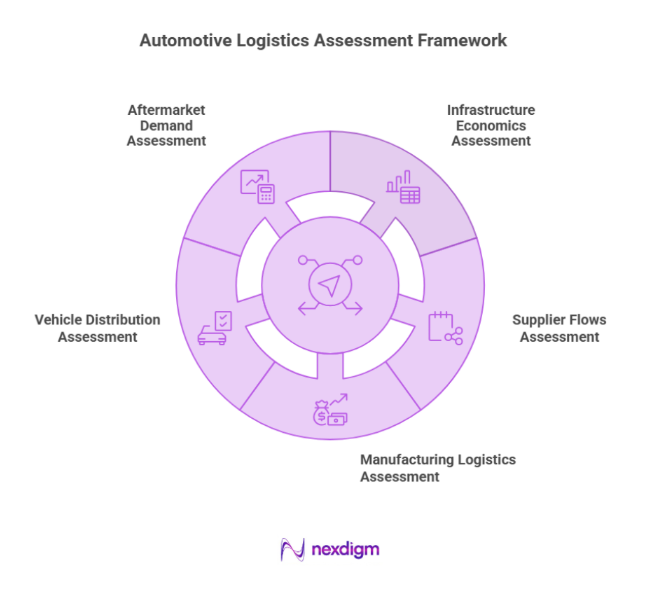
- Supplier Flows Assessment: Evaluates supplier networks, sourcing strategies, inventory positioning, and inbound material flows to understand how component movement influences logistics demand and operational requirements.
- Manufacturing Logistics Assessment: Assesses logistics activities supporting vehicle production, including sequencing, material handling, plant-side operations, and evolving requirements associated with advanced manufacturing and EV production.
- Vehicle Distribution Assessment: Analyzes the movement of finished vehicles across ports, yards, distribution centers, transportation networks, and dealerships to identify distribution requirements and growth opportunities.
- Aftermarket Demand Assessment: Evaluates replacement parts demand, service network requirements, and inventory distribution needs that support vehicle maintenance and long-term aftermarket operations.
- Infrastructure Economics Assessment: Assesses the availability, cost, scalability, and investment viability of logistics infrastructure required to support automotive supply chains and future market expansion.
Together, these assessment areas enable Nexdigm to identify where logistics value is shifting across the automotive ecosystem and which areas of the value chain present the strongest opportunities for investment, capability development, and sustainable growth.
Nexdigm’s Case
An automotive supplier used Nexdigm’s Automotive logistics market study to identify supplier-network gaps and improve distribution planning. Within 11 months, inbound logistics efficiency increased 24%, component delivery reliability improved 22%, inventory costs declined and vehicle distribution cycle times fell 19%, supporting stronger operational performance and scalable growth.
To take the next step, simply visit our Request a Consultation page and share your requirements with us.
Harsh Mittal
+91-8422857704