

Machined components sit across critical automotive assemblies, from engine and transmission systems to steering, braking, suspension and electric powertrain applications. Their performance depends on dimensional accuracy, surface finish, material integrity and consistency across production batches. For automakers, identifying a machining vendor is therefore a question of matching manufacturing capability to component specifications, programme volumes and delivery expectations.
The supplier landscape includes large integrated component manufacturers, specialist precision engineering firms and regional machine shops. Their equipment may appear comparable on paper, but differences in process control, inspection infrastructure, production planning and engineering support can significantly affect their suitability for automotive programmes.
What Makes an Automotive Machining Vendor Suitable?
Automotive machining covers several processes, including CNC turning, milling, grinding, drilling, boring, honing and specialised finishing. The relevant combination depends on the component’s geometry, material and functional requirements.
Supplier evaluation should begin with the technical specification:
- Dimensional tolerances: Assess the vendor’s ability to maintain required tolerances across the complete production run, not just sample components.
- Surface finish: Determine whether the supplier can achieve the required finish through its existing processes or needs additional operations.
- Material capability: Check experience with cast iron, aluminium alloys, steel, stainless steel and other specified materials.
- Component complexity: Examine multi-axis machining, precision boring, deep-hole drilling and the ability to machine complex geometries.
- Inspection infrastructure: Review coordinate measuring machines, gauges, surface measurement systems and in-process inspection capabilities.
A supplier’s machine inventory is only one part of the assessment. Equipment condition, programming expertise, tooling strategy and operator experience determine how consistently those machines perform.
Comparing Precision, Capacity and Production Readiness
Capacity assessment should move beyond the number of CNC machines installed at a facility. A plant may have substantial equipment but limited available capacity because of existing customer commitments, maintenance requirements or bottlenecks in secondary operations.
Procurement teams should examine:
- Number and type of machining centres, including horizontal, vertical and multi-axis equipment.
- Current utilisation and available production hours.
- Shift patterns, workforce availability and operator skill levels.
- Tooling availability, changeover time and maintenance practices.
- Capacity for secondary processes such as grinding, heat treatment and finishing.
- Expansion plans and the investment required to support additional volumes.
Production readiness also depends on how efficiently a supplier can transition from prototype or pilot quantities to serial manufacturing. A vendor may demonstrate excellent sample quality but struggle to maintain the same output and process consistency at higher volumes.
Cost and Delivery: What Should Buyers Compare?
Machining costs are influenced by cycle time, material removal, tooling consumption, labour, machine depreciation, energy and scrap. A lower hourly machine rate does not necessarily result in a lower component cost. Longer cycle times, additional finishing operations or higher rejection rates can offset apparent savings.
A commercial comparison should account for:
- Raw material and blank costs.
- Machining cycle time and machine-hour rates.
- Tooling, fixtures and setup expenses.
- Secondary operations and inspection costs.
- Scrap, rework and rejection assumptions.
- Packaging, freight and delivery schedules.
Delivery reliability should be evaluated alongside cost. Suppliers located near OEM or Tier 1 manufacturing facilities may offer shorter logistics cycles, while geographically distant vendors may have advantages in labour economics or specialised capabilities. The appropriate comparison depends on the programme’s delivery model and inventory requirements.
Mapping the Automotive Machining Supplier Base
India’s machining ecosystem includes manufacturers such as Craftsman Automation, Sansera Engineering, Bharat Forge, CIE Automotive India, Aequs and specialist precision-engineering companies. Their portfolios span different component categories, manufacturing processes and customer segments. A company with a strong position in forged and machined components, for example, should be assessed differently from a specialist producing precision housings or engine components.
This is where automotive machining vendor analysis becomes useful. It can connect supplier capabilities with regional manufacturing presence, customer relationships, equipment profiles and end-market exposure. It also helps distinguish between vendors that have relevant equipment and those with demonstrated experience in comparable automotive applications.
Nexdigm’s procurement research can support supplier identification, facility and capability profiling, regional comparisons and analysis of manufacturing capacity indicators. This gives procurement teams a clearer view of the potential supplier base before technical qualification and commercial discussions.
Automotive Machining Vendor Evaluation Framework
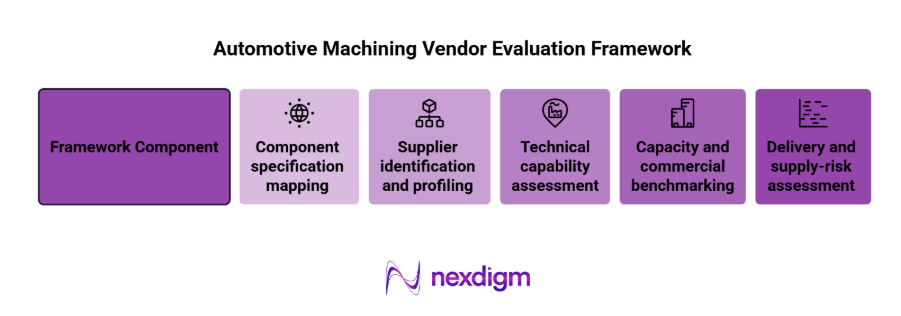
- Component specification mapping: Define material, geometry, tolerance, surface finish, annual volume and secondary-process requirements.
- Supplier identification and profiling: Map machining vendors by product category, equipment, location, customer base and manufacturing specialisation.
- Technical capability assessment: Compare machining processes, precision range, tooling expertise, inspection systems and relevant automotive experience.
- Capacity and commercial benchmarking: Evaluate machine availability, utilisation indicators, cycle times, tooling economics, labour costs and logistics.
- Delivery and supply-risk assessment: Examine plant location, production flexibility, customer concentration, critical process dependencies and alternative suppliers.
Case Study: Assessing Precision Machining Vendors
A component manufacturer evaluating suppliers for transmission housings needed to compare precision capability and production scale. Nexdigm’s research mapped 23 machining vendors across four regions, reviewed equipment profiles and manufacturing footprints, and identified six suppliers for further technical assessment based on relevant process capabilities and capacity indicators.
To take the next step, simply visit our Request a Consultation page and share your requirements with us.
Harsh Mittal
+91-8422857704