

Automotive manufacturing is expanding unevenly across regions as companies balance production capacity, investment, supplier ecosystems, and changing vehicle demand. Global vehicle production reached 96.4 million units in 2025, up 3.9% from 2024. Asia accounted for about 59.2 million vehicles, or more than 61% of global output, while India’s production reached 6.49 million units, up from 6.02 million in 2024.
EV manufacturing is adding another layer of change: nearly 22 million electric cars were produced globally in 2025, more than 25% above 2024. These shifts make automotive manufacturing market intelligence important for understanding where capacity is developing, which suppliers are following investment, and where demand can support future production.
Manufacturing Growth Is Becoming More Regional
Automotive production is increasingly influenced by regional demand, local-content policies, technology transitions, and supply-chain resilience. India, Southeast Asia, Türkiye, Mexico, and other emerging manufacturing locations are attracting new capacity, while established markets continue to adapt their production footprints. For manufacturers and suppliers, understanding these changes helps reveal where production ecosystems are strengthening and where new investment opportunities may emerge.
What Manufacturing Signals Can Reveal
Production data becomes more commercially useful when connected with investment and demand indicators.
- Capacity Expansion: New plants, production-line additions, and capacity upgrades can signal where manufacturers expect future demand to strengthen.
- Supplier Ecosystem Growth: New component facilities, supplier investments, and localization initiatives can indicate where automotive manufacturing clusters are becoming more competitive.
Together, these signals help businesses identify which markets are building manufacturing strength and where future production opportunities may develop.
Nexdigm’s Approach to Assessing Manufacturing Signals
Manufacturing signals become commercially meaningful when production changes are viewed alongside investment, supplier activity, demand, and market conditions. Nexdigm evaluates these interconnected indicators to help businesses understand where manufacturing strength is developing, what is driving capacity growth, and which markets may offer sustainable opportunities.
Key Manufacturing Signals Nexdigm’s Experts Can Assess
Nexdigm evaluates manufacturing markets through an automotive manufacturing market intelligence to determine the strength and direction of automotive manufacturing activity. These indicators are:
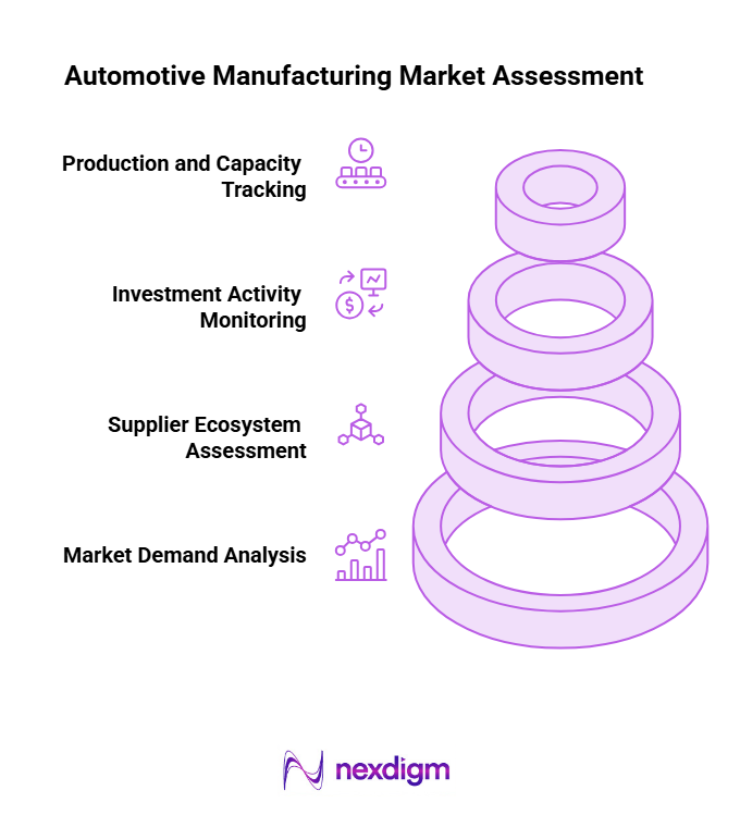
- Production and Capacity: Track vehicle output, installed capacity, utilization, plant locations, and production additions to identify established and emerging manufacturing hubs.
- Investment Activity: Monitor new plants, capacity expansions, technology investments, joint ventures, and announced projects to understand where manufacturers are committing resources.
- Supplier Ecosystem: Assess OEM suppliers, component manufacturers, localization activity, and supporting infrastructure to determine the depth and maturity of manufacturing ecosystems.
- Market Demand: Compare vehicle sales, segment growth, exports, imports, and EV adoption to assess whether local and regional demand can support additional production.
These signals provide the foundation for evaluating manufacturing strength, future capacity, supplier opportunities, and market attractiveness.
How Nexdigm’s Assessment Supports Manufacturing Decisions
Manufacturing intelligence is most valuable when it helps businesses act on market changes. Nexdigm connects production, investment, supplier, and demand signals to support decisions across the automotive manufacturing value chain through:
- Evaluating Manufacturing Locations: Comparing production ecosystems, supplier depth, infrastructure, labor conditions, incentives, and market access to identify suitable locations for new facilities.
- Assessing Expansion Potential: Examining capacity utilization, demand growth, investment activity, and supplier development to determine where additional production could be commercially supported.
- Identifying Supplier Opportunities: Mapping OEM and component-supplier presence to identify localization gaps, partnership opportunities, and markets where supplier ecosystems are expanding.
- Supporting Investment Prioritization: Combining market demand, production growth, competitive activity, and operating conditions to rank manufacturing markets according to their strategic potential.
By connecting these factors, Nexdigm helps businesses move from tracking manufacturing signals to prioritizing locations, investments, capacity expansion, and supplier strategies.
What Differentiates Nexdigm’s Manufacturing Assessment
Manufacturing assessments can vary significantly in their depth and decision focus. Nexdigm’s approach connects production data with the commercial factors that determine whether a manufacturing opportunity is viable. These factors are:
- Integrated Market View: Nexdigm brings together production, investment, suppliers, demand, trade, and competitive signals rather than assessing manufacturing capacity in isolation.
- Decision-Oriented Analysis: The assessment translates market intelligence into practical inputs for location selection, capacity expansion, localization, supplier development, and investment planning.
- Automotive-Specific Context: Manufacturing indicators are evaluated alongside vehicle segments, OEM activity, component ecosystems, EV adoption, and regional trade dynamics to provide greater sector relevance.
- Forward-Looking Assessment: Planned investments, capacity additions, supplier expansion, and demand trends are considered alongside current market conditions to identify emerging opportunities.
This integrated approach helps businesses move beyond “where vehicles are produced” to understand why a manufacturing market is attractive, how sustainable its growth may be, and where future opportunities could emerge.
Nexdigm’s Case
Nexdigm supported an automotive-sector client in evaluating manufacturing opportunities across 10 markets. The assessment found that three priority markets accounted for nearly 42% of regional production, while local supplier participation exceeded 60% in two markets. It also identified locations where planned investments could increase manufacturing capacity by 15%–20%, helping the client prioritize markets for expansion, localization, and supplier development.
To take the next step, simply visit our Request a Consultation page and share your requirements with us.
Harsh Mittal
+91-8422857704