
Automotive manufacturers increasingly depend on materials whose supply chains extend across multiple countries and processing stages. Copper, lithium, nickel, cobalt, graphite and rare earth elements support electric vehicles, battery systems, power electronics, motors and other advanced automotive technologies. Their availability and commercial competitiveness depend on a combination of resource production, refining capacity, trade conditions, and downstream manufacturing infrastructure.
For procurement teams, identifying a country with substantial mineral reserves is only the starting point. The material may be mined in one market, refined in another, and converted into an automotive-grade input elsewhere. A sourcing decision based solely on the location of mineral deposits can therefore overlook the most important supply-chain dependencies.
Critical Materials Have Different Supply Chains
Copper is used extensively in wiring harnesses, electric motors, charging systems and power distribution. Lithium, nickel, cobalt, and graphite are associated particularly with battery manufacturing, although their importance varies according to battery chemistry. Rare earth elements such as neodymium and praseodymium are used in permanent magnets for selected electric motor designs.
These materials have distinct production and processing requirements. Copper supply depends on mining, smelting, and refining. Battery materials require additional conversion into suitable chemicals and intermediate products. Rare earth supply chains involve separation, refining, alloy production, and magnet manufacturing.
Procurement research must therefore examine each material separately. The relevant sourcing markets for refined copper may differ from those for battery-grade lithium chemicals or rare earth magnets.
Where Is Supply Concentrated?
The International Energy Agency’s critical minerals research has repeatedly highlighted concentration in mineral processing and refining. China holds a significant position across several refined material categories, while Indonesia has become an important centre for nickel production and processing. Other markets play major roles in mining specific minerals, including Chile and Australia for lithium and the Democratic Republic of Congo for cobalt.
The distinction between mining and refining is particularly important. A country may have substantial mineral resources but limited domestic processing infrastructure. Automakers’ sourcing from that country may still depend on another market for the conversion of raw material into an industrial-grade input.
A detailed supplier assessment should trace the country of extraction, refining location, intermediate processing facilities and final material manufacturers. It should also distinguish between operating facilities and announced projects, since proposed capacity does not guarantee commercially available supply.
Comparing Markets on Cost, Availability and Risk
The lowest-cost source market may not offer the strongest overall sourcing proposition. Freight, duties, processing requirements, currency movements, and export restrictions can change the economics of a material purchase. A market with established refining infrastructure may offer more immediate supply access than a resource-rich country with limited downstream capacity.
A structured automotive material sourcing intelligence assessment should compare markets through five dimensions:
- Resource availability: Reserves, mine output, production trends, and operating capacity.
- Processing infrastructure: Refining, chemical conversion, alloy production and material-grade availability.
- Commercial competitiveness: Price benchmarks, processing costs, freight, duties and currency exposure.
- Trade and policy conditions: Export restrictions, tariffs, local-content requirements, and bilateral trade arrangements.
- Supply chain connectivity: Ports, transport routes, industrial clusters and proximity to component manufacturers.
These factors help distinguish a market with resource potential from one that can supply automotive-grade materials at commercially viable terms.
Diversification Requires Visibility Beyond the Country of Origin
Supply diversification can be difficult when processing technologies and downstream manufacturing remain concentrated in a limited number of markets. Identifying an alternative mining country does not necessarily reduce dependence if the material still needs to pass through the same refining network.
Automakers should examine alternative processing locations, secondary material supply, and recycling capacity alongside primary mineral production. Recycled materials can contribute to supply availability, although their commercial relevance depends on collection rates, recovery technology, material quality, and processing economics.
The sourcing strategy will differ by material. Copper procurement may prioritise refining access and regional processing capacity. Battery materials require closer attention to chemical conversion and the availability of suitable intermediate products. Rare earth sourcing needs visibility into separation, metal, and magnet manufacturing.
Automotive Critical Material Sourcing Framework
Nexdigm can support procurement research by comparing material supply markets, processing ecosystems, commercial conditions, and geographic dependencies.
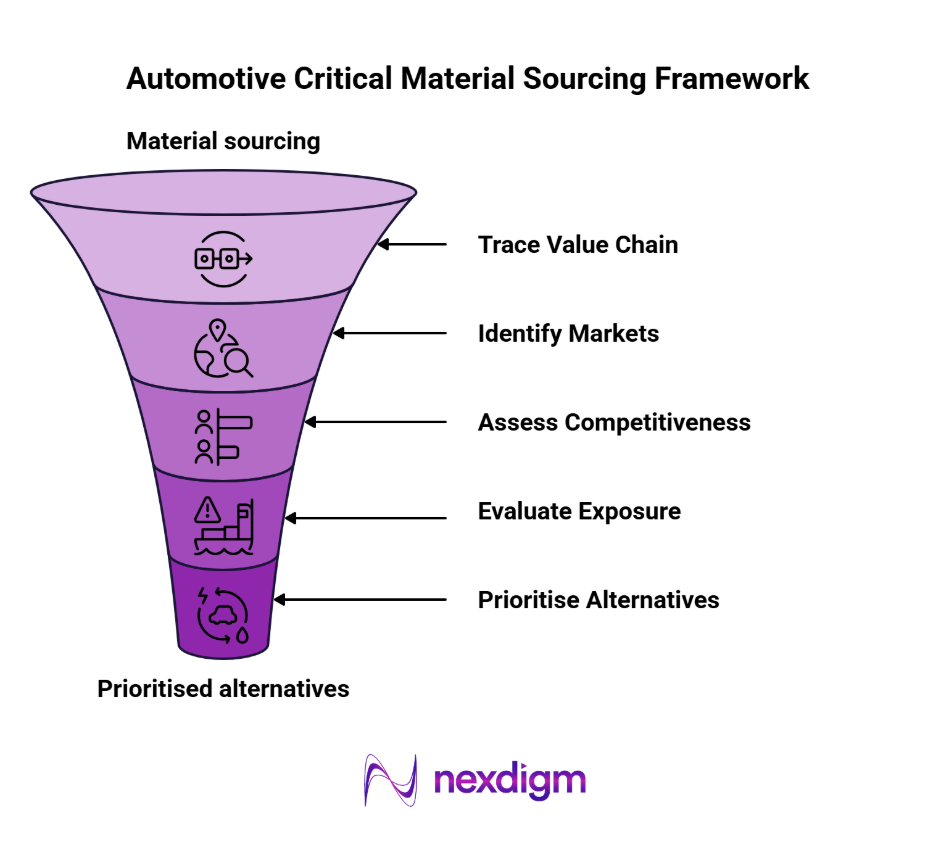
- Trace the Material Value Chain: Map extraction, refining, conversion and component manufacturing stages for each material.
- Identify Supply Markets: Compare producing countries, operating facilities, supplier networks and planned capacity.
- Assess Commercial Competitiveness: Examine material prices, processing costs, freight, duties and currency exposure.
- Evaluate Supply Exposure: Analyse geographic concentration, export restrictions, infrastructure limitations and material substitutability.
- Prioritise Sourcing Alternatives: Identify markets offering a suitable combination of availability, cost competitiveness and supply diversification potential.
Case Study: Screening Critical Material Markets
An automotive manufacturer reviewing battery and motor material sourcing required a comparison across five markets. The assessment mapped mining, refining and processing activity for four materials, identified two markets with relevant downstream capacity and highlighted three supply-chain dependencies requiring further evaluation.
To take the next step, simply visit our Request a Consultation page and share your requirements with us.
Harsh Mittal
+91-8422857704