

Automotive component costs are being shaped by both production growth and changing vehicle technology. According to recent study, global light-vehicle production is expected to reach around 89.6 million units in 2026, while battery-electric and plug-in hybrid vehicles continue to expand their share of global production. At the same time, raw-material volatility, regional manufacturing costs, and supply-chain disruptions are creating greater variation in component economics.
For OEMs, this makes supplier price comparison increasingly important. A part that appears expensive in one market may reflect higher material costs, stricter specifications, lower production volumes, or different logistics conditions. Automotive part price benchmarking provides a structured way to separate these variables and determine whether supplier pricing is genuinely competitive.
Why Component Prices Can Differ Across Suppliers
The price of an automotive component is influenced by far more than the supplier’s quoted figure. Material grade, design complexity, manufacturing process, production scale, tooling, quality requirements, freight, and regional operating conditions can all affect the final cost. As OEMs source across increasingly diverse supplier networks, comparing prices without accounting for these differences can produce misleading conclusions.
A meaningful benchmark therefore needs to establish a common basis before determining which supplier offers the strongest commercial position.
Understanding The Factors That Shape a Meaningful Price Benchmark
A reliable comparison should bring technical and commercial conditions into the same view:
- Specification Alignment: Compare parts with equivalent materials, dimensions, tolerances, performance requirements, and quality standards to avoid distorted price comparisons.
- Regional Conditions: Consider labor, energy, logistics, tariffs, material availability, localization, and manufacturing economics when evaluating suppliers across different markets.
- Volume Economics: Account for annual volumes, production scale, tooling amortization, utilization, batch sizes, and commercial terms when interpreting supplier price differences.
Together, these factors help OEMs determine whether a pricing difference reflects genuine cost variation or a potential opportunity for sourcing improvement.
Nexdigm’s Role in Making Part Pricing More Actionable
Automotive part prices often sit across different suppliers, regions, specifications, and sourcing programs, making direct comparisons difficult. Nexdigm can bring these varied inputs into a consistent analytical view, helping OEMs:
- Connect the Data: Bring supplier quotes, specifications, volumes, and regional factors into a comparable view.
- Interpret the Difference: Assess whether price variations are driven by legitimate cost factors or potential sourcing opportunities.
- Highlight the Opportunity: Identify categories, suppliers, or parts where deeper benchmarking could support better procurement outcomes.
This approach makes pricing information easier to interpret and more useful for automotive part price benchmarking and sourcing decisions.
Nexdigm’s Analysis Across Automotive Part Suppliers and Markets
Once part-level pricing is made comparable, Nexdigm can extend the analysis across suppliers, regions, and sourcing conditions to provide a broader view of competitiveness.
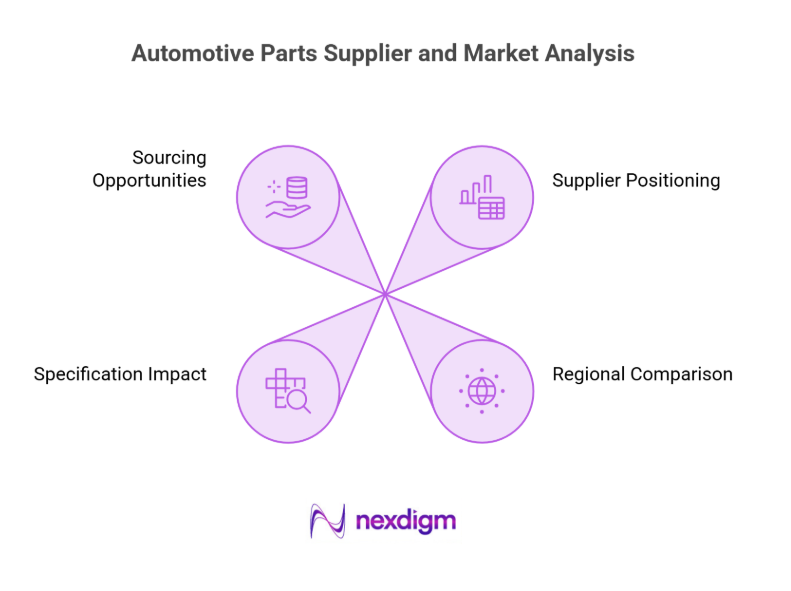
- Supplier Positioning: Compare suppliers against relevant peers to identify competitive pricing, premium positions, and areas requiring further review.
- Regional Comparison: Assess how manufacturing location, logistics, labor, tariffs, and local cost conditions influence component prices across markets.
- Specification Impact: Examine how differences in materials, technology, quality requirements, and performance specifications contribute to variations in quoted prices.
- Sourcing Opportunities: Identify parts and supplier combinations where alternative sourcing, volume shifts, or commercial discussions could improve overall procurement economics.
This enables OEMs to use automotive part price benchmarking not only to compare prices, but to understand the competitive position behind them.
Benefits of Nexdigm’s Automotive Part Price Analysis
Nexdigm’s analysis can help OEMs turn component-level pricing information into clearer procurement advantages:
- Greater Price Transparency: Create a consistent view of supplier pricing across parts, specifications, regions, and sourcing conditions.
- Better Cost Control: Identify pricing deviations and underlying cost drivers that may create opportunities for cost optimization.
- Stronger Supplier Decisions: Compare suppliers on price alongside capabilities, quality, capacity, regional presence, and overall sourcing suitability.
- Focused Negotiations: Equip procurement teams with relevant benchmarks and evidence to support more targeted supplier discussions.
- Smarter Sourcing: Identify opportunities involving alternative suppliers, regional shifts, volume allocation, or commercial improvements.
Together, these benefits make automotive part price benchmarking a practical input for improving sourcing competitiveness and procurement performance.
Nexdigm’s Case
An automaker benchmarked 22 suppliers across six component categories using Nexdigm’s automotive part price benchmarking approach. The assessment identified 38% of supplier-part combinations with notable pricing deviations, uncovered 16 negotiation opportunities, and improved benchmarking efficiency by 30%. The findings helped procurement teams prioritize supplier discussions and focus on the most relevant cost-optimization opportunities.
To take the next step, simply visit our Request a Consultation page and share your requirements with us.
Harsh Mittal
+91-8422857704