

Automotive plastics are becoming increasingly important as OEMs pursue lightweighting, electrification, design flexibility, and improved vehicle efficiency. The average North American vehicle contained 428 pounds of plastics and polymer composites in 2025, an 18% increase from a decade earlier. These materials represented more than half of vehicle volume but less than 10% of weight.
The broader automotive plastics market was estimated at $33 billion in 2025 and is projected to reach approximately $54.8 billion by 2033, according to Grand View Research. Polypropylene accounted for 32.4% of 2025 market revenue, while injection molding represented 56.1% of the market by process. These trends make automotive plastics supplier benchmarking increasingly relevant for OEMs seeking suppliers that can balance lightweighting, performance, scalability, sustainability, and commercial competitiveness.
Plastics Are Moving From Material Choice to Vehicle Strategy
Automotive plastics now contribute to more than weight reduction. They support complex component design, thermal management, electrical insulation, safety, durability, and increasingly demanding EV applications. A 10% vehicle weight reduction can improve EV range by approximately 4–6%, strengthening the case for lightweight materials.
For OEMs, supplier selection therefore needs to consider whether a plastics provider can combine material innovation with consistent quality, production scale, cost competitiveness, and the ability to support changing vehicle architectures.
Measures of a Strong Automotive Plastics Supplier
Supplier leadership can differ by application, polymer, geography, and vehicle program. Nexdigm’s assessment can bring these dimensions together through:
- Lightweighting Capability: Compare polymer formulations, density, strength-to-weight performance, design flexibility, and ability to replace heavier materials across vehicle applications.
- Performance and Quality: Evaluate thermal resistance, durability, chemical resistance, safety, dimensional consistency, certifications, and ability to meet demanding automotive specifications.
- Commercial Competitiveness: Assess material costs, conversion economics, production scale, localization, tooling capabilities, logistics, and capacity to support competitive vehicle programs.
Together, these factors help OEMs distinguish suppliers that offer innovative materials from those capable of delivering performance, scale, and commercial value simultaneously.
How Experts of Nexdigm Assess Automotive Plastics Supplier Competitiveness
Choosing a plastics supplier requires understanding how material capability translates into vehicle-level value. Experts at Nexdigm can bring these dimensions together, helping OEMs with:
- Material-to-Market Fit: Connect material capabilities with specific vehicle applications, performance requirements, and lightweighting objectives.
- Supplier Differentiation: Identify where suppliers stand apart through technology, manufacturing strength, innovation, quality, or commercial positioning.
- Future Readiness: Assess supplier investments, advanced materials, recycled-content capabilities, and technology direction to gauge longer-term relevance.
This gives OEMs a clearer basis for distinguishing strong current performers from suppliers with the potential to become strategic partners.
Nexdigm’s Approach Towards Automotive Plastics Supplier Sourcing
Nexdigm’s automotive plastics supplier benchmarking can help OEMs translate supplier strengths and differences into focused sourcing actions:
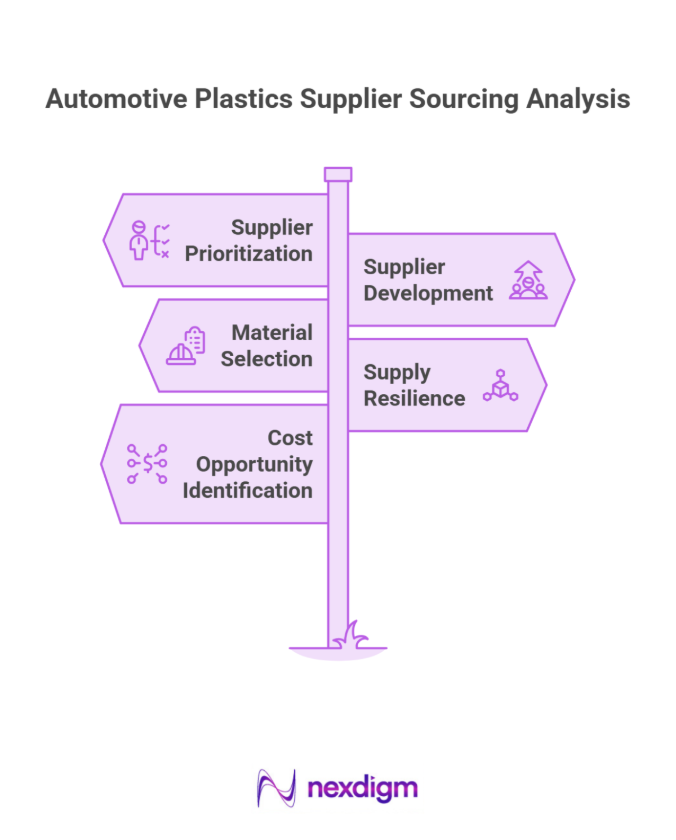
- Supplier Prioritization: Identify suppliers offering the right combination of material performance, quality, capacity, cost, and application expertise.
- Material Selection: Support comparisons between polymers and material alternatives based on weight, performance, processing requirements, and vehicle application.
- Cost Opportunities: Identify potential savings across material pricing, conversion, tooling, logistics, and supplier allocation.
- Supply Resilience: Highlight capacity constraints, geographic dependencies, raw-material exposure, and other risks that could affect program continuity.
- Supplier Development: Identify capability gaps where technical, operational, or commercial improvements could strengthen supplier performance.
Through automotive plastics supplier benchmarking, these insights help OEMs move from understanding the plastics supplier landscape to making more targeted, commercially informed sourcing decisions.
Nexdigm’s Strategic Value for Automotive Plastics Industry
Nexdigm’s analysis can help OEMs connect supplier performance with wider vehicle-program priorities. By combining technical, commercial, and market perspectives, the assessment can support:
- Better Supplier Decisions: Select partners based on a balanced view of capability, cost, quality, capacity, and strategic fit.
- Stronger Cost Management: Identify areas where material choices, supplier allocation, or commercial terms can improve overall sourcing economics.
- Greater Supply Resilience: Build visibility into supplier dependencies, regional exposure, capacity constraints, and potential alternatives.
- Future-Ready Sourcing: Identify suppliers investing in advanced polymers, lightweighting solutions, recycled materials, and technologies aligned with evolving vehicle requirements.
This helps OEMs use automotive plastics supplier benchmarking as a strategic input for both current sourcing and future vehicle-platform planning.
What Makes Nexdigm’s Assessment Different
Nexdigm’s assessment goes beyond comparing supplier specifications or quoted costs. Our expertise brings together industry context, supplier intelligence, technical capabilities, commercial positioning, and future-readiness to create a more complete view of competitiveness. This helps OEMs understand not only which suppliers perform strongly today, but also why they are competitive, where gaps exist, and which suppliers may offer greater strategic value over the long term.
Nexdigm’s Case
An automaker evaluated 18 automotive plastics suppliers across lightweighting, material performance, cost, capacity, and regional presence. Nexdigm’s assessment identified 6 priority suppliers, highlighted 10 capability gaps, and reduced supplier evaluation time by 28%. The findings supported focused technical validation, supplier negotiations, and more informed sourcing decisions.
To take the next step, simply visit our Request a Consultation page and share your requirements with us.
Harsh Mittal
+91-8422857704