

Automotive price elasticity analysis examines how changes in vehicle and component prices influence demand under competitive market conditions, where multiple OEMs and aftermarket suppliers operate simultaneously. Automotive price elasticity analysis enables firms to understand customer sensitivity to price variations, promotional discounts, and competing offerings.
Through pricing analysis, businesses can quantify demand responsiveness, forecast sales volumes, and optimize pricing strategies for different market segments. This is particularly important in highly competitive automotive ecosystems where small price changes can significantly shift consumer preferences. By applying elasticity insights, manufacturers and suppliers can balance profitability with demand stability, improve forecasting accuracy, and strengthen market positioning.
The global automotive market demonstrates strong price sensitivity, with studies indicating that a 1% change in vehicle component pricing can lead to a 1.2–2.5% shift in demand depending on product category and market maturity. Replacement parts and aftermarket services show even higher elasticity, where demand fluctuations can reach up to 3% for every 1% price change in highly competitive regions.
Elasticity-Based Pricing Strategies for OEM and Aftermarket Competitiveness
Elasticity-based pricing strategies use price sensitivity insights to adjust OEM and aftermarket prices, optimizing demand, competitiveness, and profitability through pricing analysis, ensuring balanced pricing decisions across varying customer segments and markets.
-
Demand Sensitivity Assessment
Measures how OEM and aftermarket demand changes with price variations to optimize pricing decisions effectively.
-
Competitive Pricing Adjustment
Aligns prices with competitors to maintain market share while ensuring profitability across channels.
-
Elasticity-Based Demand Forecasting
Uses price elasticity data to predict sales volumes under different pricing scenarios.
-
Segmented Pricing Strategy Design
Creates tailored pricing strategies for different customer groups based on price responsiveness.
Nexdigm’s Pricing Analysis and Elasticity Modelling for Revenue Optimization
Nexdigm’s pricing analysis and elasticity modelling for revenue optimization helps automotive companies assess demand responsiveness to price changes. It enables identification of optimal pricing points, forecasting demand shifts, and improving profitability. This supports better OEM and aftermarket pricing strategies, enhances competitiveness, and maximizes revenue under varying market conditions.
Nexdigm’s Automotive Price Elasticity-Based Demand Forecasting for Competitive Markets
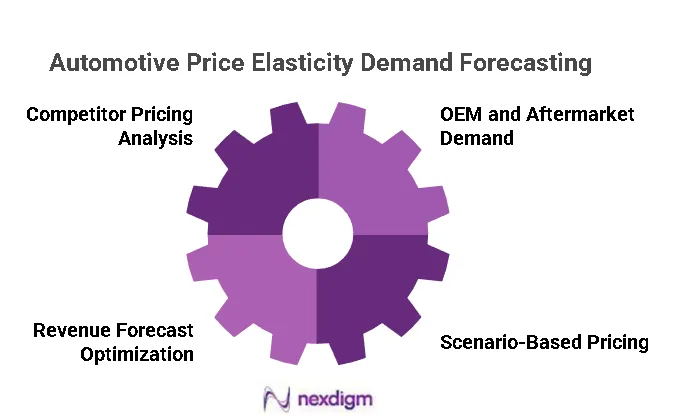
Nexdigm’s automotive price elasticity-based demand forecasting helps companies predict how changes in pricing affect demand in competitive markets. By using pricing analysis and elasticity modelling, it enables accurate sales forecasting, optimizes pricing strategies, improves revenue planning, and supports better decision-making across OEM and aftermarket automotive segments:
-
Competitor Pricing Impact Analysis
Evaluates how rival pricing strategies influence demand shifts and market share fluctuations.
-
OEM and Aftermarket Demand Modelling
Compares demand behavior across OEM and aftermarket channels using elasticity insights.
-
Revenue Forecast Optimization
Improves revenue projections by linking pricing changes with expected sales volume variations.
-
Scenario-Based Pricing Simulation
Tests multiple pricing scenarios to identify optimal price points for maximum demand and profitability.
Nexdigm’s case:
Nexdigm assisted a global automotive OEM and aftermarket supplier operating in 20 countries to implement price elasticity-based demand forecasting. Using pricing analysis and elasticity modelling, Nexdigm identified that a 5% price reduction in high-demand replacement components increased demand by 12–18%, while premium segments showed only 3–5% responsiveness. The solution improved forecast accuracy by 14%, optimized pricing strategies, and helped the company increase overall revenue by 9% while maintaining competitive positioning across OEM and aftermarket channels.
To take the next step, simply visit our Request a Consultation page and share your requirements with us.
Harsh Mittal
+91-8422857704