

Pricing strategies strongly influence automotive adoption across emerging and competitive markets, where customers are highly sensitive to affordability, ownership costs, and perceived value. An effective Automotive pricing strategy for new markets helps automakers set prices that match buyer income levels, competitor offerings, product features, and financing expectations.
As market entry strategy, pricing supports customer acceptance by reducing purchase barriers and clearly communicating value. In emerging markets, competitive pricing, flexible EMI options, variant-based pricing, and localized cost structures can improve adoption. Strong pricing decisions help automotive brands attract buyers, build trust, and compete effectively against established market players.
Recent data shows why pricing is central to automotive adoption. Global new vehicle sales were forecasted to reach 89.6 million units in 2025, reflecting a 1.7% year-on-year increase. However, slower growth in some regions highlights the impact of affordability pressures and weaker EV adoption. Reports also show that reducing the purchase-price gap remains critical for wider electric vehicle uptake, proving that pricing, financing, and ownership-cost strategies directly affect adoption in emerging and competitive markets.
Assessing Competitive Price Benchmarking for New Vehicle Launches
Assessing Competitive Price Benchmarking for New Vehicle Launches helps automakers compare rival prices, features, variants, discounts, and customer value expectations to set competitive launch prices and improve adoption:
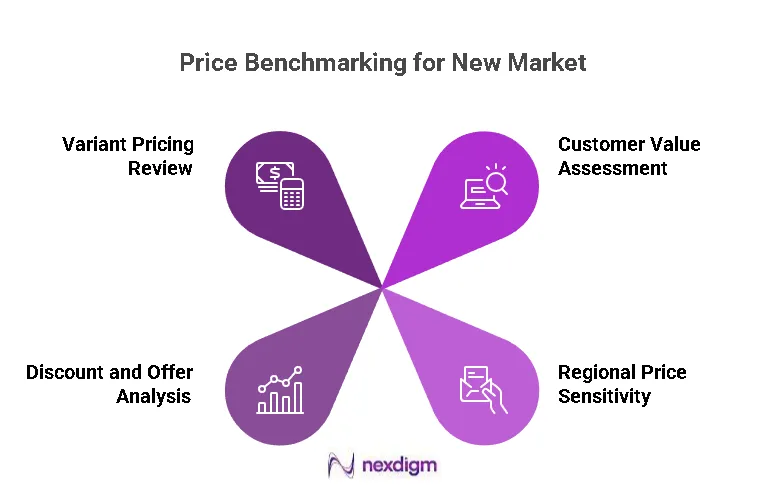
- Variant Pricing Review: Studies base, mid, and premium variants to create pricing options for different customer affordability levels.
- Discount and Offer Analysis: Reviews competitor discounts, exchange bonuses, finance schemes, and launch offers to design attractive promotional pricing.
- Customer Value Assessment: Measures how buyers perceive price against quality, brand trust, ownership cost, and expected vehicle benefits.
- Regional Price Sensitivity: Analyzes local income levels, demand patterns, taxes, and affordability differences across emerging and competitive markets.
Nexdigm’s Variant-Wise Pricing Strategy for Different Customer Segments
Nexdigm supports automotive companies in designing pricing strategies that improve adoption across emerging and competitive markets. Its services include customer affordability analysis, competitor price benchmarking, price sensitivity assessment, total cost of ownership review, and regulatory cost evaluation. These insights help companies set realistic launch prices, offer suitable financing options, balance profitability with affordability, and improve customer acceptance in new markets.
Nexdigm Price Sensitivity Assessment for Vehicle Adoption in New Markets
Nexdigm Price Sensitivity Assessment for Vehicle Adoption in New Markets evaluates how customers respond to price changes, discounts, financing options, and ownership costs to improve vehicle affordability and adoption.
- Variant Preference Study: Nexdigm evaluates which vehicle variants customers prefer based on price, features, comfort, technology, and affordability.
- Regional Pricing Response: Nexdigm compares customer price reactions across cities, income groups, and regional automotive markets.
- Purchase Barrier Identification: Nexdigm identifies pricing-related barriers such as high down payments, expensive insurance, loan limits, or maintenance concerns.
- Value Perception Testing: Nexdigm assesses whether customers believe the vehicle’s features, brand image, and ownership benefits justify its price.
Nexdigm’s case:
Nexdigm helped an international automotive company assess price sensitivity before entering a competitive emerging market. The team analyzed 3,000 customer responses, benchmarked 15 competing vehicle models, and studied pricing behavior across 6 major cities. Findings showed that 58% of target buyers were more likely to consider purchase when EMI options reduced monthly payments by 10–12%.
Based on Nexdigm’s recommendations, the company adjusted variant pricing, introduced flexible financing, and improved expected adoption among price-sensitive buyers.
To take the next step, simply visit our Request a Consultation page and share your requirements with us.
Harsh Mittal
+91-8422857704