

Automotive procurement costs are influenced by movements across a broad supplier ecosystem. Raw materials, components, energy, labour, freight and imported inputs can all affect purchasing budgets, but the impact is rarely uniform. A rise in steel prices may affect stamped and forged components directly, while currency movements and semiconductor availability may create pressure in electronics and control systems.
For procurement teams, identifying where costs are increasing requires more than tracking purchase-price changes. It involves understanding supplier economics, purchasing patterns, sourcing concentration and the timing of cost pass-through across the value chain.
Which Cost Categories Are Under Pressure?
Automotive purchasing typically spans direct materials, production components, electronic systems, tooling, packaging, logistics and selected manufacturing services. Each category responds to different market conditions.
Key areas to monitor include:
- Metals: Steel, aluminium, copper and alloy inputs influence structural parts, castings, forgings, wiring systems and electrical components.
- Polymers and rubber: Plastics, synthetic rubber and specialised elastomers affect interiors, seals, hoses, tyres and other components.
- Semiconductors and electronics: Device availability, packaging capacity, product lifecycles and technology requirements influence electronic component costs.
- Energy and utilities: Electricity, fuel and industrial gas prices affect energy-intensive manufacturing processes such as casting, forging and heat treatment.
- Logistics and freight: Shipping rates, fuel costs, route disruptions and customs requirements influence imported inputs and cross-border supply.
- Labour and manufacturing overheads: Wage revisions, skilled-worker availability and facility costs affect suppliers with labour-intensive production processes.
The exposure differs by product category and manufacturing location. A procurement cost review should therefore classify spending by component family and supplier market rather than applying a single inflation assumption across all purchases.
How Supplier Economics Influence Purchase Prices
Suppliers do not respond to cost increases in identical ways. Their ability to absorb price movements depends on margins, customer concentration, operational efficiency, inventory positions and contractual arrangements.
A supplier with long-term material contracts may experience a different cost trajectory from one purchasing inputs at spot prices. Similarly, a manufacturer with high-capacity utilisation may have less room to absorb additional volumes without investing in equipment or overtime.
Procurement teams should examine:
- Material sourcing models and dependence on imported inputs.
- Energy intensity and production technology.
- Labour cost structure and facility location.
- Capacity utilisation and fixed-cost absorption.
- Customer concentration and bargaining position.
- Inventory coverage and supplier purchasing cycles.
- Price pass-through arrangements and revision frequency.
The relationship between purchase prices and supplier costs is not always immediate. Suppliers may hold inventory purchased at earlier prices, operate under indexed contracts or renegotiate with customers only at scheduled intervals. These differences can create temporary price gaps across otherwise comparable suppliers.
Purchase Patterns and the Risk of Concentration
Spending analysis can reveal cost exposure that is not visible through individual supplier quotations. For example, an organisation may have multiple suppliers for a component category but still depend on the same upstream material source or manufacturing region.
A procurement review should analyse:
- Share of spending by component category and supplier.
- Purchase volumes and frequency across the year.
- Dependence on single-source or limited-source components.
- Regional concentration of suppliers and manufacturing facilities.
- Spot purchases compared with contracted volumes.
- Import exposure and currency sensitivity.
- Differences between forecast demand and actual purchasing patterns.
These patterns matter because rising costs can interact with procurement behaviour. Frequent spot purchases may increase exposure to short-term price movements, while excessive inventory can raise carrying costs and create obsolescence risks.
Reading Recent Cost Signals in the Indian Automotive Market
Recent industry assessments show why procurement teams need to connect commodity movements with supplier-level economics. Crisil reported in June 2026 that raw materials accounted for nearly three-fourths of the total cost structure of the auto component manufacturers it analysed, with steel and aluminium together contributing 50–60% of input costs. It also identified higher freight and energy expenses as sources of margin pressure.
In October 2026, reporting based on the SIAM Commodity Price Monitor highlighted higher steel and aluminium prices in India, alongside increases in other industrial inputs. These movements matter because the automotive sector consumes substantial volumes of both metals across vehicle and component manufacturing.
However, market price increases do not translate uniformly into procurement inflation. The effect depends on component design, material intensity, inventory timing, supplier contracts and the extent to which cost increases are passed through to OEMs.
Turning Procurement Data into Market Intelligence
A useful automotive procurement cost analysis combines internal purchase information with external supplier and market intelligence. Internal data can show where spending is concentrated and how purchase prices have changed. External research helps explain whether those changes reflect commodity markets, supplier capacity, regional cost differences or changes in the competitive landscape.
Nexdigm’s procurement research can support this assessment through supplier-market mapping, input-price analysis, regional comparisons and examination of supplier economics. This helps organisations understand the market conditions behind purchasing trends and identify categories that require closer monitoring.
Automotive Procurement Cost Analysis Framework
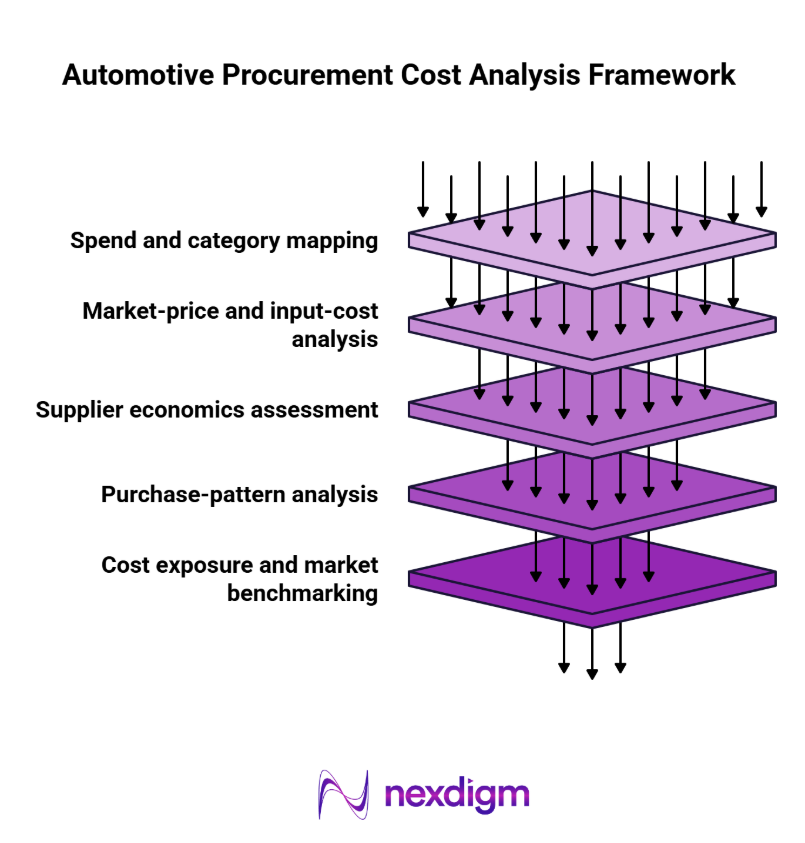
- Spend and category mapping: Organise procurement expenditure by component, material, supplier, geography and purchasing frequency.
- Market-price and input-cost analysis: Track relevant commodity prices, energy, freight, currency exposure and other supplier cost drivers.
- Supplier economics assessment: Examine sourcing models, capacity utilisation, cost structures, customer concentration and price pass-through practices.
- Purchase-pattern analysis: Identify spending concentration, spot-buy exposure, contract coverage, volume variation and single-source dependencies.
- Cost exposure and market benchmarking: Compare internal purchasing patterns with external market conditions and identify categories requiring further assessment.
Case Study: Identifying Automotive Procurement Cost Exposure
An automotive manufacturer reviewing annual purchasing expenditure needed to understand rising costs across key component categories. Nexdigm’s research assessed 42 spending categories, mapped supplier and regional exposure, and identified nine categories where material-price movements, import dependence or concentrated supply warranted closer monitoring.
To take the next step, simply visit our Request a Consultation page and share your requirements with us.
Harsh Mittal
+91-8422857704