

Automotive procurement is becoming more strategic as manufacturers balance cost, localization, supplier capability, technology access, and supply-chain resilience. India’s auto-component industry reached INR 7.59 lakh crore in FY2025–26, growing 12.7%, while supplies to OEMs increased 16.3%.
As vehicle technologies evolve, procurement decisions increasingly extend beyond price and availability. An Automotive procurement market analysis can help businesses evaluate sourcing markets, supplier capabilities, cost structures, technology requirements, and supply risks to build more competitive and resilient procurement strategies.
Drivers behind the Automotive Procurement Market
Automotive procurement market refers to the ecosystem through which automotive businesses source components, materials, technologies, and services from suppliers to meet production and operational requirements.
As procurement priorities continue to evolve, businesses must assess a range of factors that influence sourcing performance, competitiveness, and supply continuity.
With rapid changes in vehicle technologies and supply-chain requirements, automotive procurement has become more complex than ever. Businesses need to look beyond pricing and assess factors that influence long-term sourcing success, including:
- Localization: Localization has become increasingly important for reducing import dependence, improving lead times, controlling logistics costs, and strengthening supply continuity. At the same time, advanced technologies and specialized components continue to create sourcing dependencies. Businesses can assess localization opportunities to identify where local sourcing is commercially and technically feasible.
- Cost Pressure: Raw-material prices, logistics costs, technology investments, energy costs, and supplier margins can significantly influence component sourcing economics. Procurement teams therefore need greater visibility into the factors driving supplier costs. This helps them to understand cost drivers, benchmark suppliers, identify savings opportunities, and strengthen commercial negotiations.
- Supplier Risk: Dependence on a limited number of suppliers, regions, or technologies can increase exposure to production disruptions. Financial stability, capacity constraints, quality issues, geopolitical developments, and material availability can also affect sourcing continuity. Businesses can evaluate suppliers across financial strength, manufacturing capacity, geographic exposure and supply continuity to identify procurement risks and alternative sourcing options.
- Technology Sourcing: EVs, electronics, sensors, semiconductors, power electronics, connected systems, and advanced safety technologies are changing automotive sourcing requirements. Businesses can map technology suppliers, assess capabilities, identify sourcing gaps, and evaluate partnership or localization opportunities for emerging component categories.
Together, these factors help in understanding how automotive businesses evaluate suppliers and sourcing markets. As a result, procurement strategies are evolving in several important ways.
How Is the Automotive Procurement Landscape Evolving?
Procurement strategies are shifting from primarily cost-focused sourcing toward a broader assessment of cost, technology, resilience, localization, and long-term supplier capability.
- Localization potential: Identify components where domestic sourcing can reduce import dependence, lead times, logistics exposure, and supply risk.
- Cost competitiveness: Benchmark component costs and understand key cost drivers across suppliers and sourcing locations.
- Supplier resilience: Evaluate financial stability, capacity, quality, geographic concentration, and supply continuity risks.
- Technology readiness: Assess supplier capabilities across EV components, electronics, sensors, software-enabled systems, and other emerging technologies.
By assessing these dimensions collectively, Nexdigm’s Automotive Procurement Market Analysis provides businesses with a structured view of sourcing opportunities, supplier capabilities, and future procurement requirements.
Nexdigm’s Automotive Procurement Analysis
Nexdigm takes a structured approach to automotive procurement by combining market intelligence, supplier benchmarking, cost analysis, localization assessment, technology evaluation, and risk analysis.
- Procurement Landscape Mapping: Map component categories, suppliers, sourcing locations, manufacturing footprints, technologies, and OEM relationships to understand the existing procurement ecosystem.
- Supplier & Capability Assessment: Evaluate suppliers across manufacturing capability, capacity, quality, engineering, technology, scalability, and commercial performance.
- Cost & Localization Assessment: Benchmark component costs, identify major cost drivers, evaluate import dependence, and determine opportunities for competitive local sourcing.
- Supplier Risk & Technology Assessment: Assess financial, capacity, geographic, technology, and supply-continuity risks while identifying alternative and emerging technology suppliers.
Through an Automotive procurement market analysis, Nexdigm helps automotive businesses improve sourcing decisions and prepare sourcing strategies for evolving vehicle technologies.
Areas Where Nexdigm Can Help Businesses
Through its Automotive Procurement Market Analysis, Nexdigm helps businesses gain greater visibility into sourcing markets, supplier capabilities, localization opportunities, technology requirements, and supply risks. Key areas of support include:
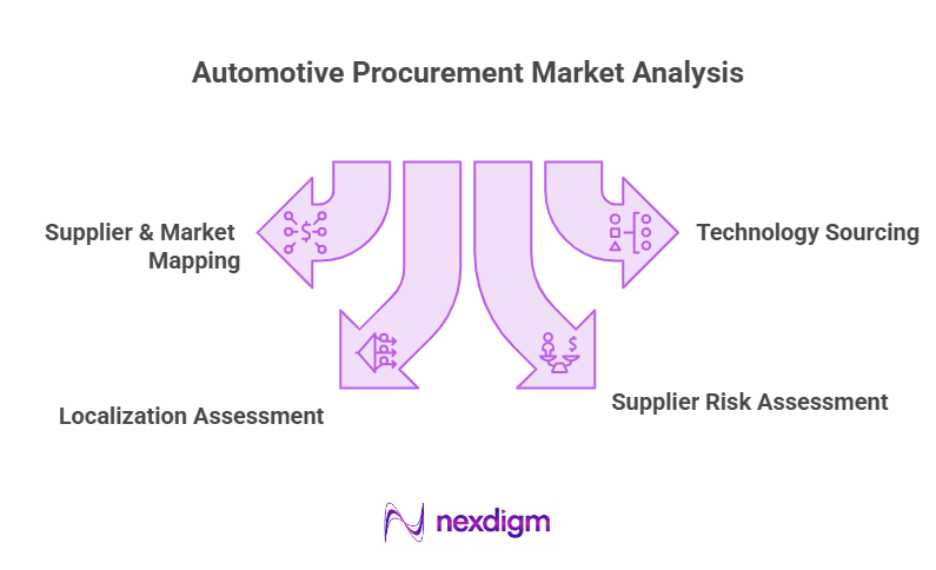
- Supplier & Market Mapping: Identify suppliers, manufacturing locations, technology capabilities, and sourcing alternatives.
- Localization Assessment: Evaluate components with potential for competitive domestic sourcing.
- Supplier Risk Assessment: Evaluate capacity, financial, geographic, quality, and concentration risks.
- Technology Sourcing: Identify suppliers and partnerships for EVs, electronics, sensors, and advanced components.
Assessing Emerging Opportunities with Nexdigm
Beyond addressing current challenges, businesses must also prepare for emerging sourcing requirements driven by new vehicle technologies. Growth in EVs, electronics, semiconductors, power electronics, sensors, and advanced vehicle systems is creating new sourcing and localization opportunities. Nexdigm helps businesses identify technology gaps, evaluate domestic and global suppliers and develop partnerships that can strengthen technology access, cost competitiveness, and long-term supply resilience.
Nexdigm’s Case
Nexdigm assisted an automotive player in strengthening procurement as India’s auto-component industry is growing at 16.3% rate and imports reaching USD 25.4 billion. The assessment identified localization opportunities, alternative suppliers, cost improvements, and sourcing risks, helping the business reduce sourcing dependence, improve cost competitiveness, and build a more resilient supplier base.
To take the next step, simply visit our Request a Consultation page and share your requirements with us.
Harsh Mittal
+91-8422857704