

Recycled materials are moving from a sustainability ambition toward a sourcing requirement for automotive manufacturers. The European Union’s 2026 circularity regulation introduces a 15% recycled-plastic target for new vehicles from 2032, rising to 25% from 2036, while at least 20% of the required recycled plastic must come from end-of-life vehicles or used parts. The regulation also establishes a framework for future recycled-content targets for steel and aluminium.
The sourcing challenge is substantial. An EU analysis estimates that plastics represent 14–18% of vehicle mass, yet only around 3% of plastic in new vehicles is currently recycled on average. For batteries, the EU framework already establishes future minimum recycled-content requirements for materials including cobalt, lithium, and nickel.
For procurement teams, an automotive recycled materials sourcing strategy therefore needs to answer more than where recycled materials are available. It must determine whether suppliers can deliver the required quality, volume, consistency, traceability, standards, and commercial value.
Availability Is Only the Starting Point
Recycled-material sourcing is constrained by more than market supply. Automotive applications often require specific grades, purity levels, technical properties, and reliable volumes. The European Commission has previously identified limited availability and quality of suitable secondary materials as major barriers to greater automotive uptake. This makes supplier selection critical: the right source must combine material availability with production capability, technical compliance, traceability, and scalability.
Key Questions That Shape Recycled-Material Sourcing
A practical sourcing assessment can begin with three questions:
- Can the Material Meet Specifications? Evaluate grade, purity, performance, consistency, certification, and compatibility with automotive applications before qualifying recycled inputs.
- Can the Supplier Scale? Assess production capacity, feedstock availability, processing capability, geographic footprint, and ability to maintain volumes over time.
- Can the Material Be Traced? Examine chain-of-custody systems, recycled-content verification, documentation, and data quality to support credible sourcing claims.
Together, these considerations help procurement teams distinguish between recycled materials that are available in theory and sources that can support automotive production reliably.
Nexdigm’s Role in Reducing Recycled-Material Sourcing Uncertainty
Recycled-material markets can vary in quality, availability, pricing, and technical readiness. Nexdigm can help procurement teams make sense of these variations by:
- Understanding Market Maturity: Examining how developed the recycled-material ecosystem is across target regions, including supply depth, processing infrastructure, and market dynamics.
- Spotting Sourcing Constraints: Identifying limitations around feedstock availability, production capacity, technical specifications, qualification timelines, or traceability.
- Testing Commercial Viability: Assessing whether recycled-material options can deliver an acceptable balance of price, quality, availability, and long-term supply security.
- Supporting Confident Decisions: Converting market and supplier findings into a clearer view of which sourcing pathways are realistic and scalable.
This makes Nexdigm’s role less about simply finding recycled-material suppliers and more about helping automakers understand where recycled sourcing can realistically work at scale.
Nexdigm’s Strategic Expertise on Recycled-Material Sourcing
Recycled materials can influence more than sustainability targets. Nexdigm can help organizations understand how their adoption fits within broader procurement and business priorities through an automotive recycled materials sourcing strategy:
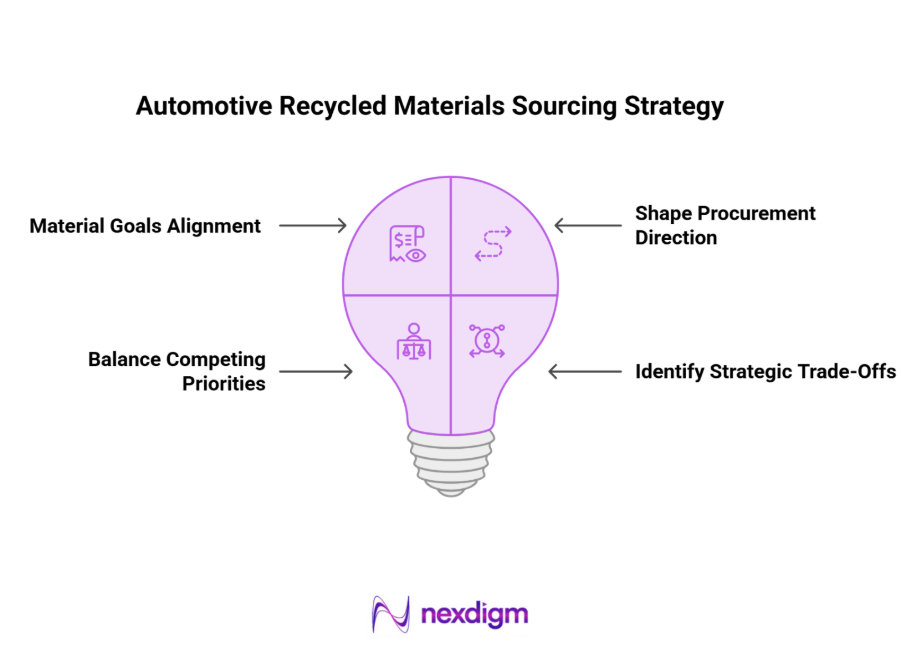
- Align With Material Goals: Connect recycled-content requirements with component specifications, production needs, and broader circularity objectives.
- Balance Competing Priorities: Examine how recycled-material adoption affects cost, quality, supply continuity, qualification, and sourcing flexibility.
- Identify Strategic Trade-Offs: Highlight where higher recycled content may require supplier changes, new processing capabilities, or different sourcing models.
- Shape Procurement Direction: Translate market and material insights into sourcing priorities that can support both near-term requirements and longer-term circular supply objectives.
This gives Nexdigm a broader role in helping automakers embed recycled materials into sourcing strategy rather than treating them as a standalone sustainability initiative.
How Nexdigm’s Recycled Material Sourcing Expertise Is Different
Recycled-material sourcing requires more than identifying suppliers. Nexdigm brings together market intelligence, automotive procurement understanding, cost analysis, and supplier assessment to evaluate opportunities from multiple areas, such as:
- Market-to-Supplier View: Connect broader recycled-material market trends with specific supplier capabilities, availability, and sourcing opportunities.
- Commercial-to-Sustainability Lens: Evaluate recycled-material choices against cost, quality, supply security, and sustainability rather than considering environmental value alone.
- Strategic-to-Practical Assessment: Translate circularity objectives into realistic sourcing options that account for qualification, scalability, standards, and operational requirements.
- Decision-Oriented Insights: Turn fragmented material and supplier information into clear priorities that procurement teams can use for sourcing decisions.
This differentiated approach makes an automotive recycled materials sourcing strategy more actionable, linking market opportunity, supplier capability, and procurement value within one assessment.
Nexdigm’s Case
An automotive manufacturer assessed potential recycled-material suppliers across five regions using Nexdigm’s automotive recycled materials sourcing strategy. The analysis identified 27% with capability or supply constraints and prioritized 16 opportunities across recycled plastics, metals, regional sourcing, supplier development, and traceability. The findings helped procurement focus qualification efforts on suppliers offering the strongest sourcing fit.
To take the next step, simply visit our Request a Consultation page and share your requirements with us.
Harsh Mittal
+91-8422857704