

Regional distribution strategies are essential for automotive brands entering markets with fragmented dealer networks, uneven service coverage, and diverse customer demand across locations. In such markets, brands must carefully plan how vehicles, spare parts, inventory, and sales support move across regions while maintaining consistent dealer performance and customer experience.
Companies assess distributor capability, logistics infrastructure, dealer access, warehousing readiness, regulatory requirements, and after-sales support before expansion. An effective Automotive regional distribution strategy enables brands to improve market reach, reduce supply gaps, strengthen retail coordination, and scale efficiently across competitive regional automotive markets.
Global vehicle sales reached around 91.7 million units in 2025, creating significant pressure on supply, logistics, and dealer coordination. The automotive logistics market was valued at about USD 249.2 billion in 2025 and is projected to reach nearly USD 460.2 billion by 2033, showing the growing need for efficient vehicle movement, warehousing, and regional delivery networks.
Designing a Market Entry Strategy for Automotive Regional Distribution
Designing a market entry strategy for automotive regional distribution involves assessing demand, dealer gaps, distributor capability, logistics infrastructure, warehousing, inventory flow, compliance needs, and after-sales support across target regions.
- Regional Demand Assessment: Analyze vehicle demand, customer segments, sales potential, and growth pockets to plan effective regional distribution entry.
- Dealer Gap Analysis: Identify underserved locations, weak dealer coverage, service gaps, and retail access challenges across fragmented regional markets.
- Distributor Capability Review: Assess distributor reach, logistics strength, financial stability, dealer relationships, inventory handling, and compliance readiness.
- Logistics and Warehousing Planning: Review transport routes, warehouse locations, delivery timelines, stock storage, spare parts movement, and regional supply efficiency.
Nexdigm’s Pricing, Margin, and Incentive Model Evaluation for Distribution Channels
Nexdigm’s pricing, margin, and incentive model evaluation helps automotive brands structure commercially viable regional distribution channels. This includes reviewing distributor margins, dealer profitability, regional pricing differences, discount structures, volume incentives, credit terms, and promotional schemes. These insights help brands balance competitiveness with partner profitability, improve channel motivation, and support sustainable distribution-led market entry.
Nexdigm’s Retail Coordination Strategy for Fragmented Dealer Networks
Nexdigm’s retail coordination strategy helps automotive brands align fragmented dealers through structured communication, lead sharing, inventory visibility, pricing consistency, service standards, and performance tracking across regional markets:
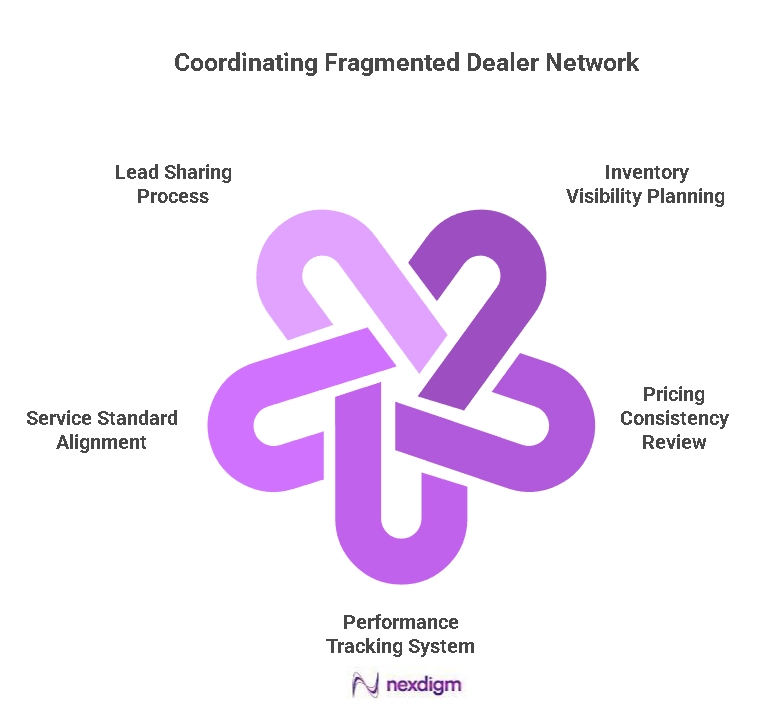
- Lead Sharing Process: Nexdigm supports lead routing, enquiry allocation, follow-up tracking, and customer handover between regional dealers and sales teams.
- Inventory Visibility Planning: Nexdigm reviews stock visibility, vehicle availability updates, allocation processes, and dealer-level inventory coordination.
- Pricing Consistency Review: Nexdigm helps assess regional pricing differences, discount controls, margin alignment, and offer consistency across dealer networks.
- Service Standard Alignment: Nexdigm reviews customer service expectations, warranty handling, complaint resolution, and after-sales support consistency across dealer locations.
- Performance Tracking System: Nexdigm supports dealer KPI monitoring, sales reporting, conversion tracking, service quality review, and continuous improvement planning.
Nexdigm’s case:
Nexdigm supported an automotive company that was facing uneven dealer performance across regional markets. The project focused on distributor-dealer alignment, spare parts availability, sales reporting discipline, and territory-level operating gaps. Nexdigm’s review helped the company redesign coordination processes across 55 dealer locations, improve projected stock allocation accuracy by 22%, reduce service response gaps by 15%, and prioritize 4 territories for stronger regional distribution control.
To take the next step, simply visit our Request a Consultation page and share your requirements with us.
Harsh Mittal
+91-8422857704