

Automotive semiconductors have become critical to vehicle production as cars incorporate more electronics, connectivity, ADAS, and electrification technologies. The global automotive semiconductor market reached approximately $74.4 billion in 2025, up from $69.9 billion in 2024.
The market is also concentrated among leading suppliers: the top five automotive semiconductor companies represented 47% of global sales in 2024. At the manufacturing level, semiconductor capabilities remain geographically specialized, with Taiwan, South Korea, Japan, the US, and Southeast Asian markets playing important roles across different stages.
Southeast Asia alone accounted for 28% of global semiconductor exports in 2023, highlighting its growing role in the wider supply network. These developments make automotive semiconductor trade flows important for identifying concentration risks, sourcing shifts, supplier exposure, and emerging supply opportunities.
Semiconductor Trade Is Becoming a Strategic Automotive Issue
Automotive semiconductor supply chains span chip design, wafer fabrication, assembly, testing, packaging, distribution, and automotive component integration. These activities are distributed across multiple countries, creating interdependencies between vehicle manufacturers and semiconductor suppliers. The OECD notes that critical semiconductor inputs remain highly concentrated in specific regions, creating potential vulnerabilities and increasing the importance of supply diversification. For automotive businesses, monitoring trade flows can therefore reveal where supply exposure is building before it becomes a production constraint.
What Semiconductor Trade Patterns Can Reveal
Trade data becomes more useful when individual chip movements are connected with suppliers, products, markets, and manufacturing capabilities.
- Supply Concentration: Import and export patterns can reveal dependence on specific supplier countries, semiconductor categories, or trade corridors.
- Sourcing Shifts: Changes in shipment origins, supplier participation, and destination markets can indicate diversification, new capacity, or changing procurement strategies.
Together, these signals help businesses understand where semiconductor dependencies exist, how sourcing networks are changing, and which markets may offer alternative supply opportunities.
Nexdigm’s Expertise in Assessing Automotive Semiconductor Trade Flows
Understanding automotive semiconductor trade requires more than tracking shipment values. Nexdigm combines automotive semiconductor trade flows analysis with market, supplier, and competitive intelligence to help businesses interpret sourcing dynamics through:
- HS Code and Product Category Analysis: Examination of semiconductor HS codes and product categories to identify traded components, assess category-level demand shifts, and understand market-specific semiconductor requirements.
- Trade Flow and Supply Network Assessment: Analysis of import-export values, shipment volumes, origins, destinations, suppliers, and buyers to uncover sourcing dependencies, supplier concentration, and changing trade relationships.
- Production Hub and Historical Trend Evaluation: Tracking of production hubs and historical trade patterns to identify emerging semiconductor manufacturing centers, evolving supply routes, and long-term automotive sourcing trends.
By translating complex trade data into actionable intelligence, Nexdigm helps businesses anticipate supply changes, evaluate sourcing risks, and make informed automotive semiconductor procurement decisions.
The Need for Automotive Semiconductor Trade Flow Analysis
As vehicles become more dependent on chips for power management, connectivity, safety, and advanced driver-assistance systems, semiconductor sourcing has become a strategic supply-chain consideration. Automotive semiconductor trade flows analysis helps businesses identify concentrated supplier markets, changing import dependencies, emerging production hubs, and alternative sourcing routes. It provides visibility into where supply exposure is building and where diversification opportunities may exist.
Nexdigm’s Analysis of Automotive Semiconductor Trade Flows
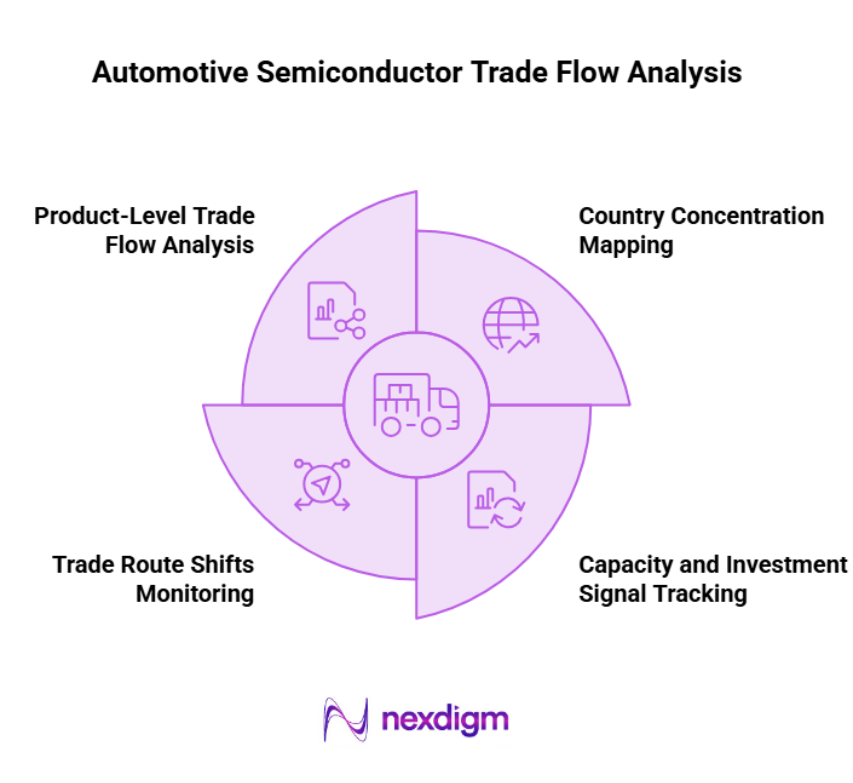
Nexdigm analyzes semiconductor trade movements at product, country, supplier, and market levels to understand how automotive chip supply networks are evolving. The assessment focuses on:
- Product-Level Trade: Examining HS codes, semiconductor categories, import values, volumes, and growth patterns to identify products with significant automotive supply exposure.
- Supplier and Country Concentration: Mapping major exporting countries, manufacturers, distributors, and sourcing markets to identify dependencies and concentrated supply relationships.
- Trade Route Shifts: Tracking changes in origins, destinations, shipment values, and supplier participation to identify sourcing diversification or emerging trade corridors.
- Capacity and Investment Signals: Connecting trade movements with semiconductor plants, packaging facilities, capacity additions, and investment announcements to identify future supply potential.
This analysis creates a connected view of where semiconductor supply originates, how it moves, and which changes could influence automotive sourcing decisions.
Applications of Nexdigm’s Semiconductor Trade Flow Analysis
The insights from semiconductor trade analysis can support decisions across various areas such as:
- Sourcing Diversification: Compare supplier countries, trade volumes, production capabilities, and market access to identify alternative sources and reduce dependence on concentrated markets.
- Supplier Discovery: Use exporter and shipment patterns to identify active semiconductor manufacturers, distributors, and emerging suppliers for potential sourcing or partnership opportunities.
- Supply-Risk Monitoring: Track changes in import concentration, supplier participation, trade routes, and product availability to identify emerging supply risks before they affect production planning.
- Localization Planning: Combine trade flows with manufacturing capacity and investment activity to identify markets where regional semiconductor sourcing or supplier development may be feasible.
These applications allow businesses to use automotive semiconductor trade flows not simply as a record of past transactions, but as an input for sourcing, risk management, localization, and growth decisions.
Nexdigm’s Case
Nexdigm assessed semiconductor trade across 8 markets, identifying 3 countries accounting for over 50% of selected imports and 6 emerging sourcing opportunities. The analysis helped the client evaluate supplier diversification, concentration risks, and alternative sourcing routes across priority semiconductor categories.
To take the next step, simply visit our Request a Consultation page and share your requirements with us.
Harsh Mittal
+91-8422857704