

Automotive service-parts sourcing is becoming more important as vehicle owners balance maintenance needs with rising cost sensitivity. Recent study reports that U.S. consumers delayed $30 billion in vehicle maintenance during 2025, including $16.5 billion for vehicles aged 12 years and older. At the same time, the average U.S. vehicle age reached 12.94 years, creating a large installed base that continues to require parts and repairs.
The sourcing challenge is also moving beyond price. Roland Berger’s 2026 Automotive Aftermarket Pulse finds that online B2B competition is shifting from price toward execution, with inventory availability and reliable delivery becoming as important as cost. Its research also shows that one in three consumers already uses AI when buying automotive parts, changing how parts are identified, compared, and purchased.
For distributors, retailers, workshops, and service networks, automotive service parts sourcing research can therefore help connect supplier capability with availability, cost, distribution reach, and service requirements.
What Is Changing in Service-Parts Sourcing?
Two developments are making supplier decisions more complex:
- Value Is Replacing Price Alone: AAPEX found that quality influences customer preference more strongly than low price, with availability also ranking as a significant factor. This increases the need to evaluate suppliers on overall value.
- Execution Is Becoming a Differentiator: As B2B online sourcing expands, reliable inventory and delivery are becoming critical to workshop purchasing decisions, making supply coverage as important as quoted pricing.
These shifts mean service-parts sourcing needs to consider what suppliers offer, how reliably they can deliver it, and what the complete sourcing economics look like.
The Real Sourcing Question Is Bigger Than “Who Can Supply?”
A service-parts supplier may offer the required component but still fall short on regional availability, lead times, technical coverage, or commercial value. Conversely, a supplier with a higher quoted price may provide stronger inventory access and faster fulfillment, creating better overall service economics. This makes supplier selection a connected decision involving product coverage, cost, inventory, distribution, and reliability. A structured sourcing view can help businesses understand these trade-offs and identify where their existing supply network may need strengthening.
Nexdigm’s View on the Service-Parts Sourcing Equation
When sourcing decisions involve multiple trade-offs, comparing suppliers on a single metric can provide an incomplete picture. Nexdigm can bring supplier capabilities, cost structures, availability, regional coverage, and service requirements into one analytical view.
Through automotive service parts sourcing research, Nexdigm can help organizations understand which suppliers are best aligned with specific sourcing needs, where the existing network has limitations, and where alternative suppliers or sourcing locations could improve overall performance.
Nexdigm’s Approach to Assessing Service-Parts Sourcing Economics
Service coverage is only sustainable when the underlying sourcing economics work. Nexdigm can help organizations examine the following areas to understand the true economics of each sourcing option:
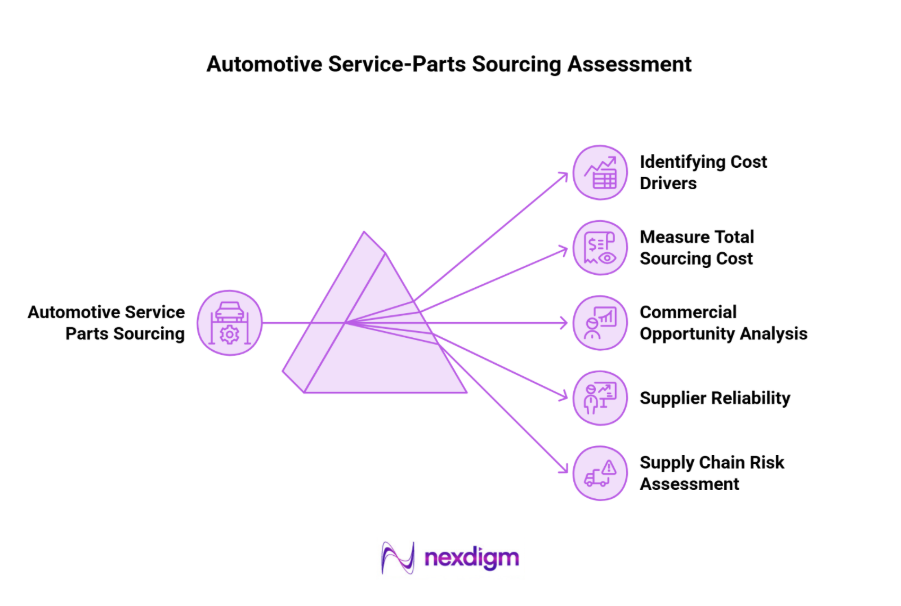
- Cost Drivers: Identify the factors contributing to supplier pricing and determine where cost differences are commercially justified.
- Total Sourcing Cost: Consider freight, duties, inventory requirements, minimum orders, and delivery conditions alongside quoted supplier prices.
- Commercial Opportunities: Identify suppliers, categories, or sourcing markets where improved terms or alternative sourcing could strengthen overall economics.
- Supplier Reliability: Evaluate supplier performance, fulfillment consistency, lead-time stability, and service levels to understand the operational impact of sourcing decisions.
- Supply Chain Risk Exposure: Assess potential risks related to supplier concentration, geographical dependencies, regulatory changes, and market volatility that may affect long-term sourcing economics.
This gives procurement teams a clearer basis for balancing competitive cost with reliable service-parts availability.
How Nexdigm’s Assessment Helps with Sourcing Priorities
The assessment becomes more valuable when its findings are translated into clear procurement priorities. Nexdigm can help organizations determine where immediate sourcing action is warranted and where longer-term supplier development may create greater value through:
- Prioritizing High-Impact Categories: Focusing attention on parts with significant cost exposure, availability constraints, or supply dependencies.
- Targeting Supplier Actions: Determining where negotiation, supplier development, volume reallocation, or additional qualification could improve performance.
- Strengthening Market Coverage: Identifying regions or service channels where alternative suppliers or distribution arrangements could improve access.
- Planning Future Requirements: Considering evolving vehicle technologies, demand patterns, and supplier capabilities when shaping longer-term sourcing plans.
This connects automotive service parts sourcing research with practical decisions, helping organizations move from supplier intelligence to a focused sourcing agenda.
Nexdigm’s Case
An aftermarket distributor assessed 30 service-parts suppliers across six categories and four regions using Nexdigm’s sourcing analysis. The assessment identified 24% additional qualified supplier options, highlighted 20% availability and coverage gaps, and improved supplier-screening efficiency by 29%. The findings helped prioritize supplier diversification, regional sourcing opportunities, and service-parts planning.
To take the next step, simply visit our Request a Consultation page and share your requirements with us.
Harsh Mittal
+91-8422857704