

Sourcing strategies are increasingly shifting toward localization, with over 40–50% of OEMs prioritizing regional suppliers to reduce risk and improve resilience. Local sourcing can cut lead and lower transportation costs by 10–15%, while reducing supply disruptions. Competitive intelligence services highlight these benefits, helping companies adapt to changing global conditions.
Automotive sourcing analysis evaluates suppliers based on cost, quality, and reliability. Data-driven sourcing strategies can reduce procurement costs by 8–12% and improve supplier performance by 10–15%, ensuring efficient supply chains, consistent quality, and timely component delivery in a competitive automotive market.
Methodologies for Competitive Intelligence in Sourcing Strategies
Competitive intelligence services offer insights to support sourcing strategies shifting towards localization, helping companies reduce supply risks. These methodologies help organizations make informed decisions by analyzing data, trends, and risks associated with supply chain transformations.
-
Market Analysis
Market analysis identifies regional sourcing trends and suppliers, evaluating their strengths, weaknesses, and capabilities. It offers insights into local supplier reliability, costs, and competitiveness, helping businesses select the best sourcing options to minimize risks.
-
Risk Assessment
Risk assessment focuses on evaluating geopolitical, economic, and environmental risks in different regions. This methodology helps organizations understand the potential vulnerabilities of local suppliers, enabling them to choose locations that ensure supply chain resilience and minimize disruptions.
-
Supplier Benchmarking
Supplier benchmarking involves comparing the performance, quality, and costs of potential suppliers. This methodology enables businesses to identify high-performing local suppliers that can deliver goods on time, with quality, while reducing dependency on international suppliers and mitigating risks.
-
Scenario Planning
Scenario planning involves modeling potential disruptions or challenges that could affect localized sourcing. By evaluating different future scenarios, companies can prepare strategies to respond to supply chain changes, ensuring they stay adaptable and resilient in unpredictable conditions.
Nexdigm’s Point on Competitive Intelligence for Localization in Sourcing Strategies
Nexdigm focuses on leveraging competitor sourcing strategy services to guide sourcing strategies toward localization. Their approach emphasizes reducing supply risks by identifying opportunities, analyzing trends, and improving decision-making through localized insights.
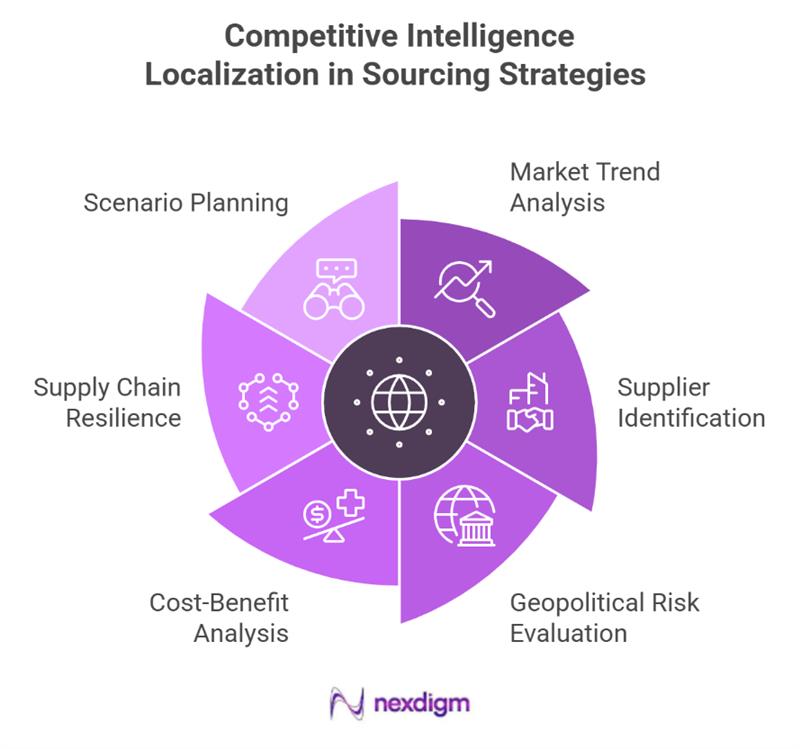
-
Market Trend Analysis
Nexdigm analyzes global market trends to identify shifting demands for localized sourcing, ensuring companies understand emerging markets and regional supplier strengths for optimized supply chain decisions.
-
Supplier Identification
They identify and evaluate local suppliers, assessing their capabilities and reliability, enabling businesses to choose the most suitable partners to minimize risk and improve supply chain efficiency.
-
Geopolitical Risk Evaluation
Nexdigm evaluates geopolitical risks to help companies assess potential challenges in different regions, ensuring sourcing strategies are resilient to external disruptions, safeguarding supply continuity.
-
Cost-Benefit Analysis
By conducting cost-benefit analysis, Nexdigm assists businesses in comparing the financial implications of local versus global sourcing, ensuring localized strategies optimize costs without compromising quality.
-
Supply Chain Resilience
Nexdigm emphasizes building resilient supply chains through localized sourcing, identifying potential disruptions, and ensuring that businesses have contingencies in place to minimize risks and delays.
-
Scenario Planning
They utilize scenario planning techniques to forecast potential challenges in the local sourcing strategy, preparing businesses for different situations to ensure smooth operations and flexibility in response.
Nexdigm’s Case:
A recent Nexdigm engagement helped a global manufacturer localize sourcing to reduce supply risks. Competitive intelligence identified regional suppliers, cutting overseas dependency by 35% and improving delivery reliability by 22%, while reducing overall supply disruption impact by nearly half.
To take the next step, simply visit our Request a Consultation page and share your requirements with us.
Harsh Mittal
+91-8422857704