

Automotive sourcing is becoming more complex as production expands across regions and vehicle technologies evolve. Global vehicle production increased 3.9% to 96.4 million units in 2025, while global sales reached 99.8 million, according to OICA. At the same time, the IEA reports that nearly 22 million electric cars were produced globally in 2025, more than 25% above 2024 levels. China accounted for nearly 75% of global EV production, highlighting the increasing geographic concentration of automotive manufacturing.
These shifts are changing automotive cost structures. Electrification introduces new material and technology requirements, while regional manufacturing differences affect labor, logistics, energy, tariffs, and supplier economics. For OEMs, reducing sourcing costs therefore requires more than negotiating lower prices. It requires visibility into where costs originate, which suppliers are competitive, and where alternative sourcing models could create value.
The Cost Opportunity Is Often Hidden Across the Supply Chain
Sourcing costs are shaped by a combination of material prices, supplier conversion economics, production scale, labor, energy, logistics, tooling, quality requirements, and commercial terms. A supplier with a higher quoted price may still offer better overall value if it provides greater localization, lower logistics costs, better quality, or stronger productivity. Conversely, a low initial quote can conceal higher downstream costs. For OEMs, the objective is to identify the total cost position of each sourcing option and determine which cost drivers can realistically be influenced.
Where the Strongest Sourcing Savings Can Emerge
Not every cost driver offers the same potential for improvement. Some opportunities may come from supplier pricing, while others may sit in material selection, manufacturing locations, logistics, volumes, or sourcing structures. The most effective approach is to identify which levers have meaningful financial impact without creating new quality or supply risks.
- Supplier Economics: Review pricing, productivity, capacity utilization, and commercial terms to identify areas where supplier economics can be improved.
- Supply Footprint: Examine manufacturing locations, logistics routes, localization, and regional sourcing options to uncover potential total-cost advantages.
- Sourcing Structure: Assess volumes, supplier allocation, specifications, and alternative sourcing models to determine where procurement decisions can improve overall economics.
Taken together, these areas help OEMs focus cost-reduction efforts on opportunities that are both financially meaningful and operationally practical.
Nexdigm’s Approach to Smarter Sourcing Choices
Once cost opportunities are identified, OEMs need to understand which sourcing changes can deliver value without introducing new operational risks. Nexdigm can help evaluate different sourcing scenarios and connect cost potential with supplier capability, regional conditions, and business priorities:
- Supplier Alternatives: Assess alternative suppliers and sourcing markets that could offer stronger economics or greater competitive leverage.
- Cost Scenarios: Compare the potential impact of volume shifts, localization, material choices, logistics changes, and supplier allocation.
- Business Fit: Evaluate each opportunity against quality, capacity, technical requirements, resilience, and implementation considerations.
This approach helps OEMs identify cost-reduction opportunities that can be translated into practical sourcing decisions, rather than treating savings as theoretical estimates.
Nexdigm’s Cost Optimization Assessment Process
Nexdigm can follow a structured assessment to move from identifying cost pressures to prioritizing actionable opportunities:
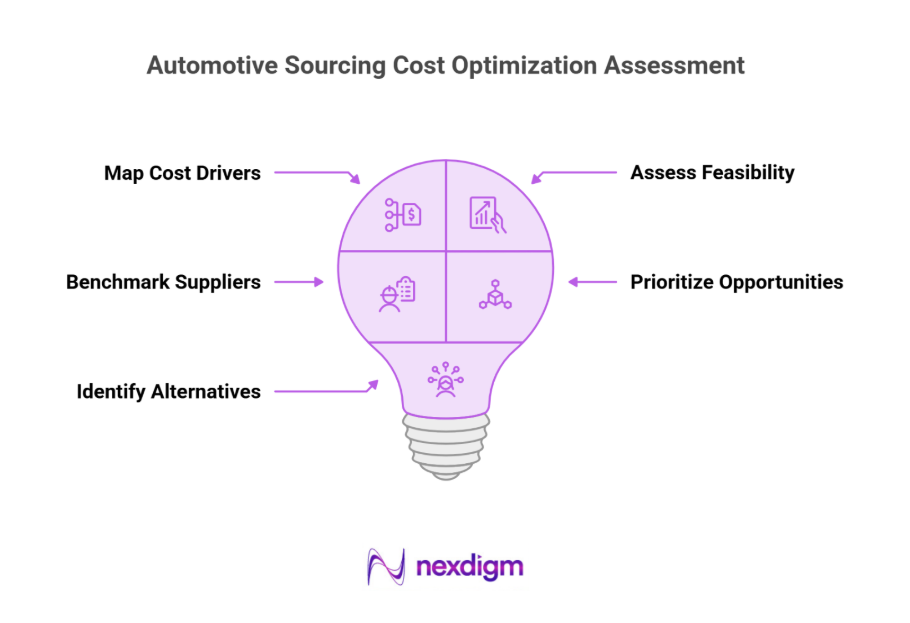
- Map Cost Drivers: Identify the major material, manufacturing, labor, logistics, tooling, and commercial factors influencing sourcing costs.
- Benchmark Suppliers: Compare supplier economics, capabilities, pricing positions, regional footprints, and relevant market conditions.
- Identify Alternatives: Evaluate alternative suppliers, regions, materials, volume allocations, and sourcing structures that could improve overall economics.
- Assess Feasibility: Test potential opportunities against quality, capacity, technical requirements, supply continuity, and implementation considerations.
- Prioritize Opportunities: Rank initiatives based on savings potential, feasibility, risk, and strategic relevance to the OEM.
This stepwise assessment helps convert broad cost-reduction possibilities into prioritized and actionable automotive sourcing cost optimization opportunities.
Nexdigm’s Impact on Automotive Sourcing Cost Optimization
Nexdigm can help procurement teams translate identified cost opportunities into measurable sourcing improvements. By combining supplier intelligence, cost analysis, and market context, the assessment can support:
- Cost Reduction: Identify sourcing levers with realistic potential to improve component and material economics.
- Better Supplier Allocation: Determine where shifting volumes or introducing alternative suppliers could improve competitiveness.
- Stronger Negotiations: Provide cost and market benchmarks that help procurement teams approach supplier discussions with clearer targets.
- Sustainable Savings: Prioritize opportunities that can deliver value while maintaining quality, capacity, supply continuity, and long-term supplier relationships.
This helps organizations approach automotive sourcing cost optimization as an ongoing strategic process rather than a one-time cost-cutting exercise.
Nexdigm’s Case
An automaker assessed 25 suppliers across seven sourcing categories using Nexdigm’s cost-optimization analysis. The assessment identified 32% of sourcing opportunities with significant cost-improvement potential, prioritized 15 supplier actions, and improved cost-analysis efficiency by 29%. The findings supported targeted negotiations, alternative-supplier evaluation, and more informed sourcing allocation.
To take the next step, simply visit our Request a Consultation page and share your requirements with us.
Harsh Mittal
+91-8422857704