

Automotive procurement is operating in a risk environment where cost, continuity, and supplier stability are increasingly connected. Dykema’s 2026 Automotive Trends Report found that 79% of respondents identified tariff-driven cost pressures as a major industry challenge, while 53% cited geopolitical disruptions and 30% pointed to semiconductor and critical-mineral availability. At the same time, BCG describes geopolitical tensions, input-cost pressure, demand volatility, and supply-chain fragility as structural challenges for automotive suppliers in 2026.
The challenge extends beyond identifying individual supplier problems. ACEA’s 2026 analysis found that for six of ten critical automotive inputs, refining and processing are the most vulnerable stages, reflecting concentration across countries, suppliers, and processing hubs. Meanwhile, ISM research shows that although 71% of organizations say balancing cost and risk drives procurement strategy, only 45% consider themselves prepared for supply disruptions.
For automotive organizations, automotive sourcing risk evaluation can provide a structured way to identify critical procurement exposures, assess their potential impact, and determine which mitigation priorities deserve attention.
Procurement Risk Is Becoming a Connected Problem
A sourcing risk rarely remains confined to one procurement decision. A tariff can alter supplier economics; a material shortage can affect production capacity; a regional disruption can expose several suppliers simultaneously. Financial weakness can also amplify operational risks when suppliers have limited room to absorb cost increases or demand changes. This makes risk evaluation less about creating a list of potential threats and more about understanding which risks can interact, where they originate, and how they could affect sourcing continuity.
Major Questions That Clarify Procurement Exposure
A practical risk assessment can begin with three questions:
- What Could Disrupt Supply? Identify exposure to supplier concentration, tariffs, critical materials, geopolitical events, capacity constraints, logistics disruptions, and financial instability.
- What Would Be Affected? Assess the potential effect on component availability, production schedules, procurement costs, customer commitments, and supplier relationships.
- How Quickly Can the Business Respond? Examine alternative suppliers, qualification timelines, inventory coverage, contractual flexibility, regional options, and switching constraints.
Together, these questions help distinguish risks that can be monitored from those requiring proactive mitigation.
Connecting the Risk Signals With Nexdigm
Procurement risks often overlap, making it important to understand how individual exposures interact across the sourcing network. Nexdigm can connect these signals to provide a more integrated view of procurement vulnerability:
- Supplier Exposure: Assess supplier concentration, dependency, capacity, and stability to identify relationships that could create significant sourcing vulnerability.
- Market Exposure: Connect material constraints, regional conditions, tariffs, geopolitical factors, and market movements to understand broader procurement pressures.
- Combined Vulnerabilities: Identify where multiple risk factors overlap, potentially amplifying disruption, cost pressure, or difficulty in finding replacement sources.
Through automotive sourcing risk evaluation, Nexdigm can help organizations turn interconnected risk signals into clearer procurement priorities and more focused mitigation decisions.
Why Nexdigm Is a Strategic Partner
Nexdigm combines automotive industry expertise with supplier intelligence, market research, cost analysis, and risk assessment to provide a connected view of sourcing exposure. This helps organizations move beyond identifying procurement risks to understanding their business impact, evaluating practical alternatives, and prioritizing actions that strengthen cost competitiveness, supply continuity, and sourcing resilience.
Nexdigm’s Automotive Sourcing Risk Evaluation Framework
Nexdigm can structure the assessment around five connected stages, helping procurement teams move from identifying exposure to prioritizing practical responses:
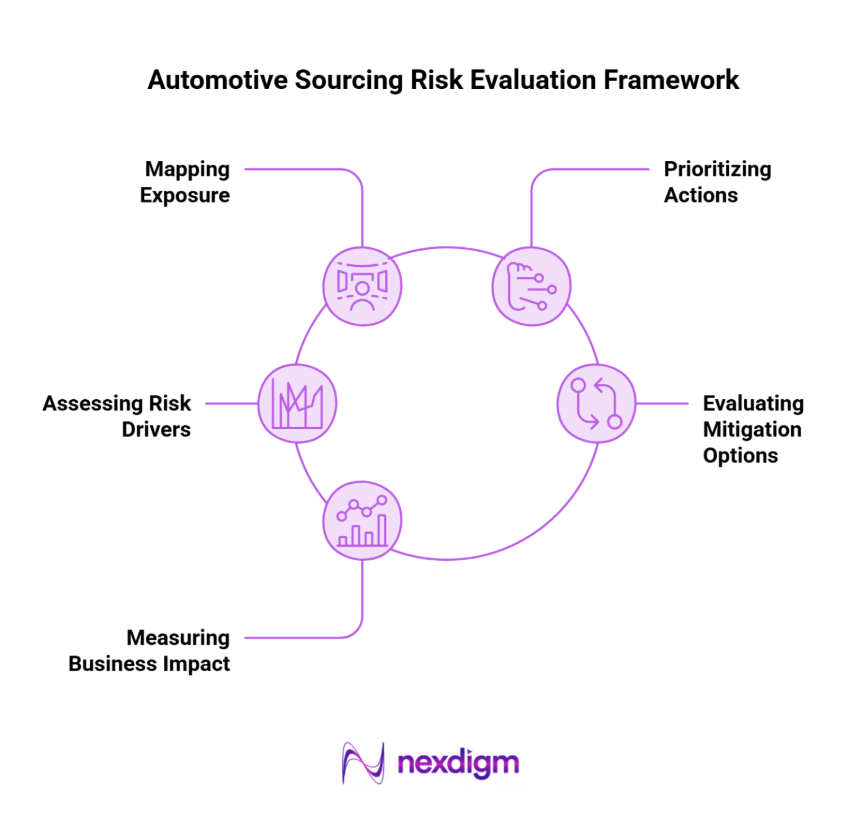
- Map the Exposure: Identify critical suppliers, components, materials, regions, logistics routes, and relevant sub-tier dependencies.
- Assess Risk Drivers: Evaluate supplier concentration, financial stability, capacity, tariffs, geopolitical exposure, material constraints, and operational vulnerabilities.
- Measure Business Impact: Determine how identified risks could affect costs, production continuity, lead times, customer commitments, and sourcing flexibility.
- Evaluate Mitigation Options: Assess alternative suppliers, regional sourcing, supplier development, inventory strategies, contractual measures, and other response options.
- Prioritize Actions: Rank risks and mitigation opportunities based on severity, business criticality, feasibility, urgency, and potential value.
This framework turns automotive sourcing risk evaluation into a structured decision-making process, helping organizations focus resources on the procurement risks that matter most.
How Nexdigm’s Strategic Framework Supports Procurement Teams
A structured risk assessment can give procurement teams a clearer basis for managing sourcing decisions and responding to emerging vulnerabilities:
- Better Risk Visibility: Give teams a consolidated view of supplier, material, geographic, commercial, and operational exposures across the sourcing base.
- Stronger Supplier Decisions: Support supplier selection, diversification, negotiation, and allocation decisions using a clearer understanding of risk and alternatives.
- Improved Cost Control: Identify risks that could drive price increases, expedited freight, inventory costs, or unfavorable commercial conditions.
- Faster Response: Highlight critical dependencies and available alternatives, helping teams respond more quickly when supply conditions change.
- Focused Mitigation: Prioritize resilience actions according to business impact, urgency, feasibility, and potential value.
This enables procurement teams to use automotive sourcing risk evaluation not only for risk identification, but as an input into more informed, resilient, and commercially effective sourcing decisions.
Nexdigm’s Case
An automotive manufacturer evaluated 37 critical supplier relationships across eight procurement categories and five regions using Nexdigm’s sourcing risk assessment. The analysis identified 22% of supplier relationships with elevated risk exposure and prioritized 14 mitigation opportunities across supplier diversification, regional sourcing, capacity planning, and inventory strategies. The findings helped procurement teams focus resources on the sourcing risks most likely to affect cost, supply continuity, and supplier flexibility.
To take the next step, simply visit our Request a Consultation page and share your requirements with us.
Harsh Mittal
+91-8422857704