

In high-volume sheet metal processing, particularly in automotive stamping, benchmarking productivity and cost efficiency is critical for maintaining a competitive edge. From a competitive intelligence perspective, organizations analyze cycle times, material utilization, tooling efficiency, and labor productivity against industry leaders. This benchmarking enables identification of performance gaps, cost drivers, and best practices, supporting data-driven decisions.
In automotive stamping, benchmarking data shows that material utilization in high-volume sheet metal processing typically averages around 60%, with nearly 40% scrap loss, highlighting a major cost-efficiency gap . Improving yield to 70% can reduce material costs by up to 24% and emissions by 26%, indicating strong optimization potential . On a macro level, the global automotive metal stamping market exceeds $90–110 billion with 5% CAGR, driven by automation and productivity gains . Competitive intelligence suggests leaders differentiate through higher press utilization, lower scrap rates, and automation-led throughput improvements.
By leveraging such insights, manufacturers can optimize operations, reduce waste, and enhance throughput while aligning with evolving market demands and competitor capabilities in the automotive stamping landscape.
Competitive Intelligence on Productivity Metrics
Competitive intelligence in automotive stamping focuses on systematically comparing operational performance indicators such as OEE, cycle time, throughput, and labor efficiency across competitors. This analysis enables identification of performance gaps, best practices, and efficiency drivers, supporting data-driven strategies to enhance productivity, optimize resource utilization, and strengthen competitive positioning in high-volume sheet metal processing:
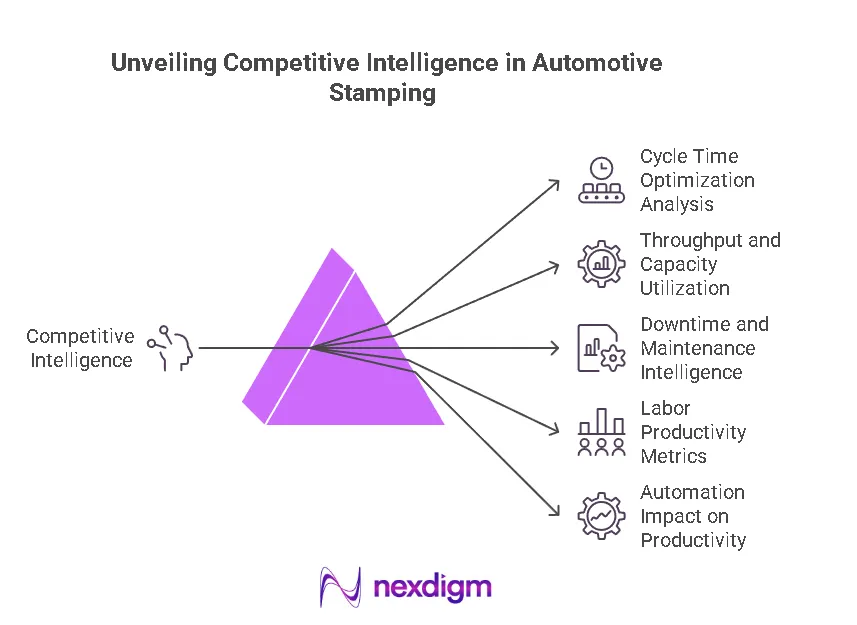
- Cycle Time Optimization Analysis – Evaluate competitor press speeds and takt times to identify throughput improvement opportunities.
- Throughput and Capacity Utilization – Benchmark production volumes and machine utilization rates against industry best performers.
- Downtime and Maintenance Intelligence – Analyze planned vs unplanned downtime and predictive maintenance practices across competitors.
- Labor Productivity Metrics – Compare output per worker and labor efficiency trends across automotive stamping operations.
- Automation Impact on Productivity – Assess how robotics and automation improve speed, consistency, and output efficiency.
Nexdigm’s service offering on Capacity Utilization
Nexdigm focuses on assessing how effectively manufacturing assets, particularly in automotive stamping, are deployed relative to their maximum potential. By analyzing metrics such as machine uptime, throughput, and bottleneck efficiency, the approach integrates competitive intelligence to benchmark performance against industry peers. This enables organizations to identify underutilized resources, uncover hidden capacity, and implement data-driven strategies to enhance operational efficiency and maintain a competitive advantage in high-volume sheet metal processing.
Nexdigm’s Framework for Enhancing Capacity Efficiency
Leveraging productivity metrics competitive intelligence, Nexdigm evaluates capacity, identifies bottlenecks, and aligns operations with industry best practices. The approach integrates technology, lean principles, and performance metrics to improve throughput, reduce inefficiencies, and enable sustainable capacity optimization in high-volume manufacturing environments.
- Capacity Utilization Benchmarking – Nexdigm benchmarks asset utilization against competitors, identifying gaps and improving client capacity efficiency using competitive intelligence insights.
- Bottleneck Identification and Analysis – Nexdigm uses competitive intelligence to detect production constraints and recommend targeted interventions to enhance throughput.
- OEE Improvement Strategy – Nexdigm enhances availability, performance, and quality through data-driven benchmarking aligned with industry leaders.
- Demand vs Capacity Alignment – Nexdigm aligns production capacity with market demand using competitive intelligence to prevent overcapacity or shortages.
- Process Optimization and Lean Implementation – Nexdigm applies lean methodologies informed by competitor practices to eliminate inefficiencies and optimize workflows.
- Technology and Automation Enablement – Nexdigm recommends automation strategies based on competitor benchmarks to improve capacity efficiency and scalability.
Nexdigm’s case:
In a Nexdigm engagement with an automotive stamping manufacturer, Nexdigm applied competitive intelligence–driven capacity benchmarking and OEE analysis to identify underutilized press lines and bottlenecks. By implementing lean process improvements and predictive maintenance strategies, Nexdigm helped increase capacity utilization from 68% to 82% and improved overall throughput by 15%, enabling the client to meet rising demand without additional capital expenditure while strengthening its competitive position.
To take the next step, simply visit our Request a Consultation page and share your requirements with us.
Harsh Mittal
+91-8422857704