

Automotive stamping suppliers manufacture a wide range of components, from brackets and reinforcements to body panels, structural assemblies and precision metal parts. Their capabilities influence vehicle weight, dimensional accuracy, crash performance, production efficiency and the economics of high-volume manufacturing.
The supplier base is varied. Some manufacturers specialise in conventional sheet-metal stamping, while others offer progressive-die operations, transfer presses, hot stamping, tooling development and integrated welding or assembly. Automakers evaluating suppliers need to understand these differences before comparing production capacity or commercial terms.
Press Capacity Is Only the Starting Point
Press capacity is commonly expressed in tonnage, but tonnage alone does not establish whether a supplier can manufacture a particular component. The required press depends on material grade, sheet thickness, component dimensions, forming complexity and production method.
A supplier assessment should distinguish between:
- Mechanical presses: Commonly used for high-speed, repetitive stamping operations.
- Hydraulic presses: Offer control over forming speed and pressure, supporting selected complex forming applications.
- Progressive-die presses: Perform multiple operations as the sheet moves through a sequence of die stations.
- Transfer presses: Move individual blanks between stations and support complex, high-volume component production.
- Hot-stamping lines: Form and quench specialised steel blanks to produce high-strength components, including selected structural and safety-related parts.
The number of presses at a facility should be considered alongside their tonnage range, bed dimensions, operating speed, automation and suitability for the required part family.
Tooling Capability and Engineering Support
Tooling has a direct influence on stamping quality, production efficiency and programme launch timelines. A supplier with in-house die design and maintenance capabilities may offer stronger control over engineering changes and production interruptions than a manufacturer dependent on external tooling partners.
Relevant assessment areas include:
- Die design, development and validation capabilities.
- Toolroom infrastructure and maintenance resources.
- Experience with progressive, transfer and tandem tooling.
- Simulation and forming-analysis capabilities.
- Die changeover time and preventive maintenance.
- Engineering support for design modifications and material changes.
Automakers should also examine tooling ownership, investment requirements and the supplier’s ability to maintain dies over the programme lifecycle. Tooling arrangements can affect both the initial sourcing decision and the cost of transferring production to another manufacturer.
Quality and Material Processing Requirements
Stamping quality depends on material properties, die condition, lubrication, press settings and process stability. Common issues include springback, wrinkling, cracking, dimensional variation and surface defects. These risks become more significant when suppliers handle high-strength steels, aluminium sheets or complex structural components.
Quality assessment should consider:
- Incoming sheet-metal inspection and material traceability.
- Dimensional measurement and process monitoring.
- Die maintenance and wear-control practices.
- Formability assessment and defect-prevention methods.
- Traceability across production batches.
- Experience with automotive quality requirements and customer-specific processes.
A supplier’s experience with conventional mild steel should not automatically be treated as proof of capability in advanced high-strength steel or aluminium stamping. Material-specific expertise is important when vehicle platforms use lightweight or safety-oriented structures.
OEM Relationships and Manufacturing Scale
Existing OEM relationships provide insight into a supplier’s programme experience, quality expectations and ability to operate within automotive production systems. However, customer names alone do not establish available capacity or technical suitability.
A supplier map should capture:
- OEM and Tier 1 customer relationships.
- Component categories supplied to each customer segment.
- Manufacturing locations and regional coverage.
- Production capacity and utilisation indicators.
- Exposure to passenger vehicles, commercial vehicles and two-wheelers.
- Export markets and cross-border manufacturing operations.
India’s stamping ecosystem includes suppliers such as Gestamp, JBM Auto, Tata AutoComp, CIE Automotive India and specialist sheet-metal manufacturers. Their operations differ in product focus, press technology, engineering resources and customer exposure. Supplier intelligence should make these distinctions visible.
Using Market Intelligence to Compare Stamping Suppliers
A useful assessment links the supplier’s equipment and engineering capabilities to the actual requirements of an automotive platform. For example, a manufacturer with high-tonnage hot-stamping capability may be relevant for structural safety components, while another with extensive progressive-die capacity may be better suited to high-volume brackets and precision stampings.
Automotive stamping supplier intelligence can help procurement teams understand these differences by mapping press configurations, tooling resources, plant locations, customer relationships and manufacturing specialisations.
Nexdigm’s procurement research can support this process through supplier landscape mapping, facility profiling, capacity analysis and regional market comparisons. The resulting intelligence helps identify manufacturers whose capabilities align with specific component categories and sourcing requirements.
Automotive Stamping Supplier Intelligence Framework
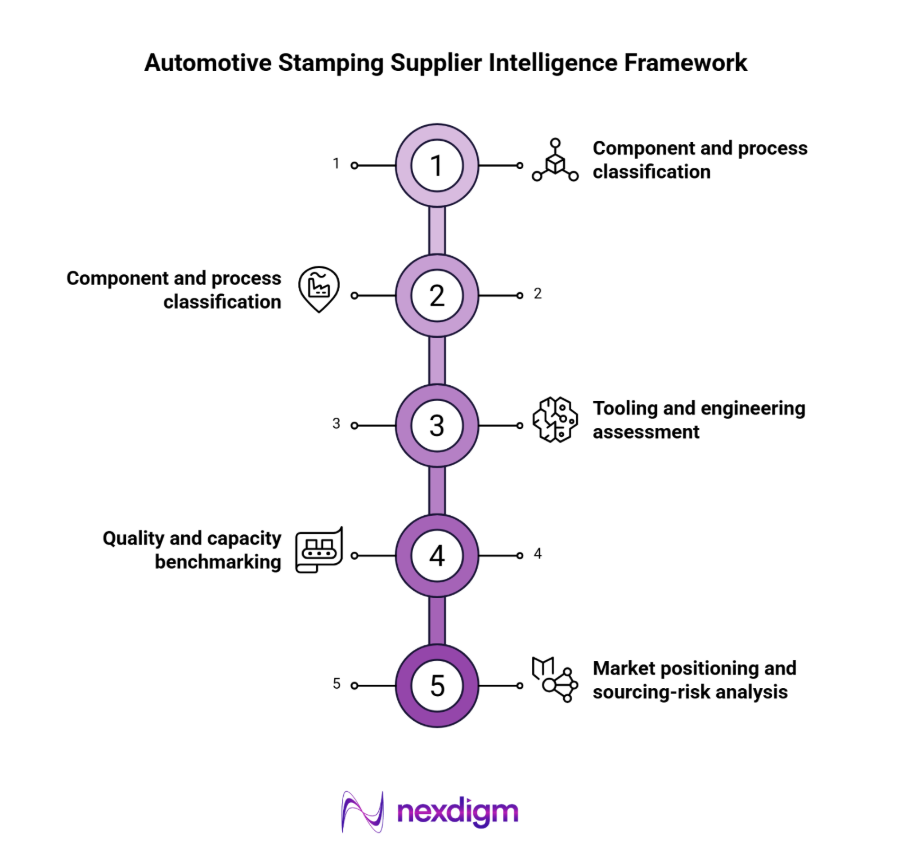
- Component and process classification: Identify part geometry, material grade, sheet thickness, production volume and suitable stamping processes.
- Supplier and facility mapping: Profile manufacturers by press technology, tonnage range, plant locations, product portfolio and OEM relationships.
- Tooling and engineering assessment: Compare die-development resources, simulation capabilities, maintenance infrastructure and technical support.
- Quality and capacity benchmarking: Evaluate process controls, material-handling capability, equipment utilisation indicators and production scalability.
- Market positioning and sourcing-risk analysis: Assess customer concentration, regional coverage, technology investments and alternative supplier availability.
Case Study: Mapping Automotive Stamping Capabilities
An OEM reviewing structural stamping sources required visibility into press capacity and hot-stamping experience. Nexdigm’s research mapped 18 suppliers across three manufacturing regions, compared press configurations and tooling capabilities, and identified five vendors with relevant structural-component experience for further evaluation.
To take the next step, simply visit our Request a Consultation page and share your requirements with us.
Harsh Mittal
+91-8422857704