

Automotive startups are scaling rapidly across mobility and electrification segments as investors support new solutions in EVs, battery technology, charging infrastructure, fleet platforms, and connected mobility services. A strong Automotive startup expansion strategy helps startups identify high-growth markets, build partnerships, manage funding effectively, and position their offerings against established automotive players.
Startups must assess customer demand, regulatory requirements, infrastructure readiness, and competitive gaps before expanding. With rising investment support, automotive startups can accelerate innovation, improve market reach, and contribute to the transformation of traditional vehicle ownership and mobility ecosystems.
Global funding for automotive startups reached nearly USD 170.8 billion by 2025, growing at a 23% CAGR from 2009 to 2025. Mobility technology and service funding also rose to USD 54 billion in 2024, the second-highest level recorded. These figures show that investors are backing startups focused on electrification, battery technologies, software-defined vehicles, autonomous systems, and mobility platforms.
Investment Readiness Planning for Automotive Startup Expansion
Investment Readiness Planning for Automotive Startup Expansion helps startups assess funding needs, business models, market potential, financial projections, investor expectations, regulatory readiness, and scalability before entering new automotive markets:
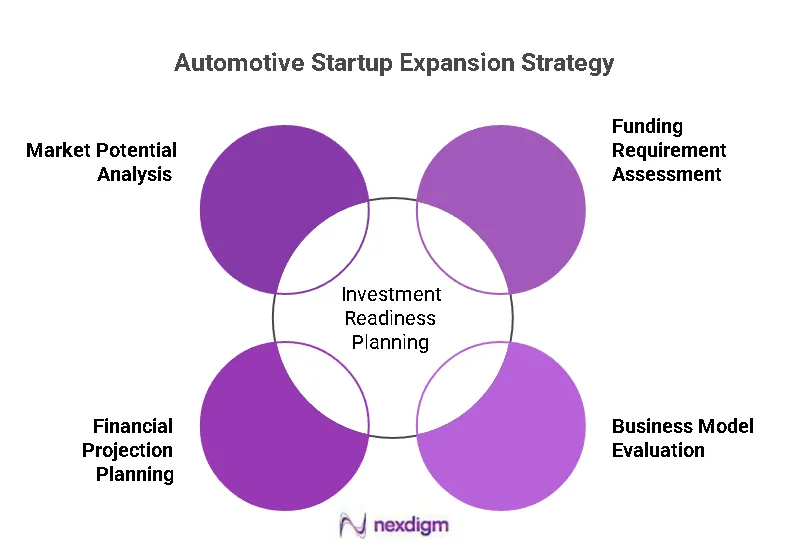
- Funding Requirement Assessment: Identifies capital needed for product development, hiring, operations, marketing, technology, infrastructure, and market expansion.
- Business Model Evaluation: Reviews revenue streams, pricing approach, unit economics, customer segments, and scalability of the startup’s automotive solution.
- Financial Projection Planning: Prepares revenue forecasts, cost estimates, cash flow expectations, profitability timelines, and investor-ready financial assumptions.
- Market Potential Analysis: Assesses demand, competition, adoption trends, customer pain points, and growth opportunities in target automotive markets.
Nexdigm Go-to-Market Planning for Automotive Startup Launches
Nexdigm Go-to-Market Planning for Automotive Startup Launches helps startups enter mobility and electrification markets with a clear launch roadmap. It supports customer targeting, market entry strategy, pricing, channel planning, partnerships, regulatory readiness, and demand assessment. By aligning product value with market needs, Nexdigm helps automotive startups improve visibility, attract investors, reduce launch risks, and scale effectively.
Nexdigm Customer Demand Assessment for Mobility and Electrification Solutions
Nexdigm Customer Demand Assessment for Mobility and Electrification Solutions evaluates buyer needs, adoption readiness, pricing expectations, usage behavior, infrastructure gaps, and regional demand to support effective startup expansion.
- Regional Demand Mapping: Nexdigm identifies high-potential cities, fleet clusters, charging zones, and customer segments for mobility and electrification expansion.
- Pricing Expectation Review: Nexdigm evaluates acceptable pricing, subscription models, usage fees, ownership costs, and affordability levels among target customers.
- Infrastructure Gap Assessment: Nexdigm studies charging access, service availability, digital connectivity, and operational support needed for successful adoption.
- Customer Segment Profiling: Nexdigm groups customers by usage needs, income, location, fleet requirements, sustainability goals, and technology readiness.
Nexdigm’s case:
Nexdigm supported an automotive startup assess customer demand for mobility and electrification solutions before expanding into India’s urban markets. The team analyzed 3,200 customer responses, reviewed mobility usage patterns across 9 cities, and mapped 150 charging and service locations. Findings showed that 61% of target users preferred electric mobility options if charging access and operating costs improved. Based on Nexdigm’s recommendations, the startup prioritized 4 launch cities, refined pricing, and built partnerships with charging operators.
To take the next step, simply visit our Request a Consultation page and share your requirements with us.
Harsh Mittal
+91-8422857704