

Strategic expansion roadmaps help automotive companies prioritize growth across global markets by identifying where, when, and how to enter new regions. An effective Automotive strategic expansion roadmap evaluates market potential, customer demand, competition, regulations, investment needs, supply chain readiness, and distribution opportunities. As part of a market entry strategy, it enables companies to compare countries, select high-growth segments, and allocate resources efficiently.
This approach reduces expansion risks and supports better decision-making across EVs, passenger vehicles, commercial vehicles, and mobility services. By aligning growth priorities with market realities, automotive companies can build scalable, profitable, and sustainable global expansion plans.
Recent data shows why structured expansion roadmaps are important for global automotive growth. Global new vehicle sales were forecasted at 89.6 million units in 2025, reflecting 1.7% year-on-year growth, while later 2025 estimates placed light-vehicle sales near 91.7 million units. Electric car sales were also expected to exceed 20 million units in 2025, representing around one-fourth of total car sales.
Automotive Strategic Expansion Roadmap for Global Market Entry
Automotive Strategic Expansion Roadmap for Global Market Entry helps companies prioritize target countries, assess demand, competition, regulations, investment needs, supply chains, and distribution channels for structured international growth:
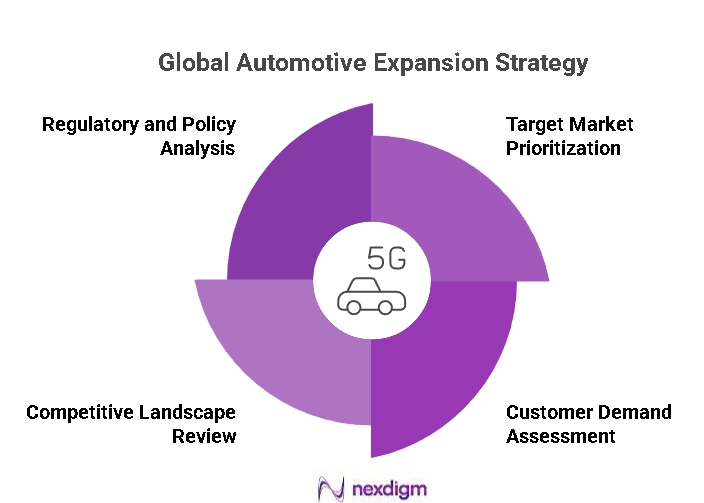
- Target Market Prioritization: Identifies attractive countries based on demand potential, competition, regulations, investment needs, infrastructure, and long-term growth opportunities.
- Customer Demand Assessment: Evaluates buyer preferences, vehicle usage patterns, affordability, segment demand, and adoption readiness across selected global markets.
- Competitive Landscape Review: Studies local and international competitors, pricing, product positioning, distribution strength, and market share across target regions.
- Regulatory and Policy Analysis: Reviews import rules, safety standards, emission norms, tax structures, incentives, and compliance requirements before market entry.
Nexdigm Dealer and Distribution Network Planning Across Global Markets
Nexdigm Dealer and Distribution Network Planning Across Global Markets helps automotive companies identify suitable dealers, distributors, retail partners, and service networks in target countries. It assesses regional demand, channel strength, logistics feasibility, customer access, and partner capabilities. This supports smoother market entry, wider vehicle availability, stronger after-sales reach, and improved expansion performance across international automotive markets.
Nexdigm Regulatory and Policy Review for Cross-Border Automotive Expansion
Nexdigm Regulatory and Policy Review for Cross-Border Automotive Expansion helps companies assess import rules, safety standards, tax policies, emission norms, incentives, approvals, and compliance risks before entering international markets.
- Import Regulation Assessment: Nexdigm reviews import duties, customs rules, documentation needs, and vehicle approval requirements for cross-border automotive entry.
- Safety and Emission Standards: Nexdigm evaluates crash norms, emission limits, certification requirements, and technical compliance before launching vehicles internationally.
- Tax Policy Review: Nexdigm studies corporate tax, indirect tax, VAT, GST, tariffs, and local levies affecting market entry costs.
- Incentive and Subsidy Analysis: Nexdigm identifies EV incentives, manufacturing subsidies, tax benefits, and policy support available in target global markets.
Nexdigm’s case:
Recently, Nexdigm engaged with a global automotive manufacturer to review regulatory and policy requirements before expanding into Southeast Asian markets. The team assessed 5 target countries, reviewed 40+ compliance checkpoints, and compared import duties, emission norms, tax rules, EV incentives, and dealer approval requirements. Nexdigm identified 12 key regulatory risks that could affect launch timelines and cost planning. Based on its recommendations, the company refined its market entry sequence, prioritized 3 lower-risk markets, and improved cross-border expansion readiness.
To take the next step, simply visit our Request a Consultation page and share your requirements with us.
Harsh Mittal
+91-8422857704