

Automotive supply networks are becoming more concentrated around a small number of suppliers, processing hubs, and manufacturing regions. The latest ACEA analysis of ten critical automotive inputs found that six have refining and processing as their most vulnerable stage, with limited alternatives and long lead times for developing new capacity. The IEA also reports that the average share of the top refining country across key energy minerals reached 72% in 2025, up from 70% in 2023.
The concentration extends into EV manufacturing. In 2025, China accounted for 70% of global electric-car production and more than 80% of battery-cell production, while its share of cathode and anode active-material production was approximately 85% and over 90%, respectively.
For OEMs and suppliers, automotive supplier dependency assessment can help reveal where sourcing networks rely heavily on particular suppliers, regions, materials, or production stages and where those dependencies could create meaningful business exposure.
Dependency Is Becoming a Supply-Chain Design Question
Supplier dependency is not simply about having one supplier instead of two. Multiple suppliers may still rely on the same processor, country, raw material, technology, or logistics route. A disruption at that shared point can therefore affect several supposedly diversified suppliers simultaneously. Effective dependency assessment needs to examine these common links and distinguish genuine diversification from apparent diversification.
Mapping Hidden Dependencies Across Automotive Supply Networks
As automotive supply chains become more global and interconnected, dependency risks often extend beyond direct supplier relationships. A supplier may appear independent on the surface while relying on the same upstream processor, raw material source, or manufacturing cluster as several competitors. This makes it increasingly important to identify dependencies across multiple tiers of the supply chain rather than focusing solely on immediate suppliers.
Nexdigm’s Expertise in Connecting the Supply Chain Dots
A supplier network can look diversified on paper while remaining connected through the same material source, region, technology, or upstream processor. Nexdigm brings these relationships together to reveal the dependencies that may not be visible through conventional supplier-level reviews.
Through automotive supplier dependency assessment, Nexdigm can connect supplier footprints, sub-tier relationships, regional concentration, material exposure, and sourcing criticality to help organizations understand where individual dependencies intersect and where those intersections could amplify supply risk.
Nexdigm’s Expert-led Automotive Supplier Dependency Assessment
Nexdigm’s automotive supplier dependency assessment can help organizations look beyond direct supplier relationships to understand the concentration and interconnectedness within their supply base by focusing on the following areas:
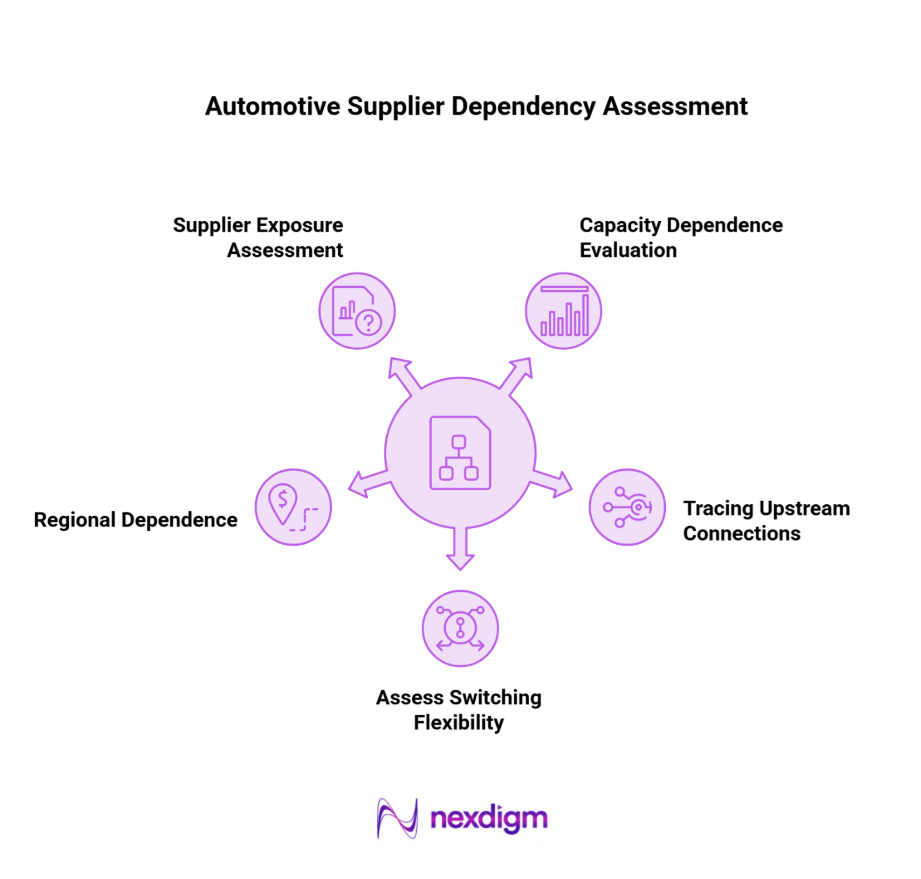
- Supplier Exposure: Assessing dependence on critical suppliers, limited-capacity manufacturers, specialized technologies, and production locations.
- Regional Dependence: Identifying concentration across countries, manufacturing clusters, processing hubs, and logistics corridors that may create shared exposure.
- Upstream Connections: Tracing sub-tier suppliers, materials, processors, and common sources to uncover dependencies that may remain hidden within a diversified Tier 1 network.
- Capacity Dependence: Evaluating whether critical suppliers have sufficient capacity, scalability, and flexibility to support changing production requirements.
- Switching Flexibility: Assessing alternative-source availability, qualification requirements, switching timelines, and potential barriers to reducing supplier dependence.
This provides a clearer view of where dependency is concentrated, how it could affect supply continuity, and where resilience measures may be most relevant.
How Nexdigm’s Assessment Can Strengthen Competitiveness
Understanding supplier dependency can also support broader sourcing and competitive decisions. Nexdigm’s assessment can help organizations:
- Improve Negotiating Position: Identify concentration points and credible alternatives to create stronger leverage in supplier discussions.
- Optimize Supplier Allocation: Compare dependency levels, capabilities, and commercial positioning to determine where sourcing volumes can be better distributed.
- Protect Cost Competitiveness: Identify dependencies that could expose the business to sudden price increases, capacity constraints, or unfavorable sourcing conditions.
- Support Faster Decisions: Provide clearer visibility into qualified alternatives, helping procurement teams respond more confidently to supplier or market changes.
By connecting dependency analysis with sourcing strategy, businesses can use automotive supplier dependency assessment not only to manage risk, but also to strengthen cost competitiveness, sourcing flexibility, and long-term supply positioning.
Nexdigm’s Case
An automotive manufacturer assessed 35 critical suppliers across eight component categories and five regions using Nexdigm’s automotive supplier dependency assessment. The analysis identified 22% of supplier relationships with elevated concentration exposure, uncovered 17 critical sub-tier dependencies, and identified 14 sourcing and resilience opportunities. The findings helped the manufacturer prioritize supplier diversification, regional sourcing, and capacity-planning initiatives.
To take the next step, simply visit our Request a Consultation page and share your requirements with us.
Harsh Mittal
+91-8422857704