

Automotive suppliers are operating in a more demanding environment where disruption readiness is becoming a competitive capability. A 2026 Global Automotive Supplier Study, based on financial analysis of more than 750 suppliers and almost 50 OEMs, identifies supply-chain fragility, geopolitical tensions, labor shortages, and demand volatility as persistent industry challenges. The study also highlights resilient and multilocal supply systems as a strategic priority.
The gap between resilience strategy and execution remains significant. ISM and Amazon Business research covering 425 global supply-chain professionals found that 71% say balancing cost and risk now drives procurement strategy, but only 45% say their organizations are prepared for supply disruptions. Meanwhile, EFESO’s 2026 survey found that only 71% of automotive respondents report full or partial supply-network visibility, while just 22% primarily use advanced analytics or real-time visibility tools for decision support.
For OEMs and procurement teams, automotive supplier resilience analysis can help distinguish suppliers that can absorb disruption from those whose operational, financial, or network constraints could create downstream exposure.
Resilience Is More Than Having a Backup Supplier
A resilient supplier needs more than an alternative source. It needs the capacity, financial strength, operational flexibility, inventory position, workforce, logistics capability, and recovery processes required to maintain performance when conditions change. Demand volatility can further complicate this equation: BCG notes that several BEV programs in the first half of 2025 deviated from original sales forecasts by up to four times. This makes supplier resilience a multi-dimensional capability, not a single performance metric.
Key Signals of a Resilient Automotive Supplier
A practical resilience assessment can focus on three connected areas:
- Operational Readiness: Examine capacity, flexibility, inventory, workforce, maintenance, quality systems, and contingency processes supporting consistent production.
- Financial Stability: Evaluate liquidity, profitability, leverage, customer concentration, investment capacity, and other indicators that could affect a supplier’s ability to withstand pressure.
- Recovery Capability: Assess alternative facilities, backup suppliers, business-continuity plans, geographic flexibility, and the speed at which operations can recover.
Together, these indicators help organizations distinguish suppliers that perform well under normal conditions from those prepared to withstand disruption.
Nexdigm’s Expertise in Automotive Supplier Resilience
Resilience cannot be judged from supplier performance data alone. Nexdigm can bring together supplier intelligence, operational information, market conditions, financial indicators, and geographic insights to develop a broader view of supplier preparedness.
Through automotive supplier resilience analysis, Nexdigm can help organizations assess how suppliers may respond to capacity disruptions, demand shifts, cost pressures, geopolitical events, logistics interruptions, and other challenges.
What Nexdigm’s Resilience View Reveals
Looking beyond conventional supplier performance can uncover important differences in how suppliers may respond when conditions change. Nexdigm’s assessment can help procurement teams understand:
- Where Resilience Is Strong: Identify suppliers with flexible capacity, robust operations, diversified networks, and stronger recovery capabilities.
- Where Vulnerabilities Sit: Highlight dependencies linked to limited capacity, financial pressure, geographic concentration, sub-tier exposure, or weak contingency readiness.
- Where Action Is Needed: Determine which supplier relationships may benefit from diversification, supplier development, capacity planning, inventory measures, or alternative sourcing.
This gives procurement teams a clearer basis for strengthening supplier resilience before disruption turns into a sourcing problem.
Nexdigm’s Approach to Strengthening Supplier Resilience
Once resilience gaps are visible, Nexdigm can help translate them into focused actions through automotive supplier resilience analysis, tailored to each supplier and sourcing category:
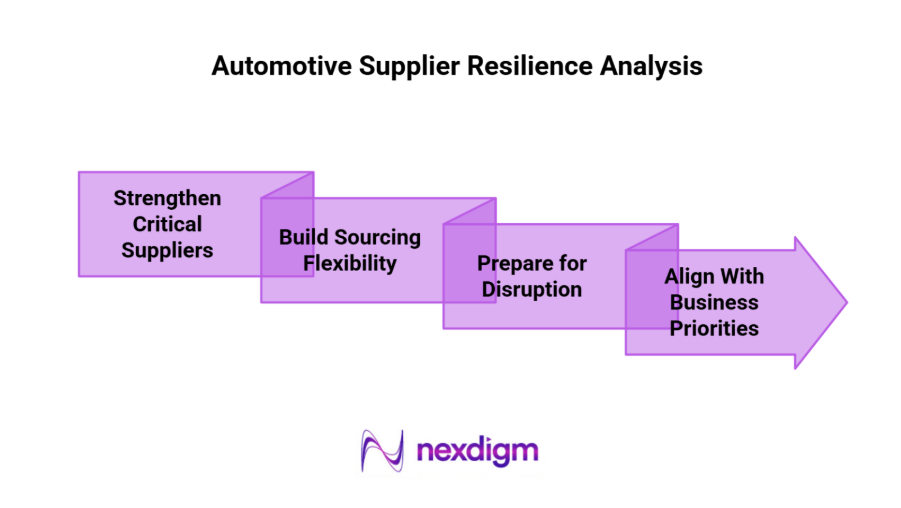
- Strengthen Critical Suppliers: Identify capability, capacity, financial, or operational gaps that could be addressed through targeted supplier-development initiatives.
- Build Sourcing Flexibility: Evaluate alternative suppliers, regional sources, and capacity options where existing dependencies create significant continuity exposure.
- Prepare for Disruption: Assess inventory buffers, contingency plans, recovery arrangements, and response mechanisms for suppliers supporting critical components.
- Align With Business Priorities: Connect resilience actions with cost, quality, production requirements, strategic programs, and long-term sourcing objectives.
This approach helps organizations move from measuring supplier resilience to actively strengthening the areas that matter most to supply continuity.
Why Businesses Trust Nexdigm for Supplier Resilience
Supplier resilience decisions require more than isolated supplier data. Nexdigm brings together automotive industry understanding, supplier intelligence, market research, financial analysis, and geographic insights to provide a broader view of:
- Industry Understanding: Apply automotive-specific context to evaluate supplier capabilities, dependencies, and disruption exposure.
- Connected Analysis: Link operational, financial, geographic, and supply-network factors to create a more complete resilience view.
- Actionable Insights: Translate findings into practical priorities around supplier development, diversification, capacity, and continuity planning.
This combination helps businesses use automotive supplier resilience analysis as a strategic input for stronger sourcing and supply-continuity decisions.
Nexdigm’s Case
An automotive manufacturer assessed critical suppliers across five regions using Nexdigm’s automotive supplier resilience analysis. The assessment identified 22% with elevated resilience exposure and prioritized 14 actions across capacity, diversification, inventory, and continuity planning, helping procurement strengthen supply continuity and sourcing flexibility.
To take the next step, simply visit our Request a Consultation page and share your requirements with us.
Harsh Mittal
+91-8422857704