

Automotive supply networks are being redesigned as concentration risk, tariffs, geopolitical uncertainty, and critical-material dependencies reshape sourcing decisions. Nexdigm’s 2026 Global Automotive Supplier Study identifies geopolitical and trade pressures, supply-chain fragility, and demand volatility among the industry’s growing concerns, while recommending multilocal, shock-resilient supply systems as a strategic priority.
The move toward diversification is already visible across procurement. AAPEX’s 2026 State of the Automotive Aftermarket Survey found that 46% of respondents were actively diversifying their supply chains, while another 18% were planning to do so; together, 70% had completed, were pursuing, or were planning supplier diversification. Another 2026 supply-chain survey similarly found that 34% of respondents were using supplier diversification or flexible distribution networks to mitigate geopolitical risk.
For automotive OEMs, suppliers, and procurement teams, an automotive supply base diversification strategy can help determine where concentration should be reduced, which alternatives are viable, and how sourcing can become more resilient without unnecessarily increasing cost.
Diversification Is Not Simply About Adding More Suppliers
A larger supplier list does not automatically create a more resilient supply base. Several suppliers may still depend on the same country, processor, raw material, technology, or logistics corridor. Genuine diversification requires independent capacity, viable alternatives, and the ability to shift volumes when conditions change. The objective is therefore to create meaningful optionality, enough supplier, regional, and capacity flexibility to absorb disruption while preserving cost, quality, and delivery performance.
Where Diversification Creates the Most Value
Diversification is most valuable where supplier concentration intersects with high business criticality, limited substitutes, or significant regional exposure. Components with long qualification cycles or constrained capacity may warrant greater sourcing flexibility, while lower-risk categories may not justify the added complexity. The priority is to identify where additional sourcing options can materially improve resilience, negotiating leverage, and continuity without unnecessarily increasing procurement costs.
Nexdigm’s Expertise Making Diversification More Strategic
Nexdigm combines supplier intelligence, market understanding, cost analysis, and regional insights to help organizations identify where diversification can create meaningful business value by focusing on:
- Identifying Alternatives: Evaluating suppliers and regions based on capability, capacity, cost, quality, qualification, and strategic fit.
- Comparing Sourcing Options: Assessing how different supplier allocations could influence procurement costs, availability, capacity, and supply continuity.
- Prioritizing Opportunities: Focusing on diversification of efforts on categories where additional sourcing flexibility can meaningfully improve resilience and competitive positioning.
Through an automotive supply base diversification strategy, Nexdigm helps organizations pursue targeted diversification rather than simply adding more suppliers.
Nexdigm’s Approach to Building the Right Supplier Mix
Diversification creates value when the supplier portfolio is deliberately structured around resilience, capability, and commercial efficiency. Nexdigm can help organizations shape this portfolio by assessing:
- Balance Supplier Roles: Determine where primary, secondary, and emerging suppliers can contribute based on capability, capacity, and strategic importance.
- Optimize Volume Allocation: Evaluate sourcing shares across suppliers to reduce concentration without unnecessarily sacrificing purchasing leverage or operational efficiency.
- Build Capacity Flexibility: Identify where additional qualified capacity can provide greater flexibility during demand changes, disruptions, or production shifts.
- Strengthen Regional Coverage: Assess how suppliers across different regions can reduce geographic exposure while maintaining competitive sourcing economics.
- Support Long-Term Scalability: Evaluate whether the supplier portfolio can accommodate future volume growth, new programs, technology shifts, and changing market requirements.
This helps organizations create a supplier portfolio that is resilient enough to manage disruption while remaining efficient, competitive, and scalable.
Nexdigm’s Automotive Supply Base Diversification Assessment
Nexdigm can structure the assessment around five practical steps to determine where diversification is needed and how the supplier portfolio can be strengthened:
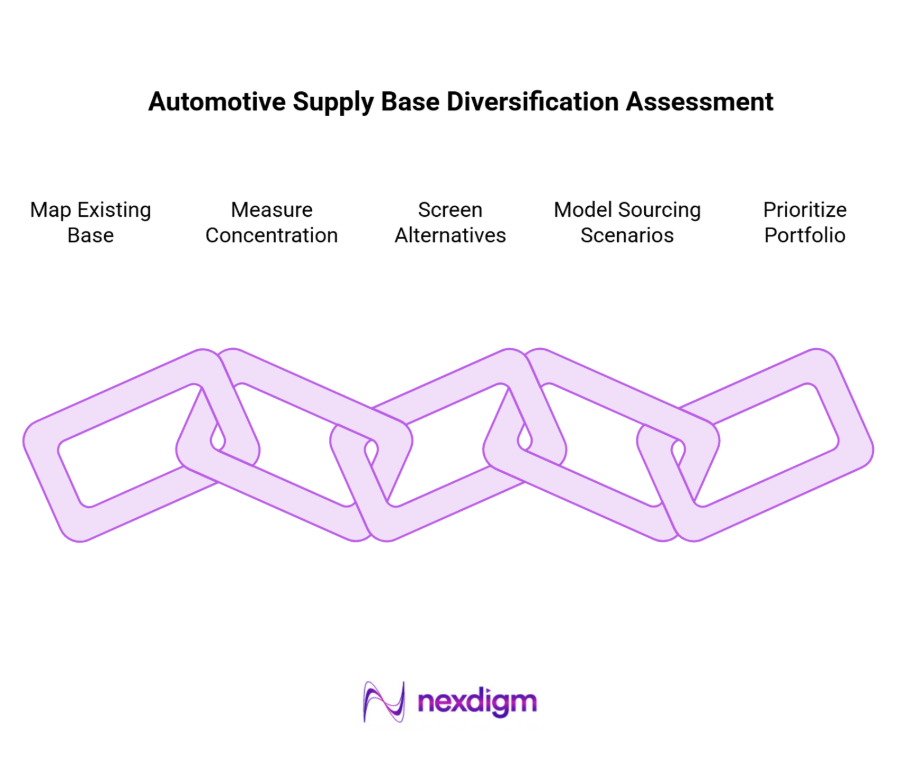
- Map the Existing Base: Identify suppliers, categories, regions, capacities, current sourcing shares, and key dependencies.
- Measure Concentration: Assess supplier, regional, material, capacity, and sub-tier concentration to identify areas of elevated exposure.
- Screen Alternatives: Evaluate potential suppliers and sourcing regions based on capability, quality, cost, capacity, qualification, and strategic fit.
- Model Sourcing Scenarios: Compare dual sourcing, volume reallocation, regional diversification, and other portfolio configurations.
- Prioritize the Portfolio: Balance resilience, cost, quality, availability, feasibility, and strategic importance to determine the preferred diversification path.
This structured approach helps turn an automotive supply base diversification strategy into a practical sourcing roadmap rather than a simple supplier-expansion exercise.
How Nexdigm’s Assessment Creates a Sourcing Advantage
A structured diversification assessment can help procurement teams understand where supplier concentration is creating exposure and where alternative sourcing can add value. By connecting supplier capability, regional coverage, cost, capacity, and resilience, Nexdigm can help organizations make more informed allocation decisions. The result is a supply base designed not only to absorb disruption, but also to support stronger sourcing flexibility and long-term competitiveness.
Nexdigm’s Case
An automotive manufacturer reviewed critical supplier relationships across eight component categories and five regions to assess concentration and diversification opportunities. Nexdigm’s analysis identified 22% of supplier relationships with elevated concentration exposure and uncovered 17 critical sub-tier dependencies. The assessment helped procurement teams focus diversification efforts on the areas with the greatest potential.
To take the next step, simply visit our Request a Consultation page and share your requirements with us.
Harsh Mittal
+91-8422857704