

Automotive supply chains are becoming more interconnected as manufacturers source components, materials, and technologies across multiple countries. In 2025, global vehicle production reached 96.4 million units, while electric-car production approached 22 million units, increasing the number of batteries, semiconductors, electronics, and specialized components required across the industry.
At the same time, disruptions to major shipping routes can quickly affect delivery schedules and inventory planning. The automotive sector also remains exposed to concentrated suppliers for several critical inputs. These conditions make automotive supply chain bottleneck prediction increasingly relevant.
Businesses need to identify where supplier concentration, logistics constraints, trade dependencies, capacity limitations, or rising demand could create pressure before those risks translate into production delays or higher costs.
Supply Risks Can Build Before Disruptions Become Visible
A supply-chain bottleneck rarely emerges from one factor alone. A supplier may have sufficient capacity but depend on a constrained port, a single upstream material, or a specific trade corridor. Similarly, strong vehicle demand can place pressure on components even when production capacity appears adequate. Monitoring supplier concentration, logistics performance, trade flows, capacity utilization, and demand together can therefore provide earlier visibility into potential bottlenecks.
Signals That Can Point to Emerging Bottlenecks
Businesses can strengthen risk visibility by monitoring changes across both supply and demand.
- Supplier Concentration: Heavy dependence on a limited number of suppliers or countries can increase exposure when capacity, trade, or production conditions change.
- Logistics and Trade Pressure: Rising shipment delays, route disruptions, freight constraints, or changing trade policies can create bottlenecks even when component supply remains available.
Together, these indicators help businesses identify where supply pressure may develop and which parts of the automotive value chain require closer monitoring.
How Nexdigm Identifies Supply Chain Bottleneck Risks
Nexdigm combines trade intelligence, supplier research, automotive market intelligence, logistics analysis, and competitive assessment to identify the factors that can create supply-chain pressure.
Our automotive supply chain bottleneck prediction approach can examine supplier concentration, production capacity, trade flows, import dependencies, logistics routes, shipment patterns, demand growth, and alternative sourcing markets.
Rather than assessing risks in isolation, Nexdigm connects these signals to determine where vulnerabilities are concentrated, what could trigger a bottleneck, and which alternatives businesses can evaluate before disruption occurs.
Nexdigm’s Role in Converting Risk Signals into Supply Chain Intelligence
Identifying a potential bottleneck is only the first step. Nexdigm evaluates the severity, timing, concentration, and business impact of each risk to help decision-makers with:
- Prioritize Critical Dependencies: Assess supplier concentration, component importance, capacity availability, and sourcing alternatives to distinguish high-impact dependencies from lower-risk exposures.
- Evaluate Risk Intersections: Connect supplier, trade, logistics, and demand signals to identify situations where multiple pressures could converge and amplify disruption risk.
- Identify Mitigation Options: Compare alternative suppliers, markets, logistics routes, and capacity sources to determine practical options for reducing exposure.
This approach transforms fragmented risk signals into a prioritized view of potential bottlenecks and the actions businesses can take to strengthen supply continuity.
Nexdigm’s Supply Chain Bottleneck Assessment
Nexdigm examines the supply chain across interconnected risk dimensions to identify where vulnerabilities could develop and how they may affect automotive production. Such dimensions are:
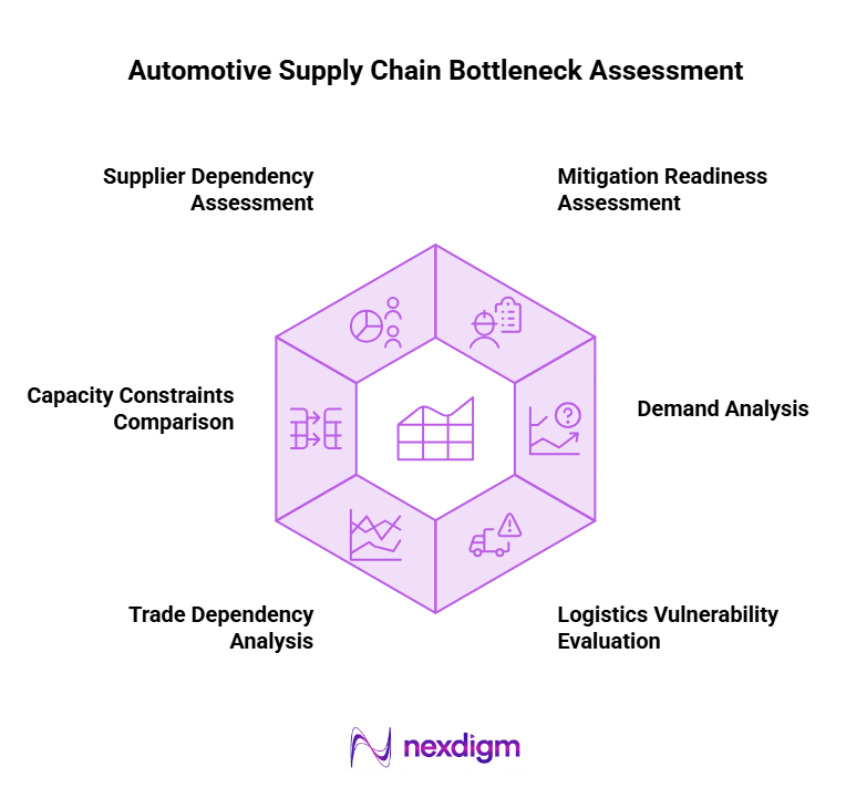
- Supplier Dependency: Assess supplier concentration, country exposure, production locations, and availability of alternative sources.
- Capacity Constraints: Compare supplier capacity, utilization, production requirements, and demand growth to identify potential supply-demand gaps.
- Trade Dependencies: Analyze import reliance, trade corridors, product flows, and changes in sourcing markets that could increase exposure.
- Logistics Vulnerability: Evaluate ports, shipping routes, transit dependencies, freight conditions, and alternative logistics pathways.
- Demand Pressure: Track vehicle production, segment growth, EV adoption, and component requirements to identify areas where rising demand could strain supply.
- Mitigation Readiness: Assess alternative suppliers, markets, logistics routes, and production sources to determine how quickly businesses could respond to a disruption.
Together, these focus areas provide a structured view of where bottlenecks could emerge, what factors could intensify them, and which mitigation options are available.
Nexdigm’s Case
Nexdigm assessed an automotive client’s exposure across 16 markets and 18 critical components. The analysis identified five high-risk supplier dependencies, with selected sources accounting for over 45% of imports, and flagged eight alternative sourcing opportunities. These insights helped the client prioritize supplier diversification and contingency planning for vulnerable components.
To take the next step, simply visit our Request a Consultation page and share your requirements with us.
Harsh Mittal
+91-8422857704