

Automotive supply chains are becoming more complex as vehicle platforms evolve, sourcing networks globalize, and OEMs face growing pressure to balance cost with resilience. Disruptions involving logistics, critical materials, trade policies, or individual suppliers can quickly affect production schedules and margins.
For automotive businesses, organizations like Nexdigm bring a market-led and commercially focused perspective to supply-chain questions, helping companies understand not only where components are sourced, but also where dependencies, bottlenecks, and opportunities for localization exist.
What Makes an Automotive Supply Chain Resilient?
Supply-chain resilience is about more than having multiple suppliers. It depends on how quickly a company can respond when a supplier, geography, logistics route, or critical input becomes unavailable. Organizations believe that resilience can be evaluated through three interconnected dimensions:
- Localization: How much of the supply base can be sourced domestically?
- Supplier concentration: How dependent is production on a limited number of suppliers, countries, or upstream sources?
- Logistics risk: How exposed is the business to freight disruptions, long lead times, tariffs, ports, and geopolitical developments?
Nexdigm’s Automotive supply chain market assessment brings these dimensions together to identify where supply-chain vulnerabilities can affect cost, continuity, and growth. This can help automotive businesses translate these insights into practical sourcing, enabling better risk management, stronger supplier networks, and greater operational resilience.
Nexdigm’s Approach towards Automotive Supply Chain Assessment
The appropriate model depends on the component, supplier ecosystem, customer requirements, and level of disruption risk. Nexdigm can help businesses assess a combination of:
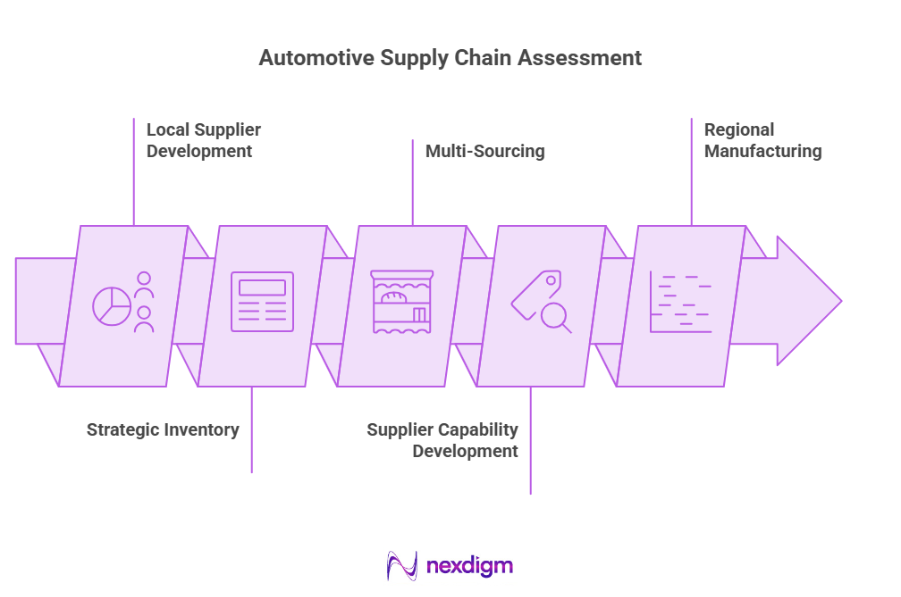
- Local Supplier Development: Developing capable domestic suppliers can reduce dependence on long international supply routes while improving lead times and responsiveness.
- Multi-Sourcing: For strategically important components, qualified secondary suppliers can reduce exposure to single points of failure.
- Regional Manufacturing: Locating production closer to major customers can reduce logistics exposure and improve supply responsiveness.
- Strategic Inventory: For high-risk or long-lead-time components, appropriate inventory buffers can provide protection against temporary disruptions.
- Supplier Capability Development: Supplier technology, quality, capacity, and financial resilience can be strengthened to improve the stability of the wider ecosystem.
Nexdigm can help prioritize these interventions based on risk reduction, cost implications, implementation complexity, and business impact.
Supply Chain Decisions Nexdigm Can Support
Supply chain resilience depends on making the right sourcing, production, and supplier decisions. Nexdigm can help automotive businesses evaluate these choices using market intelligence, supplier assessments, cost considerations, operational requirements, and risk analysis.
- Make-or-Buy Decisions: Assess whether critical components should be manufactured internally or sourced externally based on cost, capability, capacity, technology, and supply risk.
- Supplier Selection: Identify and evaluate suppliers based on quality, production capacity, financial stability, technology capabilities, location, cost competitiveness, and delivery performance.
- Localisation Decisions: Determine which imported components can be sourced or manufactured locally by assessing domestic supplier availability, capability gaps, economics, and localisation feasibility.
- Multi-Sourcing Strategy: Identify components where secondary or alternate suppliers can reduce dependence on a single source and improve continuity during disruptions.
By connecting these decisions with cost, risk, feasibility, and business impact, Nexdigm can help companies develop a supply chain that balances resilience with operational and commercial efficiency.
Benefits of Partnering with Nexdigm
Nexdigm helps automotive businesses translate supply-chain risks into practical resilience and sourcing actions. Key benefits include:
- Improved Supply Continuity: Identify critical dependencies and develop alternatives to reduce disruption exposure.
- Stronger Supplier Resilience: Assess supplier capabilities, capacity, financial stability, and operational risks.
- Reduced Sourcing Dependency: Identify localisation, multi-sourcing, and regional sourcing opportunities for critical components.
- Better Cost-Risk Balance: Evaluate resilience initiatives alongside sourcing costs, inventory requirements, and implementation complexity.
- Prioritized Interventions: Focus resources on components, suppliers, and supply-chain vulnerabilities with the greatest business impact.
- Actionable Resilience Roadmap: Convert assessment findings into clear sourcing, supplier-development, inventory, and localisation priorities.
By combining market intelligence, supplier assessment, and risk analysis, Nexdigm helps businesses build automotive supply chains that are more responsive, diversified, and prepared for future disruptions.
Nexdigm’s Automotive Supply Chain Assessment
Nexdigm assisted an automotive supplier in strengthening sourcing resilience, benchmarking localisation and supplier concentration. With India’s component industry growing rapidly and OEM supplies rising 16.3%, the assessment identified diversification priorities. This resulted in improved sourcing flexibility and resilience.
To take the next step, simply visit our Request a Consultation page and share your requirements with us.
Harsh Mittal
+91-8422857704